
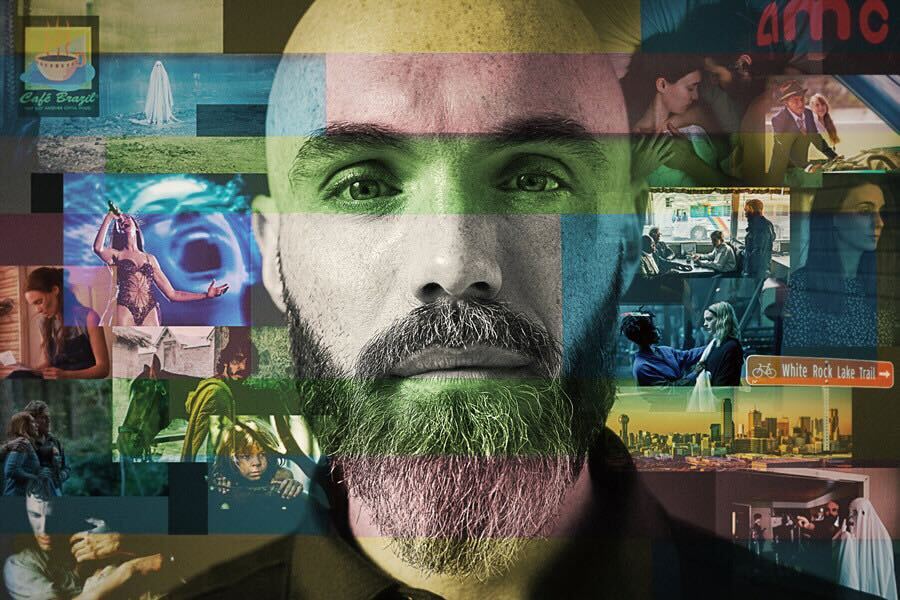
David Lowery describes his 20s as “a complete failure to launch.” Now the Dallas-based director is a celebrated filmmaker whose latest is “Mother Mary” with Anne Hathaway.
Photos: Gracie Newman, DMN file / Illustration: Michael Hogue
One evening, David Lowery had a dark night of the soul in the Cafe Brazil off Central Expressway. This was 2007, and he was living in his beat-up Hyundai, having been kicked out of his parents’ house in Irving. The documentary he’d been working on — about a tiny arthouse theater in Missouri — had been stolen from his car, along with his other belongings.

“It was a moment of utter existential despair,” says the Dallas-based director, sitting at a table in that same Cafe Brazil, a restaurant that hasn’t changed much since the aughts, when Lowery used to frequent the place after movies to chat with friends or write into the night. “I didn’t know what to do with my life at that point. I thought about driving north on 75 until I ran out of gas.”
Article continues below this ad
As he tells this story, Lowery is gearing up for the release of Mother Mary, starring Anne Hathaway as a pop star whose galactic rise has left her lost and haunted. The latest buzzy release from arthouse darling A24, the movie is hard to categorize, a psychodrama about a fractured friendship, a surreal pop opera with music by Jack Antonoff and Charli XCX, but at its heart, it’s a fable about the crucible of creative expression, what art gives and takes from those who make it. After filming wrapped in 2024, Hathaway took to Instagram to call the shoot “one of the most extraordinary, transformative experiences I have ever had.”
Michaela Coel, from left, director David Lowery, and Anne Hathaway at a New York screening of “Mother Mary” on Monday, April 13, 2026.
Evan Agostini/Evan Agostini/Invision/AP
At 45, Lowery has had some transformations of his own. His stable of films boasts a versatility that could look to the casual observer like a randomizer were pressed: neo-Western (Ain’t Them Bodies Saints), big-budget Disney remakes (Pete’s Dragon, Peter Pan & Wendy), avant-garde micro-indie (A Ghost Story), cool ′70s-style heist comedy (The Old Man & the Gun), fantasy epic of Arthurian legend (The Green Knight). This adaptability has given him a reputation as a “one for them, one for me” director, a reference to artists who alternate between commercial projects and smaller meaningful ones, but Lowery would call that inaccurate. All his movies are personal.
One of his most unlikely transformations has been from “guy living in his car” to the best Dallas filmmaker in recent memory. By the time he reached his mid-20s, Lowery was (his words) “a complete failure to launch.” College was not for him. Until 23, he worked as a movie projectionist, mostly at the AMC Grand at Northwest Highway and Stemmons, the country’s first megaplex, where he changed platters in 12 of the 24 theaters and then holed up in the cocoon of the booth for an hour to write scripts. He took that job at 16 because he’d heard Wes Anderson was a projectionist before Bottle Rocket, but while Anderson went on to build his fabled career, Lowery stayed in his hourly-wage gig for nearly eight years.
Article continues below this ad
Make Dallas News a preferred source so your search results prioritize writing by actual people, not AI.
Add Preferred Source
All he’d ever wanted to be was a filmmaker. But how?
From Star Wars to Freddy Krueger to Shakespeare
For a future movie obsessive, David didn’t grow up watching that many films. The family didn’t own a TV. His father was a theology professor at the University of Dallas; his mom taught Montessori before she started homeschooling the kids.
Article continues below this ad
David could read anything he wanted, but films were a tougher sell. He’d fallen in love with Star Wars before he even saw the film, because he had a Darth Vader action figure and a Star Wars storybook with pictures of every scene. He had a book about the making of the film, too, and that’s how he learned about this thing called “a director.” The magic maker, the one calling the shots. That would be him one day.
Movies became a quest: something to pine after, dream about, hunt down. He studied a book of Roger Ebert film reviews he’d found at his grandparents’ place, and it became an instructional manual to cinema. When his mom took him to the Albertsons in Irving, he liked to linger in the video rental section. The VHS covers were enough to start the reel in his mind. A Nightmare on Elm Street 2, with Freddy Krueger’s burn-scarred face and long claw-knives. He made up his own version of that slasher hit years before he saw it.
David Lowery making his first film at eight years old.
Courtesy David Lowery
David was the oldest of nine, a big Catholic family, and he rallied the younger kids to put on shows and make movies, though the family didn’t have a camcorder, so he had to wait to visit his cousins, who did. He wrote scripts that riffed on Indiana Jones and a galaxy far, far away, but he also enlisted his siblings to memorize Shakespeare for a version of The Tempest. David’s dad filmed them, except the camcorder had to be plugged into the living room wall, which limited the set. Prospero’s island was couch cushions and a green blanket.
Article continues below this ad
Art and ideas fueled the family, where one tradition found the kids reciting famous literary passages at dinner. “The Rime of the Ancient Mariner” or Henry V’s St. Crispin’s Day speech. But art and ideas can also unlock secret passages and articulate feelings you didn’t know you had.
The goth at Irving High
David’s goth phase started around the time he got to Irving High School in the mid-’90s. (Homeschool ended for him in junior high.) He had long black hair, a black trench coat, nails painted with Sharpie. The mood board that inspired this transformation would include the dystopian comic-book horror flick The Crow, which his parents told him he couldn’t see (he saw it anyway), and the Francis Ford Coppola version of Bram Stoker’s Dracula, which his parents also wouldn’t let him see (so he invented his own version) and anything by Tim Burton. Also Nine Inch Nails, whose Downward Spiral he first heard on the radio station for artsy-angsty teens, KDGE, better known as the Edge.
“Every circuit in my brain was lighting up,” he says.
Article continues below this ad
Dallas director David Lowery (left) directs Casey Affleck on the set of “A Ghost Story.”
Lindsay Macik/A24
Irving High School was not a hotbed of alternative fashion, but he showed an early knack for creative self-expression. “I marvel at the comfort level I had with it,” he says. “There was never a moment where I felt like I was sticking out, because I felt so thoroughly myself.” He came to school in eyeliner, spiked collars, women’s clothes from Hot Topic.
All this came to an end in his senior year after the 1999 Columbine shooting, as “Trench Coat Mafia” became synonym for hidden sociopath. Dressing in all black could mark a kid as a potential school shooter. It was an early lesson that being yourself did not come without consequence; the real world will judge you.
His inner goth has been relatively quiet in his work, but it’s on display in Mother Mary. The film is witchy and dark, with flashes of body horror and encounters with the supernatural. When Lowery started working on the script, he told people, “I’m finally making my goth movie!”
Article continues below this ad
Never mind the ATM
David’s first feature was called Lullaby, and you can’t find it anywhere, and he’s fine with that. He was 19. But the shoot proved fateful, since he met James Johnston, a guy who answered an ad for crew help. The two became part of a group of Dallas creatives who made short films that eventually landed at South by Southwest or Slamdance. (Johnston also went on to start the beloved vegan restaurant Spiral Diner with his wife, Amy McNutt.)
David Lowery making a short film in 2002, when he was 21.
Courtesy David Lowery
In 2007, Lowery met Toby Halbrooks, who’d been part of the Dallas pop-symphonic chorus, the Polyphonic Spree. Eventually the three of them would form the production company Sailor Bear.
Article continues below this ad
“David and I had similar ambitions with a talent set that was complementary,” says Halbrooks. Lowery, for instance, was not great with money. Halbrooks remembers Lowery pulling cash out of an ATM one day and holding his hand over the screen so he didn’t have to look at the low balance. (“I do that with reviews now,” Lowery said, when asked about this former habit.)
Halbrooks wasn’t great with money — he was living with his grandmother — but Lowery had a unique lack of interest. “Dude was living in his car,” Halbrooks says, laughing.
And yet, Lowery had a rare talent. “I fully believed in him,” says Halbrooks. “Somebody who is unbridled in his creativity but also loving and selfless. I’m drawn to that.”
The two of them started collaborating on television scripts. They headed out to Los Angeles for a while, crashing on friends’ couches and hoping to get work as a team. No luck. But Lowery had written a promising script for a short film called Pioneer, and they went back to Dallas to shoot it.
Article continues below this ad
“I still think that’s one of the best things we’ve ever done,” says Halbrooks.
Pioneer is a pivot moment in the Lowery trajectory, because he’d had modest success and near misses, but Pioneer was a home run. The film is intimate and expansive at once, sliding from the mythic into the everyday, and Lowery considers it a Rosetta stone for his future work.
The film stars indie musician Will Oldham as a father telling an epic bedtime story to his son. With close-ups bathed in golden light, the tale travels through space and time, but the camera never strays from the bed. Pioneer won best narrative short at South by Southwest in 2011, and it was partly on the strength of Pioneer that Rooney Mara, coming off The Girl With the Dragon Tattoo, agreed to do Lowery’s next project.
Rooney Mara in “Ain’t Them Bodies Saints”
Courtesy IFC
Hot indie filmmaker unafraid to go Disney
That next movie, Ain’t Them Bodies Saints, became Lowery’s breakout in 2013. It’s a riff on the Bonnie and Clyde mythology in which the Bonnie character is left to raise a child. Or, as Lowery conceived it: What if the crime-spree lovebirds in the 1973 Terrence Malick film Badlands both lived?
Article continues below this ad
Starring Mara and Casey Affleck, Ain’t Them Bodies Saints played to packed audiences at Sundance and got scooped up by IFC Films, transforming Lowery into the hot new indie filmmaker. Everybody wanted to know what was next, and nobody could have guessed: Pete’s Dragon, a big-budget remake of the 1977 Disney film. Lowery and Halbrook had signed on to write the script, but then Lowery got tapped to direct.
“I remember the first day of shooting, waiting for the studio filmmaking button to get pressed,” he says. “I imagined a level of gloss to a studio movie for Disney, but that never happened. It felt like we were getting away with something.”
Pete’s Dragon was proof that old Disney properties can be reimagined with visual aplomb and emotional depth; the movie, with Robert Redford and Bryce Dallas Howard, is much better than the original. For his next trick, Lowery returned to Dallas and shot a surreal $150,000 experimental film on the sly with his previous co-stars, Affleck and Mara. A Ghost Story falls into the “hard to categorize” bucket, a love story that becomes a horror story. Affleck plays a man who, after his death, haunts his former home in a white sheet, like a cartoon ghost, a visual gag that somehow becomes a moving meditation on grief.
David Lowery on the porch swing of his former home in East Dallas in 2013.
Evans Caglage/Staff Photographer
A Ghost Story was partly inspired by the sadness he felt after moving out of his East Dallas abode in the M Streets, the first home he’d owned. He shared it with his wife, Augustine Frizzell, whom he’d met back in the early aughts when he cast her in a short film. The granddaughter of country legend Lefty Frizzell, she’s an actress who became a filmmaker. (Her 2018 movie about growing up in Garland, Never Goin’ Back, led to directing the pilot of Euphoria. She’s directed several episodes of Netflix’s upcoming The Boroughs, produced by Stranger Things’ Duffer Brothers.) The couple got married in 2010.
Article continues below this ad
Shortly before Pete’s Dragon, they moved out of that East Dallas home and headed to Los Angeles, though the move didn’t stick. This is a theme of Lowery’s adulthood, actually: a few months in L.A. and back to Dallas. He’s never lasted in L.A. more than six months.
“When people ask why I moved back, I think about a line in the commentary track for Rushmore,” he says. He can’t remember if it’s Wes Anderson or Owen Wilson, talking over a cemetery scene with Bill Murray and Jason Schwartzman, but this is how he remembers the line: The weather in this scene reminds me of those really gray days you get in Dallas around Thanksgiving.
He missed those gray days. Los Angeles was too much sunshine for his goth spirit. He missed running around White Rock Lake. Los Angeles was not a running town. He and Augustine settled into an old Tudor in Lakewood where they live with their three cats. Texas in the winter had a fairytale quality he’d come to love; the twisty branches of live oaks against the leaden sky looked straight out of Brothers Grimm.
“It’s an easy city to live in,” he says. “It has the things that make my life good. I like going to the movies. I like traveling. I like …” He pauses, thinking of what he’s left out. “Well, that’s about it.”
Article continues below this ad
David Lowery directs Danny Glover, Tom Waits and Robert Redford on the set of “The Old Man & the Gun.”
Photo by Eric Zachanowich/Twentieth Century Fox
Fassbinder meets Taylor Swift’s ‘Reputation’ tour
Mother Mary began as an image he’d seen of two women holding each other; he couldn’t get that image out of his mind. He’d always wanted to make a movie about a pop star. (He’s a pop music fan.) Perhaps the pop star was having some kind of meltdown. That could be interesting.
The idea for the story was percolating as he made The Green Knight, an A24 film about Arthurian legend Sir Gawain that cost $15 million, though its fantasy world is so ravishing it looks more like $100 million. The Green Knight is a pleasure to watch, but it was hell to make. His body started breaking down; he thought he had cancer. (He did not.) He became anxious about leaving his arthouse project and going straight into the family-friendly fare of Peter Pan & Wendy for Disney.
Article continues below this ad
“Maybe for the first time since my early 20s, I was struggling with who I was as a filmmaker. I was having an identity crisis,” he says. “Even though I was earnestly pursuing Peter Pan & Wendy because it was personal to me, in the same way The Green Knight was personal to me, the disparity between the two felt huge.”
Anne Hathaway in a scene from “Mother Mary.”
Frederic Batier/AP
Mother Mary has been advertised as a “psychosexual pop opera,” and it has those elements, but it’s more of a chamber piece, two people confined in one location for most of the movie and locked in dialogue. In this case, a famous singer, played with onstage ferocity and offstage vulnerability by Hathaway, and the fashion designer and creative collaborator she left behind, played with delicious magnetism by British actress Michaela Coel.
“The dialogue, at its most essential form, could be reduced to the version of me making The Green Knight talking to the version of me I imagined would be making Peter Pan & Wendy and trying to find some reconciliation between the two,” says Lowery. “The things they talk about are as close as I’ve come to being openly autobiographical in a movie.”
Article continues below this ad
None of that is evident in watching the film, which unspools into a wild fable about art and the mysterious soul connection between two people. Part of the joy of the film — or frustration, depending on your perspective — is how the story is open to interpretation. Are these two women former lovers? When the Hathaway character says she needs a dress, is she really talking about “a dress”? (Coel has said she thinks it’s a metaphor for an orgasm.)
“Whether the relationship was romantic or not, they shared something as intimate as a love story, and that was the creative collaboration,” says Lowery. “Fraught with tension but also fraught with tenderness. It’s a beautiful relationship to have with another human being, and I wanted that to be front and center.”
David Lowery, left, and Anne Hathaway on the set of “Mother Mary.”
Frederic Batier/AP
The movie is so unusual that it’s hard to find points of comparison. Lowery took inspiration from a 1972 Rainer Werner Fassbinder classic about a fashion designer. He pitched the film to A24 — jokingly — as “The Bitter Tears of Petra Von Kant meets Taylor Swift’s ‘Reputation’ tour.”
Article continues below this ad
The Taylor Swift part is not a joke. “I’m a huge Swiftie,” says Lowery. In creating the character of Mother Mary, he was imagining Swift, or someone like her, 10 years in the future, but other references abound. The Catholic imagery summons Madonna, while the avant-garde costumes, with their nod to designer Alexander McQueen, call to mind Lady Gaga. Hathaway, a musical theater veteran, said she studied Beyoncé’s “Ameriican Requiem” to learn pop phrasing. As he wrote the script, Lowery was listening to FKA Twigs (who appears in the movie and contributed a song to the soundtrack).
The result is a film that takes common cultural points and pop myths and twists them into an original experience.
“I wanted to make something that was unwieldy and difficult and challenging,” Lowery says. “I’m also a sentimental person, and an emotional person, so it’s never going to be aggressive in a way that alienates people, but it is a challenging movie. I know some people deeply love it. I’m sure people will hate it.”

By signing up, you agree to our Terms Of Use and acknowledge that your information will be used as described in our Privacy Policy.
The reviews reflect that split. Variety called it a “thuddingly pretentious fantasia.” Rolling Stone called it “wonderfully, gloriously weird.” The film opened strong on April 17 in limited release and goes nationwide on April 24.
Article continues below this ad
Lowery is already on to his next transformation. A few days after we met at Cafe Brazil, he was headed out of town to start his next project. No doubt it will sound odd at first, because his projects always do, but he likes defying expectations. This is a filmmaker who refuses to be pinned down. So when asked what he can share about the next movie, he just smiled.
“Nothing,” he said.