
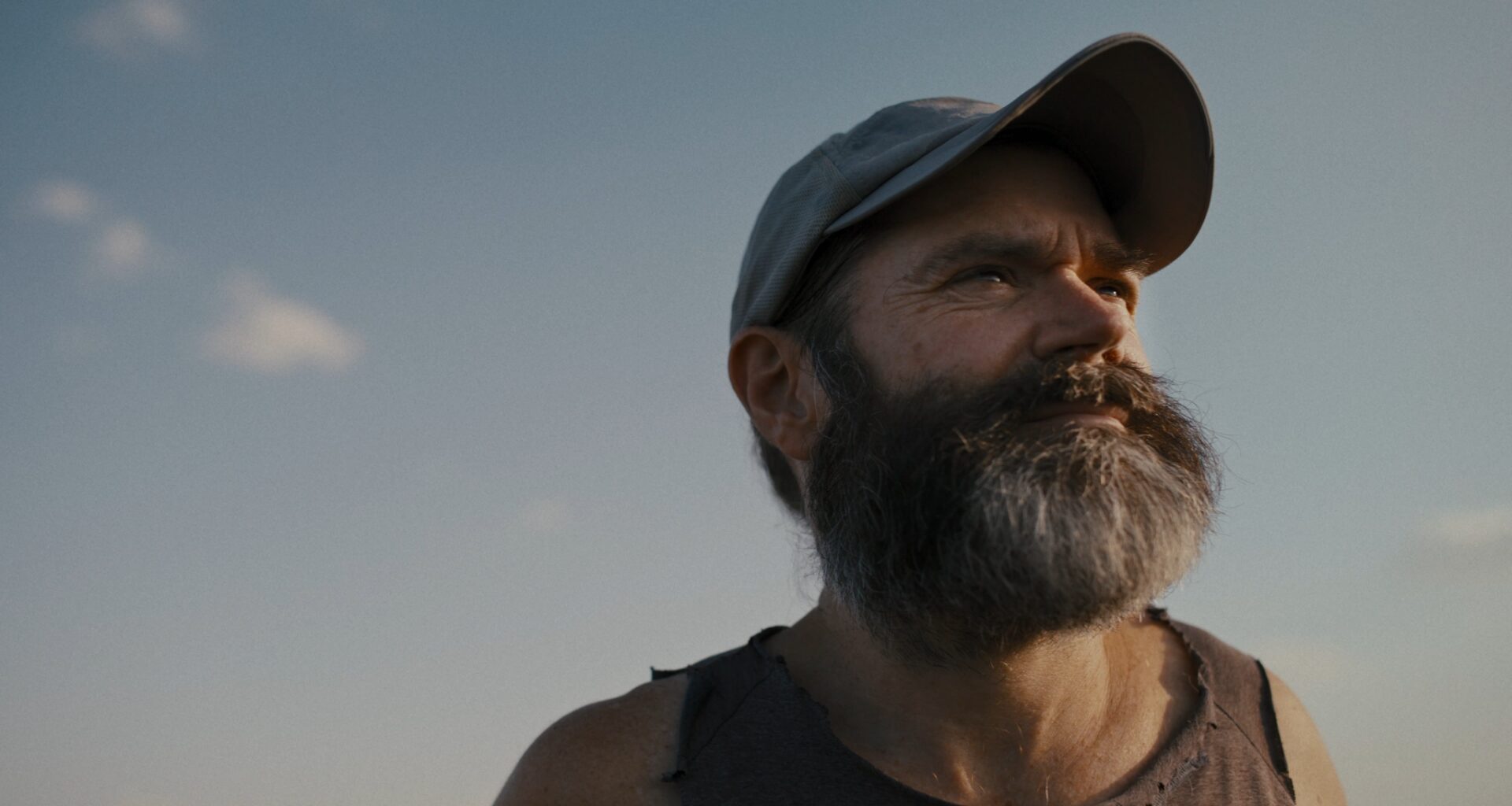
San Antonian Rob Shaver’s two-decade fight with stage 4 Ewing sarcoma, an aggressive cancer, is explored in the award-winning short documentary “The Life We Have.”
Courtesy Wondercamp
Rob Shaver created a burial fund for himself in college after he was diagnosed with stage four Ewing sarcoma and doctors told him he might not live to see 30.

More than 20 years later, the money is still in the bank.
Article continues below this ad
“The Life We Have,” a new documentary about Rob Shaver’s two-decade fight with cancer, includes a performance he gave to an invited audience. Shaver is a life-long singer who found that singing helped with his lung capacity.
Courtesy Wondercamp
“So many kids like me that have this disease don’t even get close to 40,” Shaver, 49, said in a 2024 interview with the Express-News. “I feel like I owe it to them and their families to be grateful for what I’ve got and do the best with it that I can.”
He thought that his story might help others with their struggles. That’s why he pitched an idea for a documentary to REI, his employer at the time, which has a film arm in addition to selling outdoor equipment.
Article continues below this ad
The award-winning short film, titled “The Life We Have,” explores Shaver’s experience with terminal illness and his refusal to give in to it, focusing instead on things that he could do while he could do them. It also zooms in on his close relationship with his mother Paula Shaver and his brother Rich Shaver, who have long served as his primary caregivers and champions.
The original idea was to capture his commitment to running, which he credits for helping to extend his life. As the film was being shot, he had a recurrence, and he and director Sam Price-Waldman decided that needed to be in the film, too, as did his music. So what had been intended as an eight-to-10-minute running film became a 24-minute film that digs into mortality, caregiving and other big issues.
More film: New PBS doc produced by Ken Burns features SA scholar
Article continues below this ad
The Shavers’ lives are very different now than they were then. Rob Shaver has been in hospice care since last year and is paralyzed from the waist down. He spends his days in a hospital bed in his bedroom, and his mom and his brother handle the lion’s share of his care. They recently were able to hire an aide who can care for him a few days a week.
“They are superheroes,” Rob Shaver said.
The documentary “The Life We Have” is about the two-decade fight with cancer waged by Rob Shaver (from right) with the help of his mother Paula Shaver and his brother Rich Shaver.
Courtesy Wondercamp
“The Life We Have,” which was released to the public in February, made it into film festivals across the country. It won the Audience Choice Short Award at the Telluride Mountainfilm Festival, Best Short Documentary at the American Documentary and Animation Film Festival and Best of the Fest award at the Flagstaff Mountain Film Festival. It received a Webby Award, too.
Article continues below this ad
The documentary has found an audience on Vimeo and on YouTube, where it has racked up just over 306,000 views and prompted more than 500 comments. Viewers write about the inspiration they’ve taken from the film, about how it helped them shift their perspective and live their lives differently. Some are cancer patients who recognize their own struggles and send encouraging messages to the Shavers.
“It’s affecting people,” Paula Shaver said. “Now Rob is paralyzed and sicker and life is different and everything like that — there’s cancer everywhere — but his story and his legacy is important to hundreds of thousands of people.
“And I have to say that the film has taken a different role in our lives and in Rob’s life than it would have if he hadn’t gotten so sick. You know the saying, give me my flowers before I die? People in the comments, they will even say, ‘I hope Rob’s reading these comments.’ And, of course, we don’t respond to any of them. But he is reading their comments.”
Rob Shaver hasn’t been able to see the film with an audience – by the time it was released, he was too ill. But his mother and brother have gone to a few film festivals and also have participated in a few screenings in San Antonio, including one for running groups at Eisenhower Park. They report back to him on how things have gone.
Article continues below this ad
He has been floored by the way his story resonates with people.
“I probably had the least expectation,” he said. “I just wanted the story out there, that there’s someone who was not given any time 20 years ago and who’s still here 20 years later. I just wanted that known, just so other people that were like me, looking for hope, looking for examples of hope, could find it.”
Price-Waldman has been struck by the intensity of the responses to the film.
San Antonian Rob Shaver’s two-decade fight with stage 4 Ewing sarcoma, an aggressive cancer, is explored in the award-winning documentary “The Life We Have.”
Courtesy Wondercamp
“It’s been the craziest thing to feel it resonate in the world and almost feel like it’s alive in its own way,” he said. “When Rob and I were talking about this project, what we really wanted to achieve was we want to help people in their own challenges, in their own struggles. So it’s been crazy, literally crazy, to see it actually doing those things.”
Article continues below this ad
Running and singing and cancer
Rob Shaver was in his 20s when he received his initial diagnosis of Ewing sarcoma, an aggressive cancer. In the decades that followed, his health went up and down, with brief periods when he was relatively OK followed by recurrences.
After a 2020 recurrence, a pulmonologist advised him to do whatever he could to strengthen his lungs. To that end, he committed to running at least one mile a day, every day, for as long as his body would allow. He ultimately ran every single day for three years, two months and 20 days, racking up 8,000 miles.
“When you’ve been given such negative time frames, when you start winning these chunks of time, by doing something as simple as ‘I’m going to jog a mile today’ or ‘I’m going to walk around the block three times,’ it just ups you mentally,” he said. “And so I started doing that consistently.”
Article continues below this ad
That led him to set another goal. He wanted to sing again.
Shaver went to pharmacy school and earned his PhD but was never able to practice because of his illness. He occasionally had thought about pursuing music professionally. He grew up singing in church and in school groups, and he sang with bands, too.
“He sang with groups, but he never really took it places, because of his situation, because he was sick all the time,” his brother said.
Rob Shaver, shown in 2024 in the music room of his home, has been fighting cancer for more than 20 years. His story is told in the new short documentary “The Life We Have. “
Jessica Phelps/San Antonio Express News
For a while, he was too sick to sing at all.
Article continues below this ad
“I literally coughed more than I breathed normally,” he said. “I couldn’t go out in public because I coughed all the time. And I thought, I’m going to get to where I can sing.”
He did. And with the encouragement of his mother, he also auditioned for and was cast in the Playhouse (now the San Pedro Playhouse) productions of the vocally challenging musicals “Ragtime” and “Les Miserables” in 2013. He also appeared in the Renaissance Guild’s staging of “Black Nativity” as well as other shows.
He kept singing. When he looked into how to enhance lung capacity, singing was on the list. So it became just as important to him as running.
MORE THEATER: San Pedro Playhouse’s Shakespeare in the Park will be free next season
Article continues below this ad
When Price-Waldman found out about it, he thought it was important to include music in the film, too.
“There are so many elements of Rob’s story that can speak to other people that go beyond running,” he said. “And I really felt a deepening responsibility the longer I spent with the story to kind of also talk about these other elements — family and treatment and ego death and all of the music, all of these other elements that are such a part of Rob’s life.”
To get Shaver’s singing into the movie, the filmmakers set up an intimate concert for an invited audience after-hours at the now-shuttered Brown Coffee Co. in Southtown. The small space was packed with family, supporters and friends, including many people in the city’s theater community that he had gotten close to.
Pianist and music director Darwin Newhardt helped with the logistics of the evening and accompanied the vocalists. He and Rob Shaver also wrote three original songs for the evening. “One Step at a Time” plays near the end of the film.
Article continues below this ad
“It really is an amazing study on the power of the mind and the power of the body,” Newhardt said. “Watching him beforehand, sitting on the comfy couch, drinking his tea, he looked very crumbled. But then he stood up and he walked out and you could tell he didn’t have as much wind underneath his wings as usual. But he had enough. And he had enough drive and enough passion to do it.”
The crowd sang along with Shaver on “Lean on Me,” and he pulled some of his fellow performers up to sing duets. He also sang an achingly beautiful rendition of “Bring Him Home” from “Les Mis,” which made it into the film after the rights were arranged, something he hadn’t thought would be possible.
It’s a short film, and the concert takes up a small amount of it. Newhardt and the Shavers are hoping to find a way to release more from it.
Article continues below this ad
Rob Shaver hopes that people who take inspiration from the film find their own pursuits that give their lives joy and meaning. He also hopes they see that it’s not just his story. He describes his mother and his brother as superheroes and said they and others have helped him along the way.
“I didn’t want the film to be a superhero film — look at this one guy who’s overcome all this stuff and still been able to do all that kinds of stuff. I was motivated and energized and encouraged by others, all the people I’ve met when I had been sick in the waiting rooms,” he said. “I’ve been so fortunate to live decades with this. I wasn’t supposed to. And their memory and their courage encouraged me and gave me strength and I wanted it known that it was the courage and strength of others that gave me strength and courage.”