
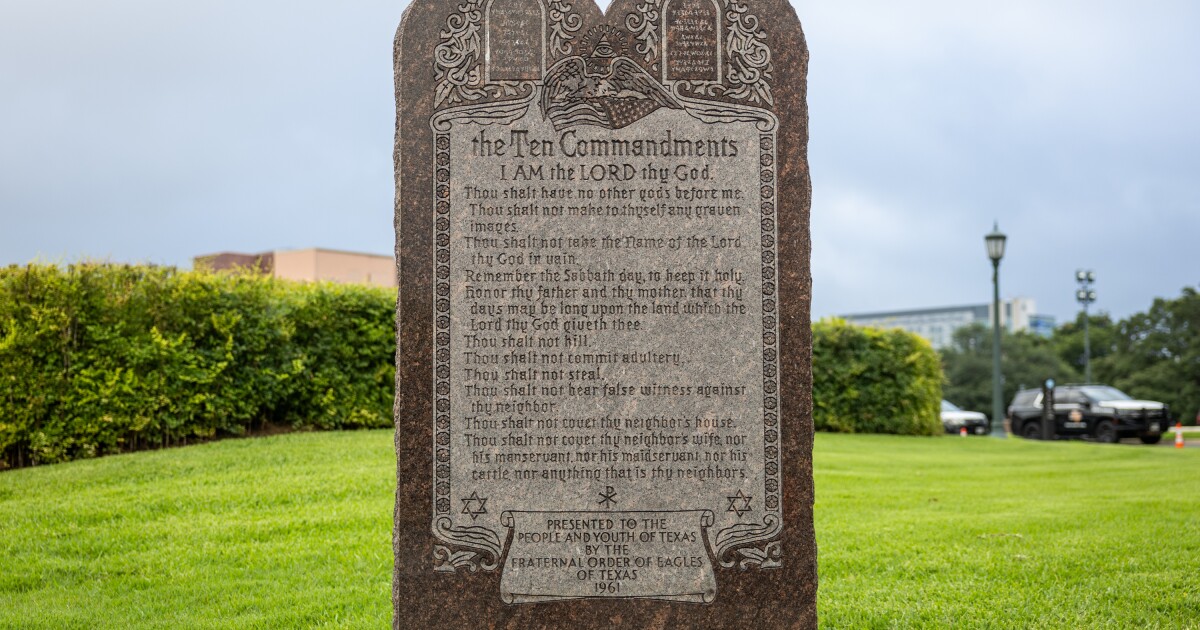
For now, the Austin Independent School District does not have to comply with a federal appeals court ruling requiring Texas schools to display posters of the Ten Commandments in classrooms.
Nine out of 17 judges on the 5th U.S. Circuit Court of Appeals ruled Tuesday in favor of Texas officials regarding Senate Bill 10. Texas families had sued, claiming the law is an “establishment of religion” and coerces students into reverence of the Commandments.
AISD was initially a defendant in the case, but last year the district said it would not post the Ten Commandments while litigation was still pending and would abide by a final ruling.
“It was a federal court who approved the stipulation that Austin agreed to not post until litigation is totally complete,” said Rachel Laser, president and CEO of Americans United for the Separation of Church and State, one of the civil rights organizations representing the plaintiff families. “The attorney general would be in contempt of court if he went after Austin because he would be violating that court order.”
Laser said the decision by the 5th U.S. Circuit Court of Appeals only applies to the districts that are part of the legal challenge, including Lake Travis and Dripping Springs. As two other lawsuits challenging SB10 are awaiting a decision and other states have taken similar steps, Laser said courts in the state and around the country are paying attention to this ruling.
An AISD spokesperson told KUT that the district’s legal team is still working “to determine any next steps after this ruling.”
Central Texas parents and advocates are raising questions about the ruling, saying the law is a religious freedom violation.
“It shows how far removed they are from being children in a public school classroom setting and looking up at the walls and knowing that what’s posted there is what you’re supposed to follow,” Laser said. “They don’t remember what it’s like to be a kindergartener and to have to ask, ‘what does adultery mean?’”
SB 10, which passed during the last legislative session, requires all public elementary and secondary schools to display donated posters of the Ten Commandments in each classroom. The poster must be at least 16 by 20 inches and displayed in a “conspicuous place.”
“It sends this visual message that the Judeo-Christian values are the ones that count in this place that is paid for by public tax dollars,” said Kimmie Fink, a former teacher and a Liberty Hill Independent School District parent. “That’s a huge problem to create an environment in which one religion is privileged over another.”
The 5th Circuit ruling said SB 10 is far from coercing students into engaging with religious worship, but that “it puts a poster on a classroom wall” and “does not transform the poster into a summons to prayer.”
Emily Glankler, a former teacher and Austin Independent School District parent, said if teachers have to hang a Ten Commandments poster in their classroom, they will have to interact with it, since kids will be asking questions. She said students and teachers will be having conversations that a lot of parents and community members might think are inappropriate to be having in the classroom.
“At the same time that we’re wanting them to not talk about sex education, not talk about relationships in the school, they’re also gonna put a poster up that mentions adultery and coveting your neighbor,” Glankler said. “It’s really ironic, and it’s gonna lead to a lot of discomfort. It’s gonna put teachers in a really difficult situation.”
Schools can either purchase the posters or accept donations. Fink said she is concerned that at smaller districts like Liberty Hill, which is part of another lawsuit, it will be easier to have donations for every classroom. She said people have already donated.
“I certainly feel like this will embolden people to donate more because essentially the appellate court has rubber stamped it and then, you know, don’t think they’re going to waste their money,” Fink said. “From a Christian point of view, I think that’s wrong. From someone who loves the Constitution, I think it’s wrong.”
Glankler said that enforcement of the law could be a teaching opportunity for districts.
“I would have a poster of the Ten Commandments and I would [have] a poster of the Eightfold Path from Buddhism and I would have a poster of the Five Pillars of Islam,” she said. “I’d want my students to know kind of the basics of all the different world religions.”
The coalition of organizations representing the plaintiffs said in a written statement they anticipate asking the Supreme Court to revise the decision of the 5th Circuit. Laser said that because the court is ruling on the constitutionality of the law, it could have the effect of all school districts across the state having to post the Ten Commandments, unless the Supreme Court puts a temporary hold on it.