
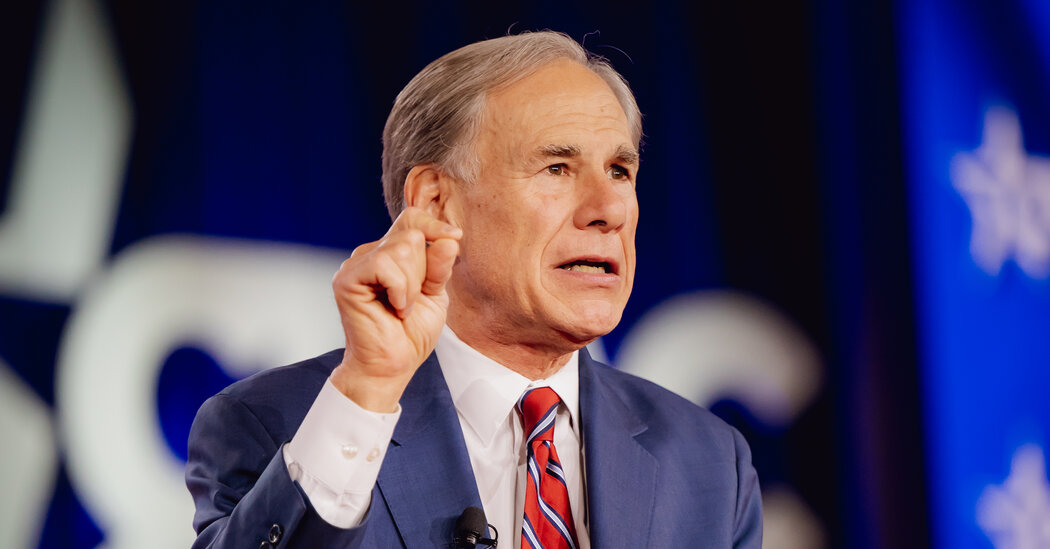
Gov. Greg Abbott of Texas has been engaged this month in a tense face-off with three of his state’s largest cities over how local police officers work with federal immigration agents.
The governor gave the leaders of Houston, Dallas and Austin until Wednesday to amend their policies to his liking, or face losing more than $150 million total in public safety funding, including millions dedicated to providing security at World Cup matches this summer.
Republican state leaders have frequently tried to control the policies of their state’s Democratic cities, often through legislation, and sometimes through lawsuits. But with Mr. Abbott using critical funding as leverage, some consider this an echo of the Trump administration’s aggressive tactics.
“It’s a play out of President Trump’s playbook,” said Alejandra Salinas, a Houston councilwoman. “He thinks he can bully the city of Houston in the same way.”
Legal experts said the issue at hand — whether officers on the street can hold a person longer than usually permitted if the person is wanted by Immigration and Customs Enforcement — was not settled, and that Mr. Abbott could be testing the bounds of what support the police can provide federal immigration agents.
The fight began in Houston, where this month the City Council passed a new ordinance clarifying when its officers could detain people wanted by immigration agents. Mr. Abbott expanded the fight to Dallas and Austin after he said both had policies that also broke a contract with the state requiring the police to cooperate with immigration agents in exchange for funding.
On Wednesday, the Houston City Council conducted an extended and, at times, pointed debate over amending the ordinance. Some progressive council members, including Ms. Salinas, suggested the city should have taken the state to court instead.
Councilwoman Abbie Kamin, a lawyer who was recently appointed the top attorney for Harris County, which includes Houston, warned that supporting an “Abbott amendment” would be a capitulation to the governor and could invite more state interference.
But Mayor John Whitmire, a moderate Democrat in a nonpartisan position, said the city could not effectively push back on the governor.
“The person that controls the purse strings can kind of set the rules,” Mr. Whitmire, who initially supported the ordinance, said in an interview before Wednesday’s meeting. “What good would it be for me to be annoyed with the governor and strike back at the governor? I’m trying to get the damn money.”
At the meeting, the mayor stressed the need for “collaboration” as he presented new language that he said Mr. Abbott’s office supported. The amended language largely kept intact the substance of the ordinance while underscoring that officers could consider the “totality” of circumstances in deciding whether to hold a person for immigration agents. He said he was seeking to turn down the temperature on the issue.
“I know Abbott,” Mr. Whitmire said to his opponents on the council, “and quite frankly, y’all played right into his hands.”
The council voted 13 to 4 to adopt the new language on Wednesday.
The attorney general, Ken Paxton, joined the fray last week to file a suit against Houston over its ordinance. And Senator John Cornyn, who is facing a Republican primary challenge from Mr. Paxton, announced legislation that would cut some federal funding from cities that do not cooperate with ICE.
But it was the threats from Mr. Abbott that set off a scramble among city leaders and police officials. In Houston last week, officials said they were evaluating the effect of the looming cuts on things like officer overtime, even as they sought to reassure representatives of FIFA, soccer’s international governing body, that patrons in their city would be safe this summer.
“This vote is a step in the right direction,” Mr. Abbott’s press secretary, Andrew Mahaleris, said in a statement, adding that the city’s police department still had to update its policies.
For much of Mr. Trump’s second term, Texas cities have avoided scrutiny over their handling of immigration enforcement, in part because of state laws requiring cooperation with federal immigration agents and prohibiting the creation of so-called sanctuary cities that put limits on such cooperation.
In recent days, each city has approached the threat from Mr. Abbott in its own way.
The mayor of Austin, Kirk Watson, a moderate Democrat, expressed frustration and defiance.
“We don’t have the time and will not play into this political theater,” he said in a statement last week. A spokesman for the city said officials were still discussing a resolution with the governor’s office on Wednesday.
The mayor of Dallas, Eric Johnson, a longtime Democrat who became a Republican while in office, has said nothing publicly.
For Mr. Whitmire, a former state lawmaker, the political standoff threatens a central promise of his administration: to govern by avoiding polarizing conflicts with Republican state lawmakers and federal leaders.
“I’m not going to be cursing ICE, or challenging ICE, because it doesn’t work,” Mr. Whitmire said in the interview.
The clash in Texas appeared to be over a relatively small number of instances when officers encountered people during routine street or traffic stops who were wanted by ICE.
The Houston Police Department, for example, has recorded around 300 such episodes, according to data provided by Mr. Whitmire’s office. A little more than half of the people stopped were released by the officers. Another 104 were turned over to immigration agents “in the field.” The remaining people were arrested on other charges.
The city’s original ordinance directed officers to release a person, even if they were sought by federal immigration agents, if the purpose of the original stop had already ended. The policy was similar to those other Texas cities, proponents said, and was in response to occasions when Houston officers had improperly held people for immigration agents.
Council members and legal experts warned that reversing the policy, as Mr. Abbott has demanded, could result in officers violating the Constitution’s prohibitions against illegal searches and seizures.
“I’m not aware of any other state or municipality attempting to mandate arrests solely on the basis of these administrative warrants,” said Lindsay Nash, a professor at the Benjamin N. Cardozo School of Law in New York, who has written on the history and legality of administrative warrants, which are issued by the agency, not a judge.
If police officers hold a person beyond the time they would otherwise have been released from custody, based solely on administrative warrant, she added, that “violates the Fourth Amendment.”
Mr. Whitmire proposed revised language for the ordinance on Tuesday, adding that officers, in accordance with the Fourth Amendment, could temporarily detain someone beyond the length of the initial stop for “legitimate purposes discovered during the detention.”
The Houston city attorney, Arturo G. Michel, said during the council hearing on Wednesday that the new language did not mean that an officer could hold someone based only on an administrative warrant.
Mr. Abbott’s office has said the issue was not the Constitution, but rather the contracts the cities signed agreeing to cooperate with ICE in exchange for the funding.
If the cities do not roll back their policies, the governor has warned, the state would take back about $110 million in World Cup safety spending and other grants from Houston, $32 million in grants from Dallas (plus the city’s portion of another $55 million for World Cup security in the area, with games being played in Arlington), and more than $2 million from Austin.
“Enforcement of the contract doesn’t defund police,” Mr. Abbott said in a frustrated, middle-of-the-night social media message on Sunday. “I signed a law preventing defunding the police.”
That law, Mr. Abbott has argued, would force city leaders to make up any shortfall by using money from their already strained municipal budgets.