
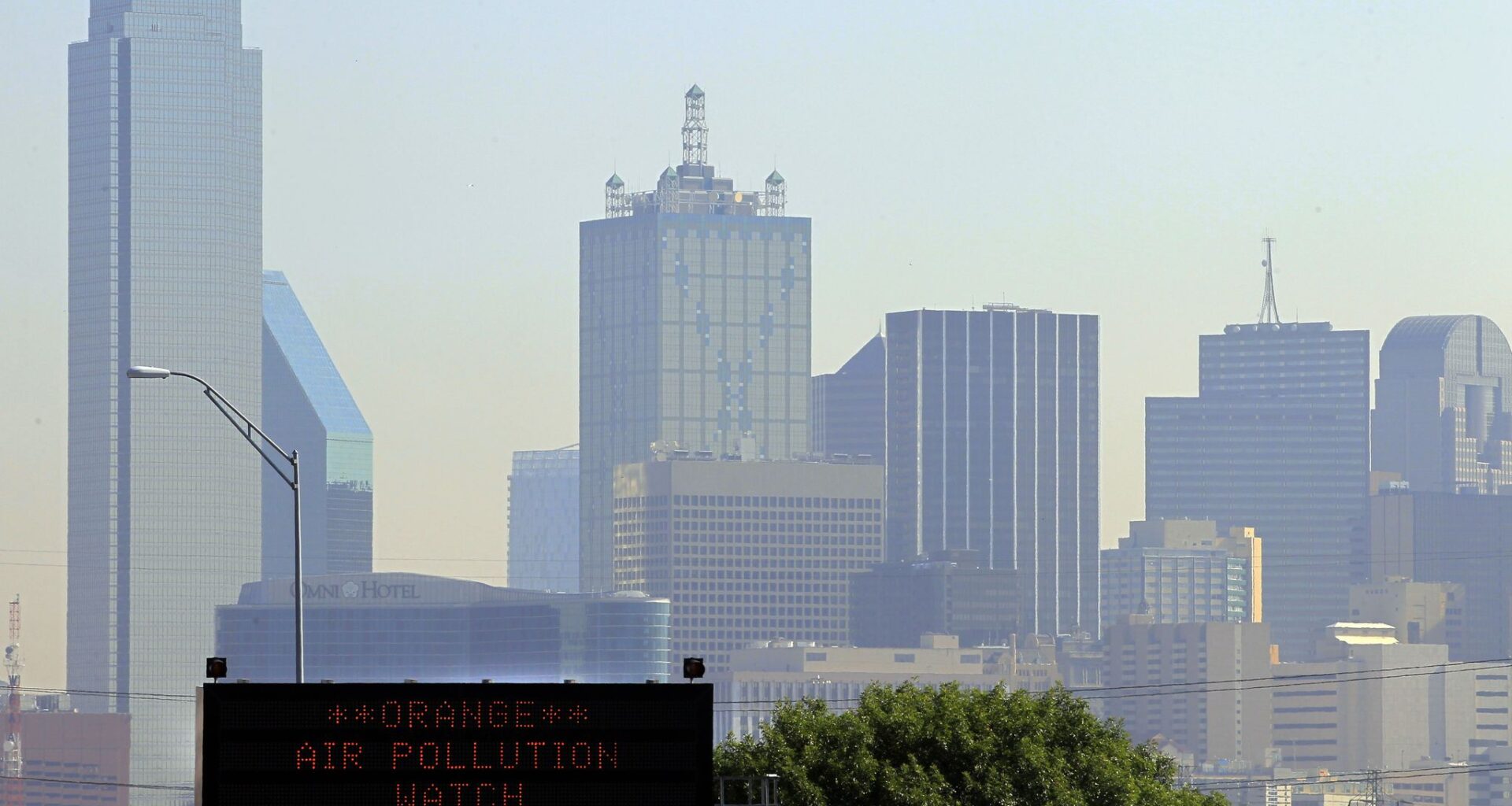
Dallas-Fort Worth is, once again, among the most ozone-polluted metro areas in the U.S., according to new data from the American Lung Association.
The 27th annual “State of the Air” report, released Wednesday, examines ozone and particle pollution in metro areas, counties and states across the country. The report analyzes data from 2022-2024.
Dallas-Fort Worth was included on two of the three “worst 25” rankings of cities with the highest number of unhealthy air days.
Researchers determined that 152.3 million people — about 44% of people in the U.S. — live in areas that received failing grades for unhealthy levels of ozone or particle pollution. That means more than 4 in 10 people in America are breathing unhealthy levels of air pollution, according to the organization.
“Although particle pollution showed some improvement relative to its decade-long worsening trend, populations exposed to high levels remained much higher than historic lows,” researchers wrote in the report. “Meanwhile, unhealthy levels of ozone pollution impacted more people than in the previous five reports.”
Ground-level ozone air pollution, also known as smog, is a respiratory irritant with effects likened to a sunburn of the lungs.
The D-FW area was ranked No. 9 for worst high ozone days — a minor improvement from the previous year — and No. 22 for year-round particle pollution.
Other Texas locations with high ozone days included the Houston-Pasadena area at No. 6 and El Paso-Las Cruces, N.M., at No. 16.
The year-round particle pollution had many more Texas areas: Brownsville-Harlingen-Raymondville at No. 2; Houston-Pasadena at No. 8; McAllen-Edinburg at No. 17; Austin-Round Rock-San Marcos and Texarkana tied at No. 23.
Researchers noted that only 42 of Texas’ 254 counties had data that could be graded for at least one measure of air quality.
Multiple North Texas counties, including Collin, Dallas, Denton and Tarrant, received an “F” rating for ozone pollution. Dallas and Tarrant were rated a “C” for particle pollution, Denton was a “B” and Kaufman an “A.” Information was not provided for Collin.
Ozone season marks the window when there’s a greater risk of harmful amounts of ground-level ozone. It lasts from March 1 to Nov. 30 in Dallas-Fort Worth.
During last year’s season, North Texas had 44 “exceedance days,” meaning the air quality became unhealthy for some people in North Texas, according to the North Central Texas Council of Governments.
This reporting is part of the Future of North Texas, a community-funded journalism initiative supported by the Commit Partnership, Communities Foundation of Texas, The Dallas Foundation, the Dallas Mavericks, the Dallas Regional Chamber, Deedie Rose, the McCune-Losinger Family Fund, The Meadows Foundation, the Perot Foundation, the United Way of Metropolitan Dallas and the University of Texas at Dallas. The News retains full editorial control of this coverage.