
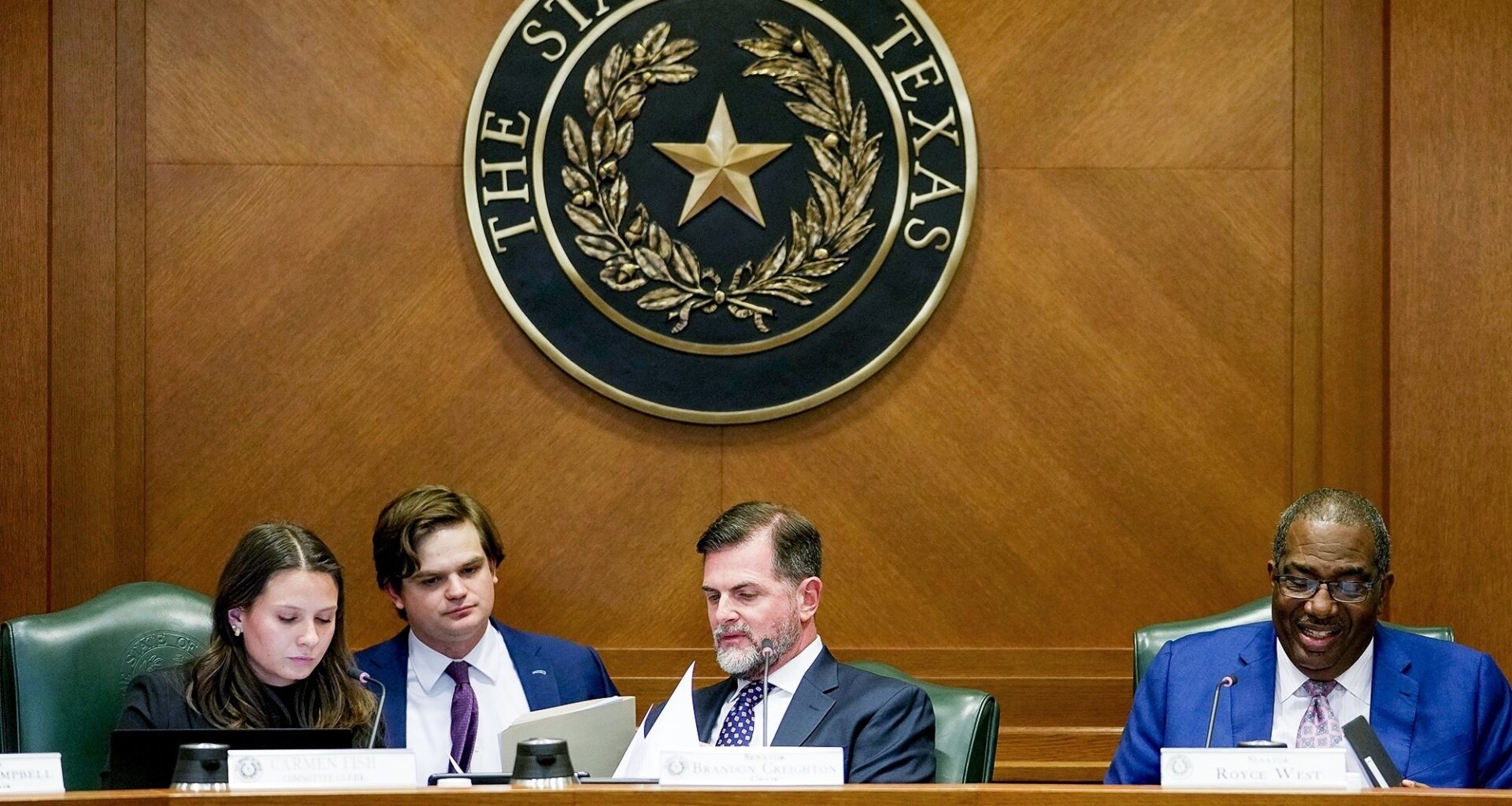
Sen. Brandon Creighton looks over paperwork with his staff at a Senate Committee on Education hearing. Creighton now leads the Texas Tech University System as chancellor. He is one of several Republicans appointed to higher education leadership positions in 2026.
Ricardo B. Brazziell/American-St
American Federation of Teachers President Randi Weingarten, left, with Texas AFT President Zeph Capo, speaks at a news conference at the AFL-CIO in Austin on Tuesday, Jan. 6, 2026. Weingarten said in April that Democrats need to do more to address conservative reforms of higher education.
Jay Janner/Austin American-Statesman
Randi Weingarten could have chosen anywhere to launch the American Federation of Teachers’ plan to elevate higher education issues in the midterm elections. She chose the University of Texas.

Weingarten, the president of the national teachers’ union, last week spoke before a crowd of about 100 people gathered to oppose threats to academic freedom and protect ethnic studies programs at higher education institutions.
Article continues below this ad
At UT, President Jim Davis has promised to address conservative concerns that the university has let indoctrination replace inquiry by recommitting his institution to “balance” and civic education. The changes during Davis’ first year in office — including the consolidation of gender and ethnic studies and leadership shakeups — have made some faculty fearful that UT is changing in response to political pressure, not input from students, staff or the public.
Get the latest UT news from Lily Kepner delivered straight to your inbox. Sign up for Inside UT.
At a time when Republicans are successfully reforming higher education, Democrats, Weingarten said, are not doing enough to stop them or to advocate for universities.
“We know where the Republicans stand,” Weingarten said. “We see this stripping out of people’s right to learn, right to teach, and we’re seeing the undermining of pluralism. And so part of my question — and I say this as a lifelong Democrat — is where are the Democrats? Where is the fight?”
Article continues below this ad
Ahead of midterm elections, changes to higher education should be a central issue for Democrats, Weingarten said. But as conservatives are shaping Texas universities in their image, Democrats, experts say, can’t keep up — and may not benefit strategically from trying.
Michael Harris, dean of Southern Methodist University’s Simmons School of Education and Human Development and an expert in university behavior, said Republicans in Texas “without question,” have controlled the narrative around higher education for decades.
But how Texas conservative leaders have reshaped the state’s colleges and universities is unlikely to be a big factor in the midterm elections for Democrats given the success Republicans have already had and the other pressing national issues dominating the news, he said.
Kendall Scudder, chairman of the Texas Democratic Party, said that the party considers education access a “kitchen table issue” and is concerned about how political interference will impact educator retention. But Texas Democrats are limited in what they can message on as other issues like affordability or health care intensify, he said.
Article continues below this ad
The party isn’t intentionally sidestepping higher education, but it is prioritizing other pressing concerns families face, he said.
“I understand this frustration from these organizations with us, I get it, but the challenge that Democrats are facing is that we’re drinking through a fire hose,” Scudder said. “Of course, these issues are important to us. I mean, we are the ones who created these institutions and invested in them in the first place, and that could be part of why Republicans are trying to tear them down.”
‘Now we can finally start’
As Democrats fight other battles, Republicans will want to center education in the midterms because their messaging works, said Cal Jillson, a politics professor at SMU.
Article continues below this ad
“They’re running against universities as hotbeds of socialism,” Jillson said. “And that intimidates and frightens lots of parents.”
Republicans are also in a position of power to drive the debate around higher education in Texas, Harris said.
This year, conservatives have secured non-legislative wins too, pressuring universities to fire professors and eliminate classes and departments targeted for being too liberal. Since the beginning of 2025, three former conservative lawmakers were named chancellors of state university systems, putting them in a position to further change how their universities operate.
Article continues below this ad
Texas Tech University Chancellor Brandon Creighton is one of those newly appointed conservative leaders. He authored major higher education reforms laws as a state senator and was critical of perceived indoctrination at universities. At a recent conference hosted by the conservative think tank Texas Public Policy Foundation, he told the audience that there was “garbage” in higher education curriculum that he and others had to root out.
Glenn Hegar, the newly appointed chancellor of the Texas A&M University System is now overseeing a vast overhaul of how LGBTQ, gender and race topics are taught at all his system campuses.
Before 2027, when the Texas Legislature next meets for a regular session, Republicans are planning how to be more proactive around higher education policy.
“We’ve been getting rid of stuff in higher ed, and now finally we can actually start to pass things instead of clearing the way,” said Kate Bierly, higher education policy director for TPPF.
Article continues below this ad
In an interview, Bierly said the think tank is planning future changes, including drafting legislation that would center Western civilization in core curriculum, curb foreign influence and target grade inflation.
‘An assault on public education’
Higher education is certainly not above reproach, according to the Pew Research Center, which found 70% of Americans believe higher education is heading in the wrong direction. Universities are to blame for the public’s lack of trust, a report from a specially appointed Yale University committee concluded this week.
The committee, charged with investigating public distrust in higher education, found that grade inflation, varied intellectual experience, political correctness, affordability challenges and investments into areas outside of a university’s core academic purpose detract from universities’ ability to build public trust and grow and produce knowledge.
Article continues below this ad
“Both sides of the political aisle should be alarmed and even appalled at the lack of quality civic education that kids are getting at universities,” Bierly said in an interview before the report was released. She added that her organization’s suggested policies could gain bipartisan support.
But Weingarten said the Republican-controlled discourse discredits the good higher education already does and distracts from pressing issues like affordability and equal college access.
AFT’s policy blueprint for the midterms centers around broad issues with wide appeal, including regulating artificial intelligence and enhancing career education and innovation. The teachers’ union higher education platform also outwardly opposes the federal government’s “unprecedented campaign to control higher education” through research and program cuts that threaten the institutions, she said.
Weingarten said the policies are something either party could adopt to get higher education back on track. But Democrats aren’t engaging, she said, and in doing so, they’re leaving higher education behind.
Article continues below this ad
Centering higher education’s value and adopting AFT’s platform before the midterms would be an unnecessary political risk for Democrats with little potential reward, Jillson, the political scientist, said.
Because of the Republican majority, “it is very difficult for Democrats in Texas to shape issue definition, let alone policy,” he said. With affordability issues and the declining trust in President Donald Trump’s leadership, Democrats, he said, “should play the hand that they hold right now.” They should focus on attacking Republican policies instead of trying to define new ones, Jillson said.
“Much of the public believes that there are issues and problems that need to be addressed and resolved. So you can’t just be a proponent of higher education as it currently exists without some danger,” said Jillson. “Certainly they don’t want to make it a midterm issue.”
That wasn’t always the case. Two years ago, Democrats often stood with students in opposition to Republican policies on college campuses. U.S. Rep. Greg Casar, D-Austin, visited UT with other Democrats the day after dozens of people were arrested at a pro-Palestinian protest. Texas Democrats also drafted statements and made public remarks opposing UT’s decision to fire staff after it adopted Senate Bill 17, a law banning diversity, equity and inclusion support for students.
Article continues below this ad
At the AFT press conference last week, Casar, who is up for reelection, decried Texas’ “extremist politicians trying to control what gets taught in our classroom,” but left before questions. Colin Diersing, a spokesperson for Casar, declined to respond to criticism from AFT on Democrats’ lack of action or answer if Casar has reached out to Texas university leaders directly.
Still, some Texas Democrats are paying closer attention and weighing in on higher education changes in their own way. Last December, the Texas House Democratic Caucus held a virtual “People’s Caucus” on free speech in December to counter an official interim hearing focused on civil discourse after Charlie Kirk’s murder.
In November, Rep. Donna Howard, D-Austin, who is the vice chair of the House Higher Education Committee, testified against the UT System Board of Regents’ policy limiting how professors can discuss controversial topics. The lawmaker said she feared the policy would be too vague and could chill classroom debate. The board thanked her, but passed the policy regardless.
At the same press conference Casar spoke at, Howard said she has met privately with UT President Davis to share her concerns on academic freedom and pressure from conservatives and the federal government. She said she knows leaders may be “hesitant” to meet with a Democrat in this political climate.
Article continues below this ad
“There is probably less communication going on than there should be and that I would like to see,” Howard said about the relationship between Democrats and university leaders. “The leadership of the institutions have been put in a very difficult position.”
UT did not respond to requests for comment.
On the windy march to the Texas Capitol where Weingarten launched AFT’s higher education policy platform, students, professors and community members chanted: “Save UT.”
Article continues below this ad
Professors spoke of censoring themselves out of fear of retaliation if they said the wrong thing. Students spoke of their desire to be heard in university decisions impacting the classes and programs available to them.
“If you are fighting against the assaults on higher education and trying to make the case about how important it is to the next generation of students,” Weingarten said. “Why not go right to the place where the fight is?”