
Texas leads the nation in utilities shutting off electricity and natural gas services to customers who can’t afford their energy bills, according to a first-of-its-kind report released recently by the federal government.
The report, prepared by the Energy Department’s data wing, reflects how difficult it has become for many Texas residents to make ends meet as utility bills and other costs have risen over the last several years.
EXPLAINER: What to do if you receive a disconnection notice
Without intervention, Texas’ utility shut-off problem could worsen, especially since the state’s residential electricity rates are expected to keep climbing in the coming years, said Margo Weisz, director of the Texas Energy Poverty Research Institute.
“We’re seeing a problem that is out of control,” Weisz said. “When you look at what’s happening to our rates, and you pair it to (the fact) we’re already No. 1 in shut-offs, it’s kind of terrifying, actually.”
RELATED: Struggling to pay your electricity bill? Here’s a list of resources
The Energy Department report was based on data collected in 2024, before electricity costs spiked last year and became a hot-button political issue. Even so, it found that utilities across the country shut off power to households more than 13.4 million times that year.
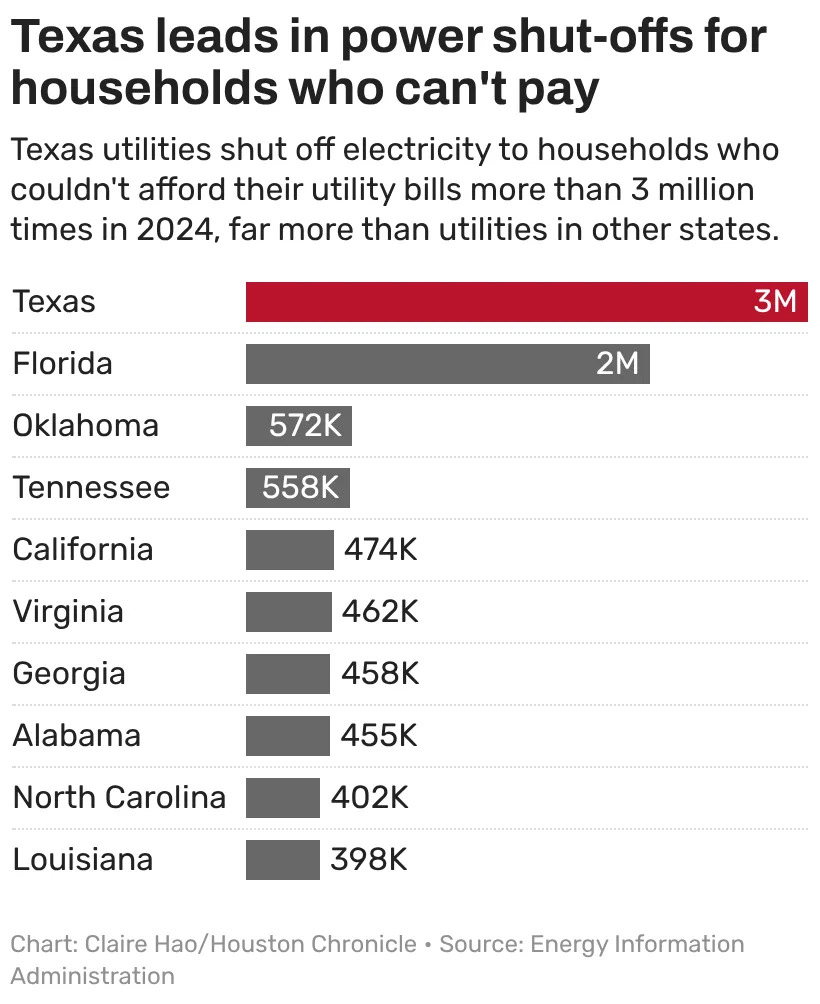
More than 3 million of those shut-offs – by far the highest number of any state – were recorded in Texas.
In fact, only one other state reported a six-figure disconnection statistic: Florida, where utilities shut off power nearly 2.2 million times in 2024.
As for natural gas, utilities shut off this service nearly 1.7 million times nationwide, according to the Energy Department report. Texas accounted for 200,000 of those disconnections, once again the highest of any state.
The high number of utility shut-offs can’t just be attributed to the fact that Texas is the second-most populous state.
The Lone Star State has one of the highest rates of electricity disconnection – second only to Oklahoma, according to the Energy Department data. Texas is also in the top third of natural gas shut-off rates nationwide.
Growing financial strain
Weisz, the Texas Energy Poverty Research Institute director, said Texas’ “dismal” utility shut-off figures are not surprising, given that wages have lagged behind costs of living.
In the last five years, Texas electricity rates have risen approximately 30% because of extreme weather and policy changes instituted after the 2021 grid crisis, according to the nonprofit’s research.
Through 2030, the nonprofit forecasts that electricity rates could spike another 29%, largely to cover the costs of power lines needed to support data centers, oil and gas companies, and other large industrial operations.
These increases could further squeeze residents who are already cutting back spending on other essential needs to pay their utility bills, Weisz said. The phenomenon could be particularly acute in Texas because the state provides no financial assistance to help low-income residents who can’t afford their utility bills, unlike many other states.
Texas used to have such a program, but government misuse of those aid dollars eventually led to it shutting down. A bill to restart the fund failed to pass the Texas Legislature last year.
Other resources are limited. A federal assistance program received a record number of applications from Houstonians last summer, leaving most who sought help without the funds they needed. Nonprofits and faith-based organizations say they struggle to fill the growing gap.
Meanwhile, utilities are poised to earn substantial profits amid a projected surge in energy use from the artificial intelligence boom, consumer advocacy groups noted in response to the newly released disconnection data.
Potential solutions
Still, Weisz said she was heartened that advocates and researchers finally have access to comprehensive, nationwide disconnection data for the first time.
Texas could consider expanding its programs helping low-income residents access money-saving technologies such as smart thermostats and home batteries, Weisz said. Similarly, it could move more quickly to cut energy waste and tighten building codes.
Recent data indicates that more transparency about how to choose an electricity plan in Texas’ complicated electricity market would also help.
Retailer Base Power has said seven out of 10 residents who submitted bills via its rate comparison tool were overpaying for electricity, while broker ElectricityPlans.com found in a recent survey that confusion about how to pick a plan is still widespread.
In addition, groups such as AARP have pushed state regulators to strengthen rules that prohibit when utilities can disconnect customers.
Currently, Texas utilities can’t shut off power during extreme heat or cold, or if the resident has a critical medical condition, but definitions for those exemptions are limited.
“Maybe now that we actually can see how bad the problem is, we can start being more creative at both the legislative level and in the private sector in trying to really understand and address it,” Weisz said.
This article originally published at Texas, the nation’s energy capital, shuts off the most utility customers, federal report finds.