
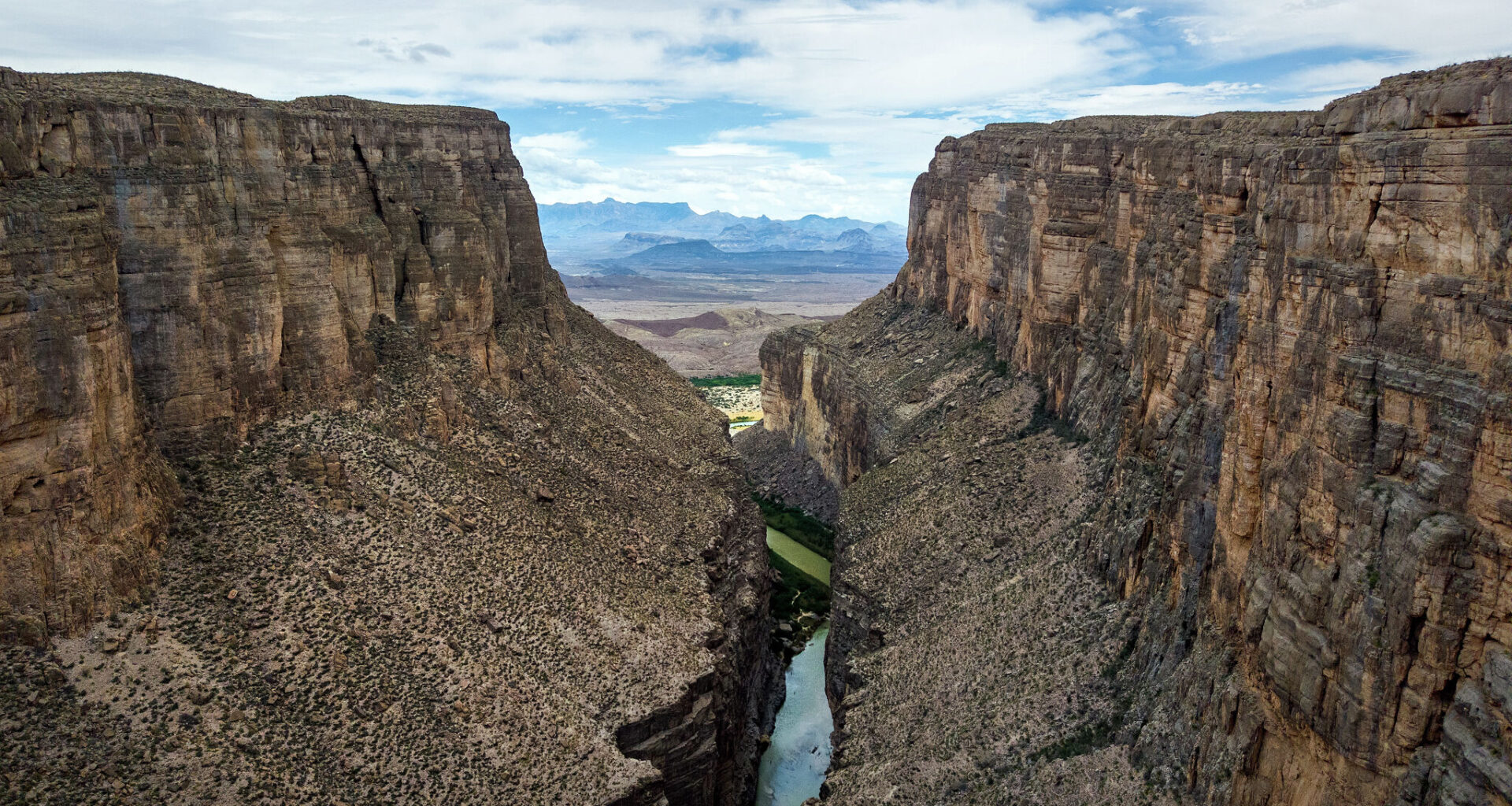
The Rio Grande flows through Santa Elena Canyon in Big Bend National Park, where the center of the river marks the U.S.-Mexico border. In the Big Bend region, a more flexible approach using technology and strategic infrastructure instead of traditional physical barriers has proven effective while preserving the land, Hudspeth County Judge Joanna E. MacKenzie writes.
John Moore/Getty Images
Border security is not an abstract policy debate where I live. It is part of everyday life.

As Hudspeth County Judge, I serve not only as a chief elected official, but also as the head of emergency management. When something happens, we are not reading about it later. We are in it — working with law enforcement, coordinating resources and supporting the families and landowners who call this place home.
Article continues below this ad
I see firsthand both the progress that has been made and the challenges that remain.
Recently, I joined my fellow border county judges in sending a letter to U.S. Homeland Security Secretary Markwayne Mullin. Together, we represent 100% of the contiguous Texas-Mexico border.
Possibly for the first time in history, every one of those counties is speaking with one voice. Not in anger. Not in politics. But in partnership.
We are asking the Department of Homeland Security for a clear and practical partnership: consistent communication with border county judges, early coordination with local officials and landowners before major decisions are finalized, and flexibility in how border security is implemented across different regions. That includes ensuring reasonable access to private land, protecting water and environmental resources, and considering the real-world needs of agriculture and land management along the border.
Article continues below this ad
We support effective border security. We live the realities of unlawful crossings through strained resources, risks to public safety, and impacts on farmers, ranchers and landowners. We also recognize the measurable progress that has been made and are grateful for the continued commitment from federal and state partners.
But supporting border security and asking for a seat at the table go hand in hand.
The Texas-Mexico border stretches nearly 1,300 miles and includes urban ports, small communities, working ranches and vast remote terrain. What works in one place may not work in another.
We have seen well-intended decisions create unintended consequences limiting access to water, complicating property access, and temporarily restricting airspace in ways that affected both rural operations and activity in the El Paso region. These challenges are not about bad intent. They reflect how difficult it is to get it right from a distance.
Article continues below this ad
U.S. citizen Antonio Rosales Jr. shows a map of his property in Laredo where the U.S. government plans to build a border wall. The county judges of all Texas border counties are calling for early coordination with local officials and landowners before major border security decisions are finalized.
RONALDO SCHEMIDT/AFP via Getty Images
There is a better way, and we have seen it work.
In the past, collaboration between federal agencies and local leaders has led to smarter, more effective solutions. When border infrastructure once threatened to divide a university campus in Brownsville, local input helped reroute the project in a way that maintained both security and community integrity.
More recently, in the Big Bend region, a more flexible approach using technology and strategic infrastructure instead of traditional physical barriers has proven effective while preserving the land.
Article continues below this ad
That happens only when local knowledge is part of the process.
As county judges, we sit at the intersection of federal policy and local impact. We know the terrain, the people and the realities of daily life along the border.
That is why we are asking for a true partnership — one that reflects the differences across this region and includes local voices from the start.
Strong border security and strong border communities are not competing priorities. They reinforce each other.
Article continues below this ad
This is not a partisan issue. It is a practical one.
The people who live here want to be safe, keep their livelihoods and build a future for their families. We stand ready to keep working alongside our federal partners to make that happen.
Because at the border, we are not observers. We are partners.
Article continues below this ad
There is an old saying that you can go fast alone, but you go farther together. That is exactly what this effort represents.
Joanna E. MacKenzie is the Hudspeth County Judge and the chair of the Texas Border Coalition.