
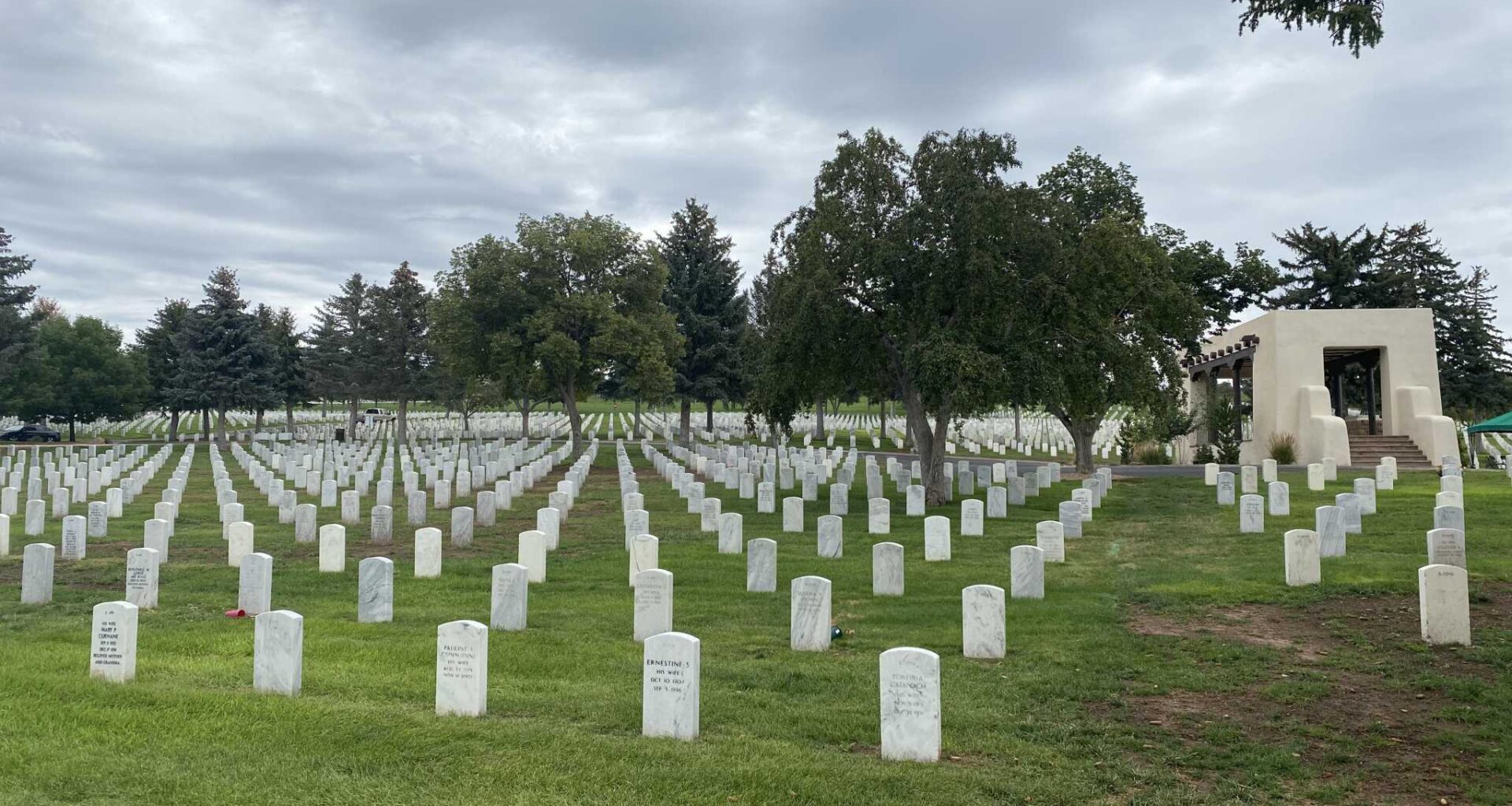
When a mass grave of 30 Texans was discovered more than a century after the Battle of Glorieta Pass, the remains were reinterred at the Santa Fe National Cemetery.
Susan Holley / Susan Holley
House Speaker Dustin Burrows wants to take a bite out of his neighbor. (That would be the state of New Mexico.) Not a big bite — not like Texans of old, who lusted after the whole enchilada (with green chile) — but just a nibble.
The Lubbock Republican has instructed the next session of the Texas Legislature to study the possibility of raking into the Lone Star State “one or more contiguous counties of New Mexico.” Those counties make up a strip of eastern New Mexico called “Little Texas,” a desolate region that most definitely lacks the natural beauty for which the Land of Enchantment is known.
FILE – Texas Speaker of the House Dustin Burrows, R-Lubbock, oversees a debate during a special session, Aug. 20, 2025, in Austin, Texas.
Eric Gay/AP
A marker dedicated in 1939 commemorates the bravery of Texas Confederates who fought and died at the Battle of Glorieta Pass.
Joe Holley / Contributor
A recently dedicated marker on the site of the Battle of Glorieta Pass commemorates New Mexico volunteers and Colorado miners who defeated Texas Confederates.
Joe Holley / Contributor
Since beauty is only skin-deep, Burrows’ interest goes deeper, much deeper. Little Texas produces the oil and gas bounty that has made New Mexico the nation’s second-largest oil producer, trailing only Texas. The region also shares the politically conservative proclivities of the Permian Basin just across the state line.
Article continues below this ad
Annexation or secession is about as likely as the blue cities of Texas — the state’s economic dynamos — seceding in the face of relentless disdain and disenfranchisement from our GOP state behemoth. Nevertheless, residents of Hobbs, Lovington, Eunice and other oil-boom towns are open to the idea. Like conservative residents of eastern Oregon who want to split off and join deeply conservative Idaho, they feel neglected by a domineering Democratic Party.
“Anything to get away from Albuquerque and Santa Fe,” Hobbs News-Sun editor Andy Brosig told me, explaining his neighbors’ frustration. Lea County (Hobbs) and Eddy County (Carlsbad) account for more than half the state’s budget every year, he said, but while state government relies on their oil money, they only get the shaft.
FILE – Pump jacks operate in the Permian Basin east of Carlsbad, N.M., on Tuesday, May 20, 2025.
Susan Montoya Bryan/AP
Beyond Little Texas, most state officials in our blue-and-getting bluer neighbor reacted with disdain to the Burrows proposal. New Mexico House Speaker Javier Martinez, an Albuquerque Democrat, challenged his Texas counterpart to “come and try to take it.” (He apparently knows his Texas history.)
“New Mexico isn’t afraid of a fight,” Martinez said in a statement. “I suggest that he get offline, touch some grass, and get his own House in order. I am certain Texans would much rather see their elected leaders come up with real solutions to the soaring health care, grocery and energy prices brought on by the reckless actions of President Donald J. Trump and his Republican friends in Washington, D.C. We’re good.”
Article continues below this ad
Martinez may or may not be aware that Texans have indeed tried to “come and take it.” I hate to say it, but we Texans have been something of an invasive species off and on for nearly 200 years. Metaphorically speaking, we’ve been the airline passenger who hogs the armrest, the guy at the pre-event reception who grabs the last bacon-wrapped shrimp off the canapé tray, the driver who refuses to let you in at the Shepherd entrance to I-10.
Erna Ferguson, a member of a distinguished New Mexico writing family in the middle decades of the 20th century, put it this way: “Texas has always looked toward New Mexico covetously, yearning to own it as a nation, a state, or individually. For more than a century Texans have kept coming in various guises and with various projects to occupy New Mexico.”
A portrait of Lamar, Mirabeau Buonaparte (1798–1859)
Texas State Historical Association
Our first “project” was the ill-fated Texan Santa Fe Expedition, conceived in 1841 by Mirabeau Buonaparte Lamar, president of the Republic of Texas. The infant nation was broke, and Lamar’s idea was to send to Santa Fe a contingent of merchants, government officials and a company of soldiers in an effort to persuade the New Mexicans to open up a trail through Texas to the Gulf Coast. The soldiers were, in Lamar’s words, “for the occupation of New Mexico in case the people desired to become members of the Texas republic.”
They didn’t. Instead, the Mexican Army arrested the Texans as criminal intruders and marched them under guard to prisons in Mexico City.
Article continues below this ad
Ferguson, the 20th-century writer, relying on an account written by a New Orleans newspaper editor who went along for the adventure, wrote that the Texans were pretty much defeated before they ever reached New Mexico. “While still in country teeming with fish and game,” she wrote, “the Texans butchered their animals and so faced starvation when the going got tougher. They forced needless fights with Indians, lost goods, equipment and even lives in stampedes; and because they could not take care of themselves were often ill.”
Two years later, a detachment of Texans invaded again. Twice. Both times they were thwarted.
For nearly two decades, we minded our own business, but early in the first summer of the Civil War word reached Texas that the Confederacy needed soldiers to march from San Antonio to El Paso and then northward along the Rio Grande into New Mexico Territory. The Texan volunteers would help the breakaway nation carve a path across the West to the California gold fields and its Pacific ports. (New Mexico Territory included Arizona.)
Gen. Henry Hopkins Sibley, commander of a Confederate cavalry brigade, was attempting to connect the Confederacy to California when he was forced to retreat after losing the Battle of Glorieta Pass.
New Mexico Military Museum / New Mexico Military Museum
Under the command of a former U.S. Army officer named Henry Hopkins Sibley, the Confederate Texans took Albuquerque and Santa Fe without a fight and then at Glorieta Pass met a force of New Mexican volunteers, their strength fortified by volunteers from the Colorado gold fields who called themselves the Pike’s Peakers.
Article continues below this ad
On the second day of fighting, a New Mexican colonel named Manuel Chaves noticed from atop Glorieta Mesa, hundreds of feet above the valley, that the Texan army below had drifted several miles away from its supply train. At least 60 wagons filled with supplies, food, weapons and ammunition had been left unguarded. Chaves, who had fought the Tejanos on the Santa Fe Trail twenty years earlier, led a small assault force over the rim of the flat-topped mesa to the canyon floor. After driving off 500 horses and mules and setting everything afire, the Union soldiers climbed back up, pausing to watch every wagon, one by one, explode.
Union victory at the Battle of Glorieta Pass meant that the Confederacy would not extend westward through New Mexico to California.
New Mexico Military Museum / New Mexico Military Museum
With no supplies and no ammunition, the Confederates — sick, wounded and broken in spirit — had no choice but to straggle back to Texas. “The West remained in the hands of the Union,” Megan Kate Nelson writes in “The Three-Cornered War,” “and the Confederacy was surrounded on all sides by states and territories loyal to Abraham Lincoln.”
Although our bellicosity — then and now — gets us in trouble, we could invade again, I suppose. With the Texas/Mexican border quiet these days, Gov. Greg Abbott could redirect the billion-dollar boondoggle he calls Operation Lone Star toward the newer Mexico, intending to lop off those oil-rich Little Texas counties with force.
Article continues below this ad
Meanwhile, Texans have been invading all along — skiing at Taos and Red River, blackjacking in the casinos, shopping and opera-going in Santa Fe, fishing the Pecos and the Chama, fleeing to a second home in Ruidoso or Cloudcroft to escape the Texas heat. We come in peace. Mostly.
Joe Holley is a Pulitzer-winning editorial writer and was the “Native Texan” columnist for the Houston Chronicle.