
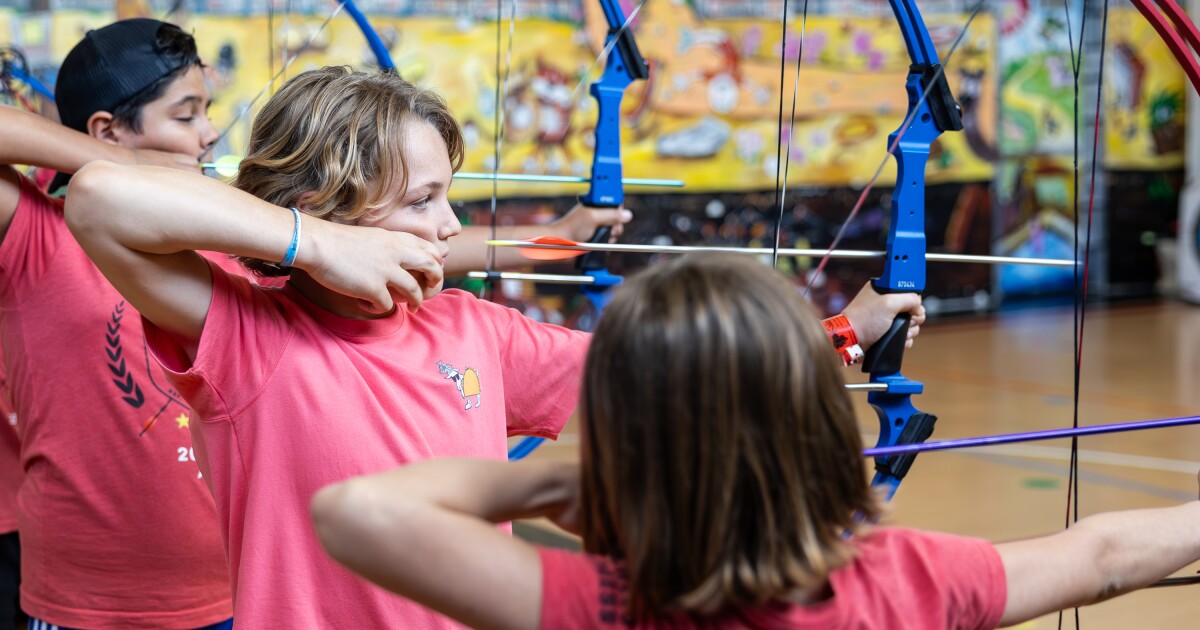
Nearly 200 students from Austin are headed to Salt Lake City for a national archery tournament kicking off Thursday.
Among the strongest contenders under 12 are those from Austin ISD’s Highland Park Elementary, where coach Jim DeLine has built one of the most successful youth archery programs in Texas.
DeLine didn’t set out to create a pipeline for child archery champions. He brought the sport to Highland Park about a decade ago as a two-week physical education unit.
“Instantly found that it was a game changer for a lot of kids in a lot of different ways,” DeLine said. “Kids that are kind of on the periphery of team sports or don’t get a lot of social interaction with other people or might be on the spectrum a bit, instantly saw the change in how this impacted them.”
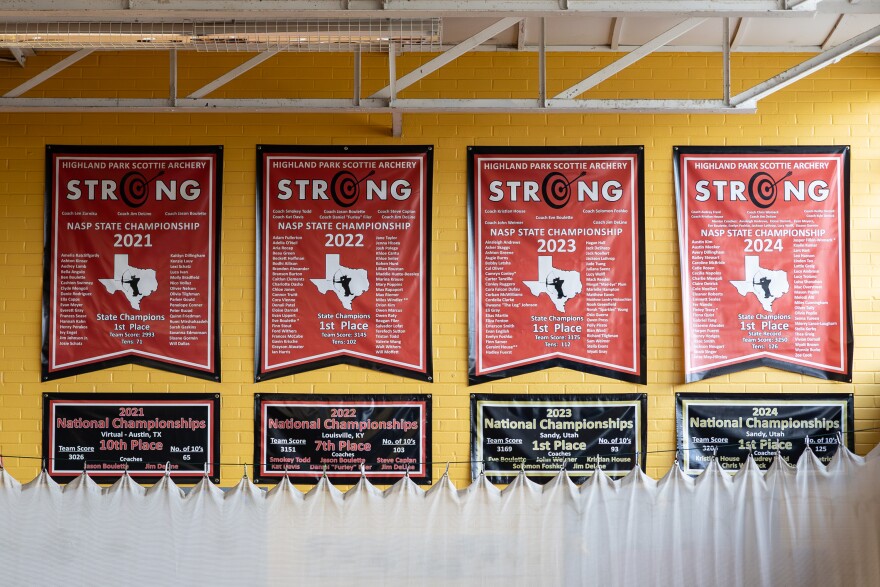
In 2016, they started a club. Just two years later, Highland Park won state. DeLine said the team has not lost since. The Highland Park program is now listed as a 12-time Texas state champion and four-time national champion in the National Archery in the Schools Program (NASP).
Michael Minasi
/
KUT News
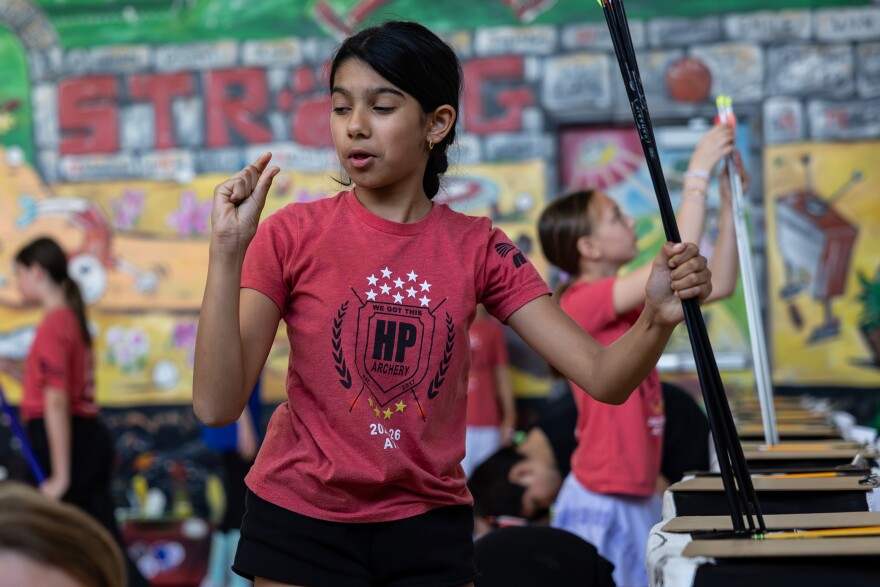
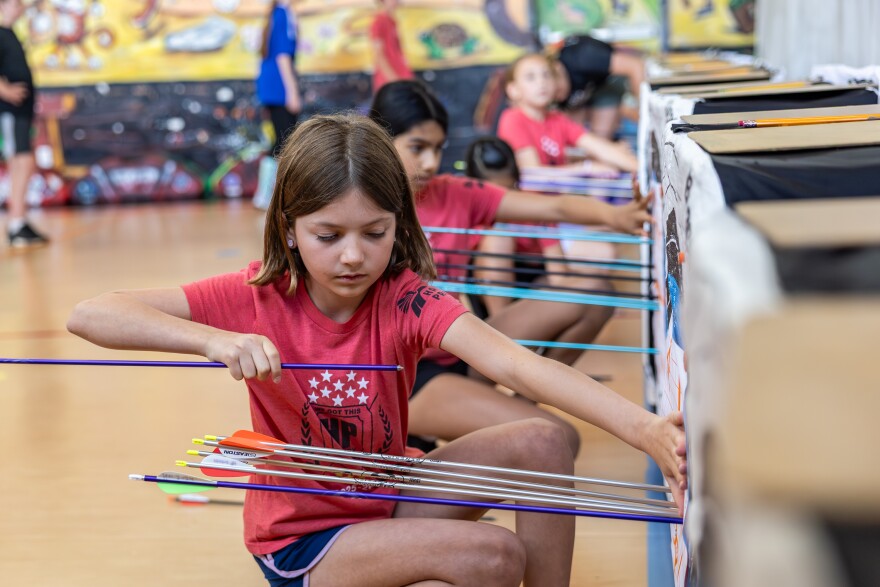
Fifth grader Seva Deshpande chats with a teammate about her performance while collecting her arrows from the target during after-school archery practice.
NASP started in Kentucky in 2002 and spread to all 50 states. Now, more than a million students in 4th through 12th grades participate annually, including in at 1,700 schools across Texas.
Archery programs exist at a handful of Austin campuses including the Ann Richards School for Young Women Leaders, Kealing Middle School, McCallum High School and LASA.
DeLine’s nonprofit, Bat City Archery, offers programs at Highland Park Elementary, Lamar Middle School, Magellan International and St. Francis School.
Michael Minasi
/
KUT News
Banners on the wall of the Highland Park gym celebrate team victories at national and state archery tournaments.
AISD, which is facing an ongoing financial crisis, doesn’t pay for the program. Families mostly cover the cost, which can run about $1,000 a year per student including equipment. Scholarships are available.
So how does DeLine do it?
Part of the answer is repetition. Part of it is mindset. And a lot of it, parents and students say, is the coach himself.
Inside the Highland Park gym, DeLine’s message is constant: focus on the next step, not the final result. Stay calm. Trust your routine. Let your teammates help you.
Michael Minasi
/
KUT News
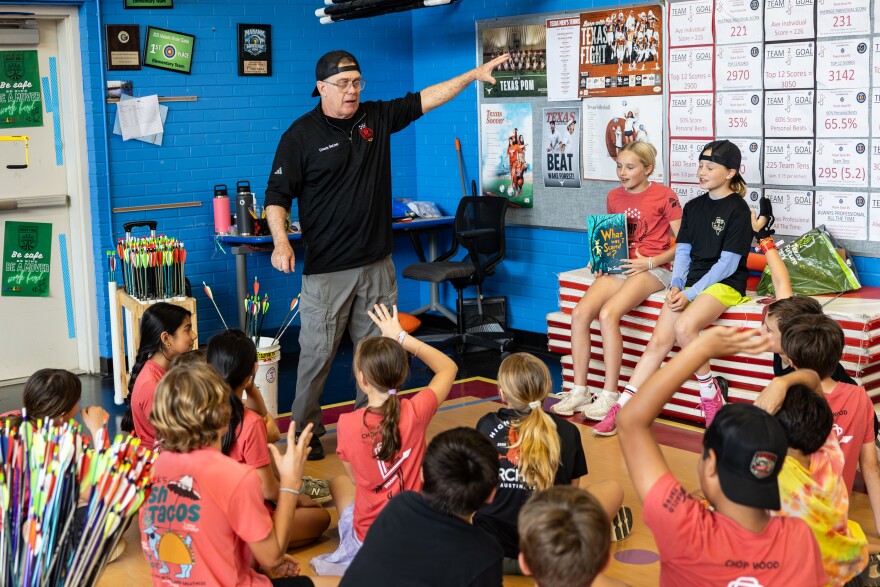
Coach Jim DeLine gives a motivational speech to students before running drills during after-school archery practice.
He seems to have a saying for every situation. When getting ready for nationals, DeLine asked the team: “If you’re not nervous, you’re not what?”
“Normal!” the kids shouted in unison.
“And it’s okay to be nervous as long as you don’t?”
“Barf,” the kids responded together.
“We’ll let the other teams barf and throw up, but we’re not going to. Got it?” DeLine said.
Ten-year-old Etta Moskowitz won a state title just weeks ago. It’s only her first year doing archery.
“I felt really happy during [the competition], so I think my attitude had a little bit to do with it,” she said.
Michael Minasi
/
KUT News
Fifth grader Etta Moskowitz collects her arrows from the target during after-school archery practice. She won a state title in March and is headed to the U.S. Western Nationals in Salt Lake City.
Etta’s mom has noticed her daughter gain confidence since starting archery.
“I’ve seen her learn to trust herself more,” Whitney Moskowitz said. “She is able to wield a sense of control over her emotions in a way that is new, because she has more space with this additional ability to breathe through challenges.”
Etta’s teammate, 11-year-old Louis Garcia, also won a state title. For him, success is as much mental as physical.
“Don’t get in your head. That’s the biggest thing,” Louis said. “Stay calm.”
The philosophy shows up everywhere in DeLine’s program. He talks to kids about effort, attitude and mindfulness. He tells them that even the lowest-scoring archer has a place if they’re the hardest-working teammate.
“National championships and state championships are really a byproduct of our effort just to make kids the best version of themselves,” DeLine said.
Michael Minasi
/
KUT News
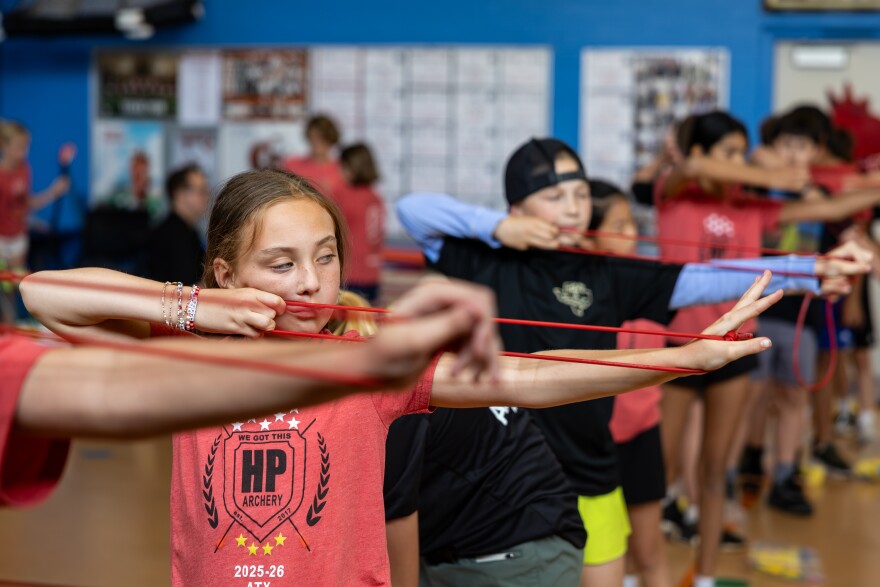
Fifth grader Margot Jacobson does warm-ups at the beginning of after-school archery practice inside the Highland Park Elementary School gym.
Eleven-year-old Robby Schooler said he keeps a whiteboard chart of his exercises, practices them almost every day and writes about archery in a journal to help with his mindset.
“If you want to get really good,” Robby said, “you have to set small goals and have a routine that you do every day.”
When asked what motivates him, Robby said he looks up to older archers in middle and high school who shot perfect 50s — the maximum score obtained by getting all five arrows in the ten-point center ring.
“I want to work hard to get that,” Robby said. “Even if it’s going to take a lot of work.” He said he got two 50s this year.
That kind of buy-in is what DeLine seems most proud of. But he also speaks fondly of the notes he gets from students who tell him how much they appreciated what he taught them in elementary school. His first archery class is now college-age.

Michael Minasi
/
KUT News
Coach Jim DeLine leading drills during after-school archery practice. DeLine says he keeps a “gratitude wall” of thank you notes sent to him by former archery students.
“Coaches don’t cry, we just sweat out our eyeballs,” DeLine said. “When I start feeling sorry for myself, I just go look at one of the notes a kid took time to write.”
“When I read notes, I get awful sweaty,” he said.
Just before I left, there was a burst of cheers from across the gym.
“Robby got a 50!” a teammate shouted.
“Alright,” DeLine said calmly. “When you get a 50 here, what happens is you get a sticker and then we get to feed you to the llamas.”
Now Robby and his teammates are in Salt Lake City, where they’ll try to bring another national tournament victory back to Austin.