
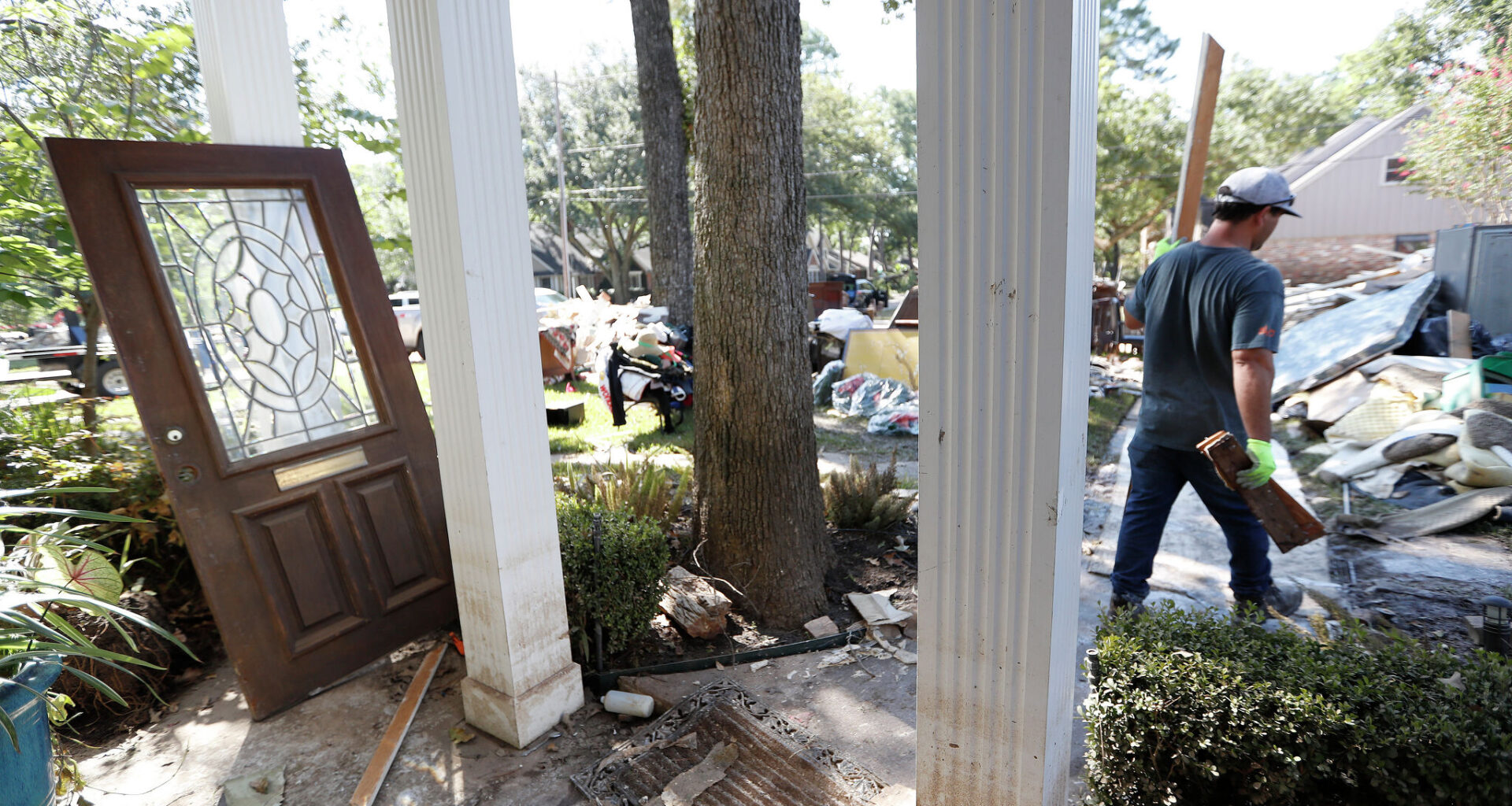
Workers clean out the Otermat’s flood gutted home in the Memorial Glen subdivision, west of Beltway 8, near Memorial and Wilchester, Friday, Sept. 8, 2017, in Houston. As people in homes in that area were finally able to start working on cleaning up the mess left behind after their homes were flooded for more than a week. ( Karen Warren / Houston Chronicle )
Karen Warren/Houston Chronicle
Homes in the Cinco Ranch area along S. Mason Road north of the Westpark Tollway are surrounded by water from Barker Reservoir, Saturday, September 2, 2017, in Houston.
Mark Mulligan/Houston Chronicle
People wade through chest deep water down Pine Cliff Drive as Addicks Reservoir nears capacity due to near constant rain from Tropical Storm Harvey, Tuesday, Aug. 29, 2017 in Houston. The push of subdivisions and freeways across what once was hundreds of square miles of flood-absorbing tallgrass prairies was part of the U.S.-leading population growth of Houston and surrounding Harris County. But the go-go-growth placed housing developments across the drainage basin of the two major reservoirs and dams safeguarding downtown Houston.
Michael Ciaglo/Houston Chronicle
Chris Gutierrez, second from right, helps his grandmother, Edelmira Gutierrez, down the stairs of their flooded house and into a waiting fire department truck in the Concord Bridge neighborhood as Addicks Reservoir surpasses capacity due Tropical Storm Harvey, Tuesday, Aug. 29, 2017, in Houston. (Michael Ciaglo/Houston Chronicle via AP)
Michael Ciaglo/Houston Chronicle
Harris County Sheriff’s Deputy Rick Johnson pauses to listen for people’s voices as they search for people in a neighborhood inundated by water from the Addicks Reservoir, Wednesday, Aug. 30, 2017, in Houston.
Jon Shapley/Houston Chronicle
Homes in the Canyon Gate area of Cinco Ranch are surrounded by water from Barker Reservoir, Saturday, September 2, 2017, in Houston.
Mark Mulligan/Houston Chronicle
Fran Cuong, second from left, shields his daughter from wind and rain as he and his family are rescued by Mason Broussard, left, Edrick Browne, right, and a third man, in rising floodwaters, in a neighborhood along Beechnut Road, south of the Barker Reservoir, as heavy rains continue from Tropical Storm Harvey, Monday August 28, 2017, in Fort Bend County.
Jon Shapley
An airboat travels north along S. Kirkwood Rd. west of Beltway 8 and south of Interstate 10 where homes are inundated with water from the overflowing Buffalo Bayou to the north, Saturday, September 2, 2017, in Houston. Houston mayor Sylvester Turner issued a new mandatory evacuation order Saturday for homes with water in them south of Interstate 10, north of Briar Forest, east of Highway 6 and west of Gessner Rd. As water continues to be released from the Addicks and Barker reservoirs.
Mark Mulligan/Mark Mulligan / Houston Chronicle
A federal judge vindicated Houston homeowners who have argued for years that the U.S. Army Corps of Engineers’ decision to open Addicks and Barker dam gates during Hurricane Harvey flooding — sending water into their downstream homes — was no act of God.
Judge Loren A. Smith ruled Wednesday in a test case of 12 plaintiffs that first went to trial in 2024, finding that the government’s actions amounted to a “taking” of private property and that homeowners were eligible to be compensated for the damage it wrought.
IN COURT: Seven years after Harvey, flooding victims downstream of reservoirs go to trial
Article continues below this ad
Smith’s decision said the property owners proved they flooded more than they would have if the Army Corps had kept the dam gates shut. He dismissed the government’s argument that the closure was necessary given the exceptionally devastating flood levels, saying operators opened the spigot “before an actual emergency posed an imminent danger to the structural integrity of Addicks and Barker.”
The ruling reversed Smith’s stance in 2020, when he dismissed the downstream case outright and said that the hurricane itself was responsible for the damages.
“Of course, the water from the hurricane was not the government’s water, unless the storm was also created by the government’s wind and air and sun and sky,” he wrote in 2020. “These were flood waters that no entity could entirely control.”
The ruling in a lawsuit brought by homeowners flooded during Hurricane Harvey found the government liable for damages.
Ken Ellis / Houston Chronicle
A federal appellate court reversed that decision in 2022, setting the stage for the lower court trial.
Article continues below this ad
The team of attorneys representing owners of flooded properties downstream of the reservoirs celebrated the new ruling, which came nearly a decade after flood victims suffered damages during the storm. Next, the court will determine total damage amounts for 11 homeowners and one business owner in the test case. Property owners with comparable cases will then be able to seek remuneration.
TRIGGER: Harvey flooding victims downstream of reservoirs get new chance in court after appeals ruling
Plaintiff’s attorney Richard Mithoff said there could be many thousands of claims once the effort is all said and done. Mithoff, who currently represents 502 clients, went to trial alongside two attorneys, Rand P. Nolen and Jack E. McGehee, from other firms that represented their own slates of plaintiffs.
“This is an enormous victory for the citizens of Houston who have been waiting a long time for a decision on their claims,” Mithoff said.
A separate group of homeowners with properties sitting upstream of the two large reservoirs also sued the federal government after flooding during Harvey, arguing that the overflowing reservoirs spread onto their properties in a way that was similarly controlled by the Army Corps’ operations. Their wins came more quickly: A lower court found in their favor in 2019, and that decision was largely upheld by an appeals court panel in December.
Article continues below this ad
Water is released from the Barker Reservoir in the aftermath of Hurricane Harvey on Tuesday, Aug. 29, 2017, in Houston.
Brett Coomer/Staff photographer
In the downstream case, government lawyers did not dispute that the properties in question also flooded; instead, they argued that Addicks and Barker offered an overall flood benefit to those homes. They said its detention gates prevented the worst of the area’s potential flooding, compared to how water would have spread had the infrastructure never been built.
Addicks and Barker were constructed during World War II between 1942 and 1945, long before urbanization spread throughout the area. Smith’s latest decision detailed how the government “considered purchasing downstream land in anticipation of increased flooding events,” but did not due to “astronomical” costs and a belief that the move would be unacceptable to Houston residents.
Then, Hurricane Harvey made landfall in Texas on Aug. 25, 2017, and dumped record-breaking rainfall on the Houston area. Two days later, the Army Corps said it would open the reservoir gates. The next morning it did, releasing water that flooded thousands of homes and businesses in the Buffalo Bayou watershed.
Article continues below this ad
Fleetwood, Thornwood, Westchester, Nottingham Forest and the Energy Corridor all received the floodwater racing downstream. At least two people died in their homes after the gates were opened.