
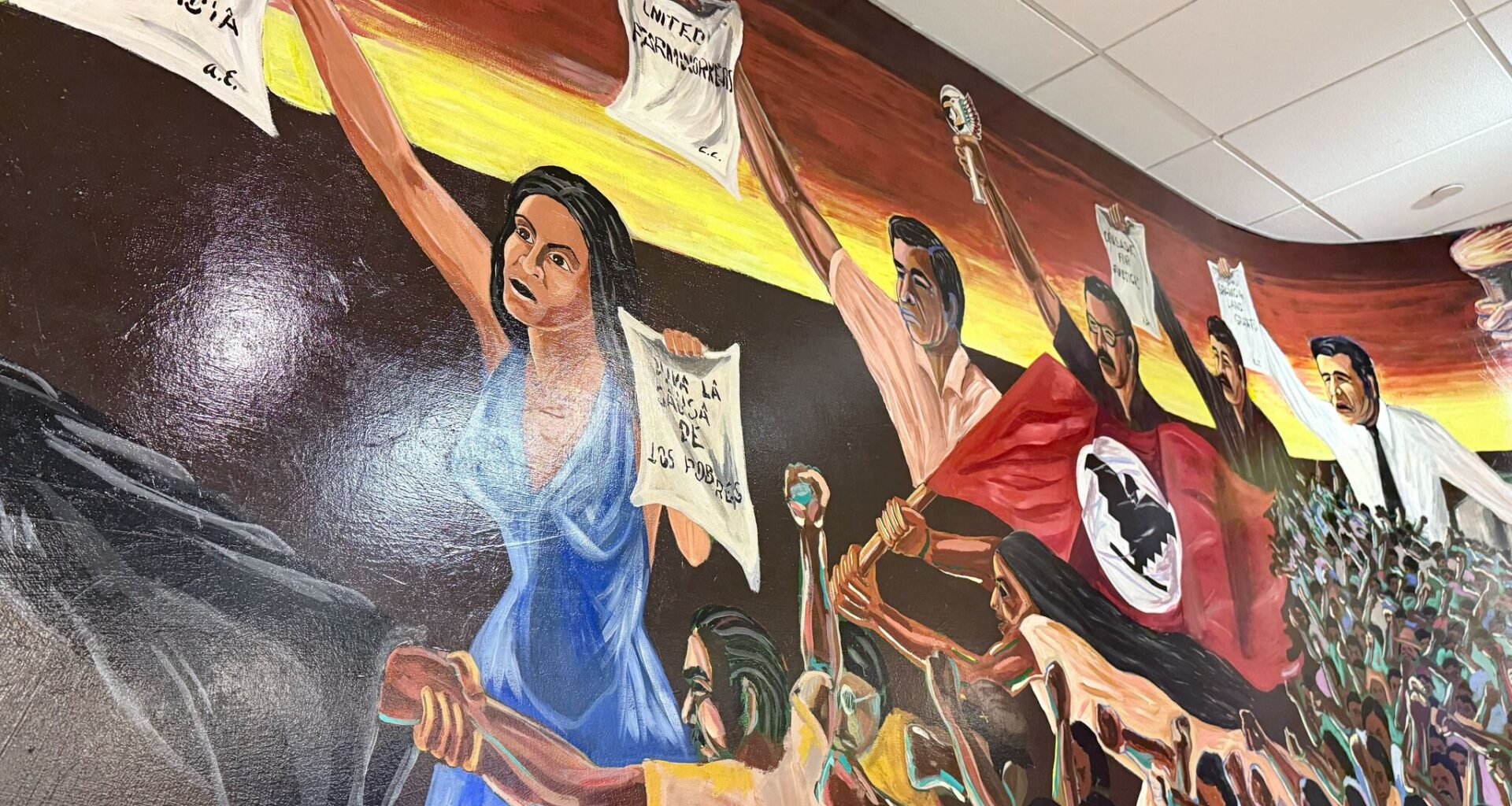
A debate is unfolding at the University of Houston over whether a decades-old campus mural featuring labor leader Cesar Chávez should remain as portrayed following recent allegations that have reshaped public understanding of his legacy.
The mural, “La Marcha Por La Humanidad” has hung in the Student Center South for more than 50 years as a symbol of Mexican American identity, struggle and activism. Created in 1973 by former art student Mario R. Gonzalez, the mural depicts Chavez alongside other civil rights figures, reflecting his influence on that era’s labor and civil rights movement, a movement he led alongside organizer Dolores Huerta.
Now, university officials say the work is under review after Huerta revealed to the New York Times that Chavez had sexually abused her and other young women—allegations that have sparked national debate and a renewed scrutiny of his legacy.
“The University of Houston is aware of the reports recently brought forward regarding Cesar Chavez, which fundamentally shifts the historical understanding of this figure,” a university spokesperson told The Cougar, UH’s student newspaper.
“As an institution, we unequivocally condemn sexual abuse and are committed to fostering a campus environment where survivors are supported.”
The debate arrives as Texas college campuses are already grappling with how to balance the removal of controversial material against the need to equip students with an unvarnished understanding of today’s world.
Gov. Greg Abbott has moved to eliminate the state’s formal day of observance for Chavez, while the Texas Education Agency has directed K-12 schools to remove related instructional materials.
Meanwhile, the Houston City Council has already begun the process of formally removing fixtures across the city, such as those on Cesar Chavez Boulevard in Magnolia Park.
However, for Texas higher education systems, there is no statewide directive guiding how public colleges should respond, leaving campuses like UH to navigate the issue independently.
The Texas Higher Education Coordinating Board (THECB), the primary agency overseeing the state’s public universities, has not issued any directive to campuses on how to handle existing materials tied to Chavez or related controversies.
“The THECB does not have a role in overseeing the issues you mentioned,” a spokesperson from THECB told Chron.
Colleges and universities are required to follow state laws and are overseen by their respective institutional and Board leaderships, according to THECB.
“Removal is not accountability—it is erasure, and erasure is not what a university is for,” senior David Parra, told The Cougar. “UH exists to educate, and that means engaging with complexity, not curating it away.”
University officials say the mural itself will remain in place, but a group of campus stakeholders, including faculty, students and subject matter experts, will review “how to best address the specific depiction of Cesar Chavez within the artwork,” the university said.
Moving forward, “the group is tasked with exploring thoughtful options and making a recommendation to University leadership. This work is currently underway,” according to the university.