
North Texas Wildlife Center reports 50% rise in animal intake, citing development, awareness and growth as key factors driving record cases in 2026.
PLANO, Texas — Inside the North Texas Wildlife Center, the front room functions like an intensive care unit. Animals fill nearly every space — victims of cars, poison, habitat loss and human activity — in what staff describe as one of their busiest years yet.
The nonprofit has treated 1,812 animals so far in 2026, representing 101 species, according to center data. That marks a sharp increase from the same time last year, with intake up about 50%.
“We see a lot of animals that are hit by cars, a lot of animals that are poisoned, and trapped animals,” said Rebecca Hamlin, president of the center.
The facility operates like a wildlife hospital, complete with triage, predator and prey rooms. Recent patients include an opossum rescued from a glue trap in Lake Highlands and a group of Eastern screech owls found when a tree was cut down in Richardson. The owls, hatched in an incubator two weeks ago, are now beginning to open their eyes.
Like all animals admitted, they will eventually be rehabilitated and released back into the wild.
But staff say demand is stretching capacity.
“We’ve had to close for intake more this year than ever before,” Hamlin said. “It’s because all of our cages are full.”
Among the most common animals treated are opossums, rabbits, squirrels and birds such as doves and mallards. Many cases are tied directly to human activity.
The center reports frequent cases of orphaned wildlife caused by tree removal and pest control practices. In some instances, young animals are unintentionally separated from their mothers.
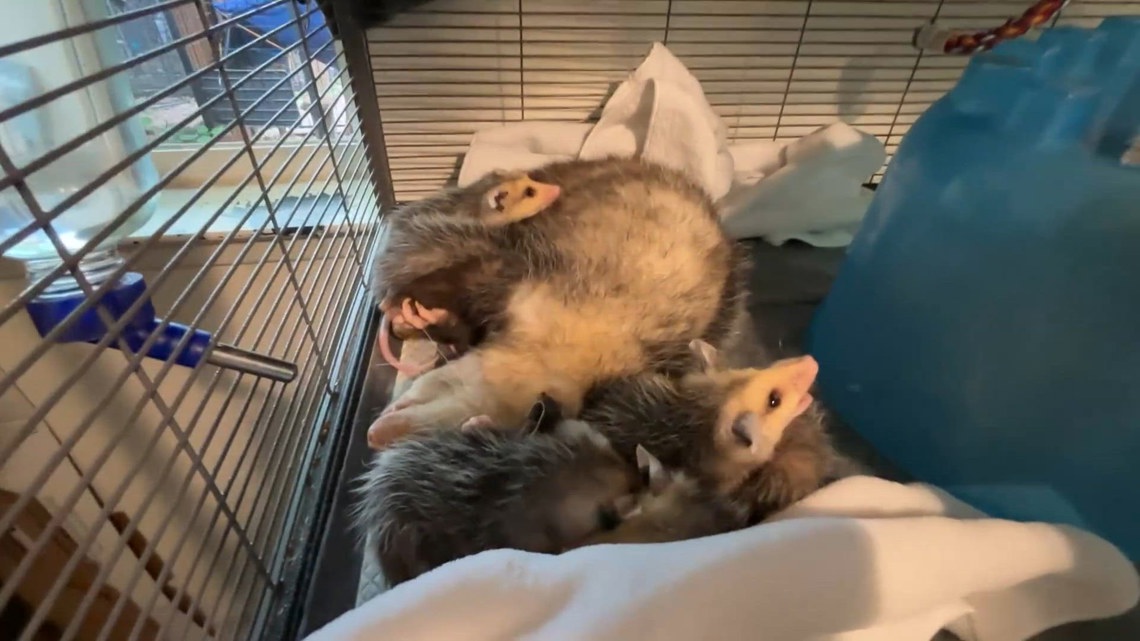
There has also been a notable rise in opossums hit by cars — often mothers whose babies survive in their pouches. In one recent stretch, staff treated about a dozen such cases in just over a week. None of the mothers survived, but many of the babies were rescued.
Hamlin points to three main reasons behind the surge.
First, rapid development across North Texas is shrinking natural habitats and pushing wildlife into closer contact with people.
“We’re building on more land, we’re cutting down more trees,” she said. “So, we’re forcing those animals into areas where humans are.”
Second, increased exposure through films, documentaries and social media is prompting more people to intervene when they encounter wildlife in distress.
And third, the center itself has grown in visibility, leading to more calls and drop-offs from the public, veterinary clinics and local animal services agencies.
To keep up with demand, the center relies heavily on community support, including donations of supplies, financial contributions and volunteers. More than 1,250 volunteer hours were logged in March alone.
Hamlin says small changes in human behavior can make a significant difference — from keeping pets indoors or on leashes to being more mindful of wildlife habitats.
“When we know better, we can do better,” she said.
As North Texas continues to grow, human expansion is reshaping the environment — and the animals caught in the middle are arriving at their door in record numbers.