

File photo / Jesse Stone
As a college student in the mid-1980s, Lolín Martins-Crane descended the stairs of the University Center’s far west side and entered the Dry Gulch, a university-owned dive bar. The current director of the Career Development Center met a DJ who would become her husband and formed lifelong friendships.
In 2015, Narda Perez walked down the same stairs, but the bar was gone. In its place was The Shorthorn newsroom, a space that at first, she found intimidating, but by the time she graduated four years later, had become a safe space. She ate there. She napped there. She worked there. The experiences she built in the chilly UC basement are still part of her life.
For decades, students walked down the same set of stairs for different reasons — first for drinks and dancing at the Dry Gulch, later for drafts and deadlines inside The Shorthorn newsroom.
Soon, there will be no stairs left to walk down.
“That was my home, and I was there much more than I was in my actual home,” said Perez, who was Shorthorn editor-in-chief in spring and fall 2018.
In June, UTA will begin a $160 million renovation of the University Center, a project that will close off the basement. Built in 1953, the student center has been renovated several times before university officials proposed rebuilding it in 2022.
The departments in the basement, which include UC Operations, Student Government and other student organizations, have also slowly relocated.
Even though they knew it was coming, the news that the space would no longer exist after the renovation left many people reminiscing about what had been hidden there all along.
‘I would go back to that’
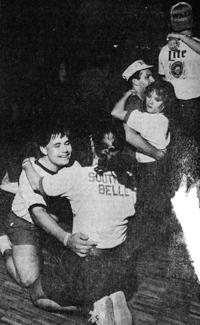
Martins-Crane can still picture how the Dry Gulch was arranged.
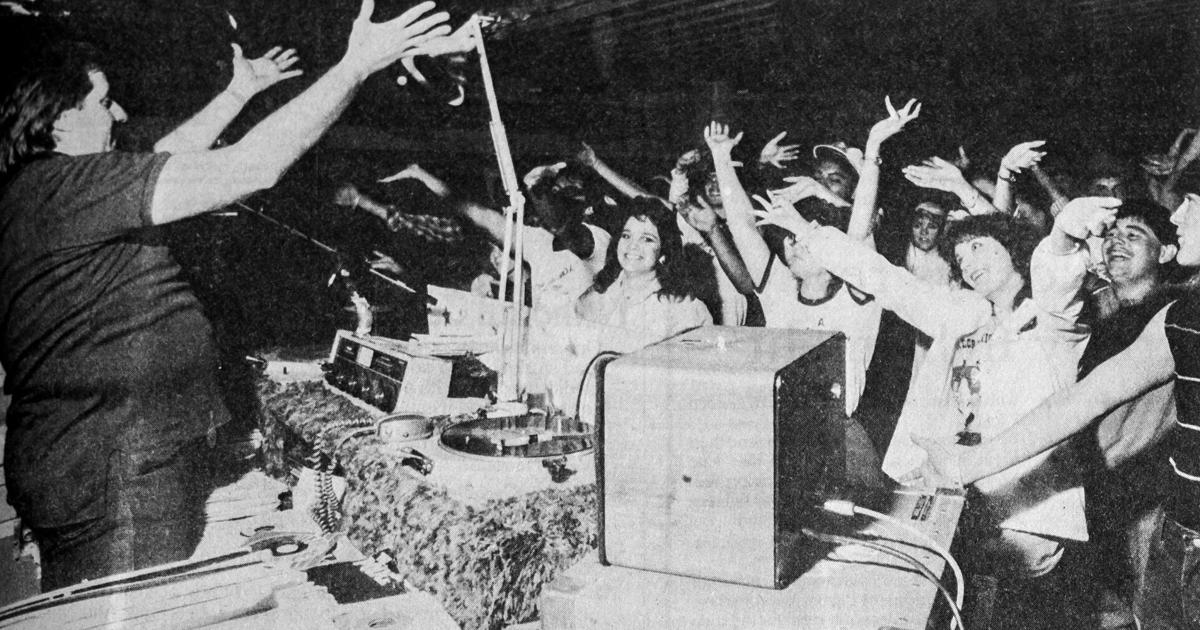
The stage sat up front, where bands performed beside a small dance floor. Tables filled the middle of the room. A pool table rested nearby. A diner with food was housed in the back.
On Tuesday nights, she returned again and again. Her now-husband stood behind the DJ stool playing alternative sets from The Smiths and Depeche Mode.
“It was kind of a little hidden dive,” Martins-Crane said. “But if you knew that it was there, then that’s the place to go.”
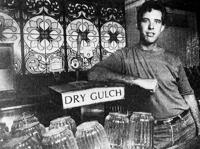
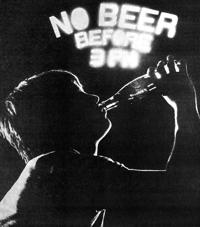
When The Dry Gulch opened in 1978, it was something most campuses didn’t have — a university-run gathering place where students stayed after classes and bought a pitcher of beer for $1.50.
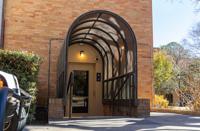
The entrance to Student Publications sits on the southwest side of the University Center. The Shorthorn has been UTA’s student publication since 1919.
“We just thought it was the coolest thing ever,” said Keith Head, who served as Student Body president in 1978-79.
At first, the space was simple.
There were no live bands yet. Mostly, students — and professors — came down to drink a beer, listen to country and disco music, and, as Head put it, study — or at least say they were studying.
Then, the place grew in popularity. Martins-Crane described packed afternoons, bands occasionally passing through, the TV playing soap operas — and, later, everyone gathered as they watched coverage of the Challenger explosion.
“You go down, you have a bite, you do your homework, you meet up with people in the middle,” she said. “Then you would kind of end up on the dance floor in the evening.”
The friends Martins-Crane met there came from different majors, backgrounds and parts of campus. What connected them was the alternative music — and the fact that they kept showing up, usually around 3 p.m. at the Gulch.
“People talk about, ‘Would you go back?’ It’s like, ‘Yeah, I would go back to that,’” Martins-Crane said. “We were connected, we were having fun, we were young, we were bright-eyed, and ready to go and ready to tackle anything.”
After Texas raised the drinking age to 21, fewer students came to the Gulch. The university closed the bar in April 1992 after several years of financial losses.
File photo / James Bland
Martins-Crane never had photographs from those nights.
“That’s what makes me the most sad,” she said. “It’s when I talk to my kids, and I always talked about the Dry Gulch, and your dad used to be a DJ, and, you know, there’s nothing that I can really show them of what it looked like.”
No camera. No archive. No record of the room on the day she met her husband.
Only the memory of where she danced and her coming down the stairs.
The newsroom moved underground
John Dycus could still describe those early days in 1994 when The Shorthorn left Ransom Hall to take over the basement space: no longer a bar, but not yet a newsroom.
File photo / Jesse Stone
“There was a great big bale of hay in the middle of an area that is now the advertising directors,” said Dycus, former Shorthorn adviser and associate director of Student Publications. “Everything else is blank and musty and dirty.”
But he was ready for the rebuild.
“I saw it as a new beginning architecturally,” said Dycus, who became the namesake of the newsroom when he retired in 1998.
UTA carpenters, designers and painters transformed the open space where students once gathered around tables into a place for student journalists, Dycus said.
Elise Cooper Anthony, Shorthorn editor-in-chief in 1994-95, was part of the inaugural staff that entered the new basement newsroom. The move ushered in new newsroom technology that streamlined production and pushed the paper toward digitization, she said.
“It changed how we recruited people,” Cooper Anthony said. “It changed everything.”
Even two years later, the space still felt new.
“Nobody wanted to spill anything on anything,” said Lloyd Goodman, former Student Publications director from 1996 to 2013. “We were a little bit too conscious about that.”
In the middle of campus
The University Center basement carried a contradiction for the newsroom.
It was underground, windowless and sometimes hard to find. It was also in the most public building on campus.
That mattered.
“It was just very much a message that, ‘If you want us, this is where we are,” Goodman said. “But it was also a message that we’re in the middle of campus, we’re going to cover the whole campus, not just parts of it.”
Student Publications director Kevin Cummings said he saw the same value in the location, as it collapsed the distance between student journalists and their audience. Students could walk in and see the newspaper not as a distant institution but as classmates working, asking questions and trying to get the story right.
That everyday proximity is what the renovation interrupts. The Shorthorn will move to a temporary location in the Continuing Education and Workforce Development Center while the University Center is rebuilt.
The newspaper will keep publishing. But for a while, the paper will lose the everyday geography that made it feel closer to the students it’s serving. In a building where students gathered for everything else, the newspaper could say it belonged there, too.
“We’re looking forward to being back in the middle of the university after the renovation,” Cummings said.
File photo illustration / Leslie White
What to keep and what to let go of
Along the hallway of the Student Publications department sit dozens of small boxes waiting to be carried away.
Inside are newspapers and yearbooks. Awards and certificates. Old files. Small trinkets left by staff.
In the final days of The Shorthorn in the basement, how does anyone pack away more than three decades of memory?
“We find more and more stuff that I don’t want to be thrown away because it’s like parts of our history,” Cummings said.
The plan is to carry the things that make The Shorthorn The Shorthorn, he said.
‘Blood, sweat and tears’
Over time, the newsroom stopped feeling new.
The carpets are stained. The desks have worn down. The basement carries the marks of use. That was almost the point.
“You can feel something about this place,” Cummings said. “You can feel the amount of work and, you know, blood, sweat and tears that people have put into it.”
That kind of history is hard to recreate. It accumulates slowly — in late nights, memorabilia, stories that changed the campus conversation and alumni who remember where they used to sit.
Who’s going to remember?
Dycus understands progress.
He knows the University Center has been renovated many times. He also realizes that the leaking and flooding every time it rains never fully goes away.
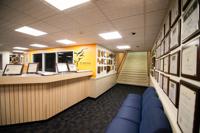
The lobby of the Student Publications department, which houses The Shorthorn newspaper, is located in the lower level of the University Center on April 17 at UTA. The space was once home to the campus bar, the Dry Gulch, which opened in 1978.
He thinks about the generations who studied there, ate there, worked there, fell in love there and helped one another through campus life. He thought about the people who no longer have the chance to tell those stories themselves.
“The old guys are going to die,” Dycus said. “And who’s going to remember these things that I remember because a lot of those folks are no longer here.”
In a few years, students may still gather in the new University Center, heading to dining spaces, meeting rooms, the ballroom or places to sit between classes.
They will not find a windowless newsroom where the day disappears and student journalists work toward the same goal.
They will not learn, as generations before them did, that some of the most important places on campus are somehow the ones almost no one sees.
There will be no stairs to walk down anymore.
@DangHLe