
Houston leaders offer ideas, hope at Lyon Cohen Symposium at Beth Israel
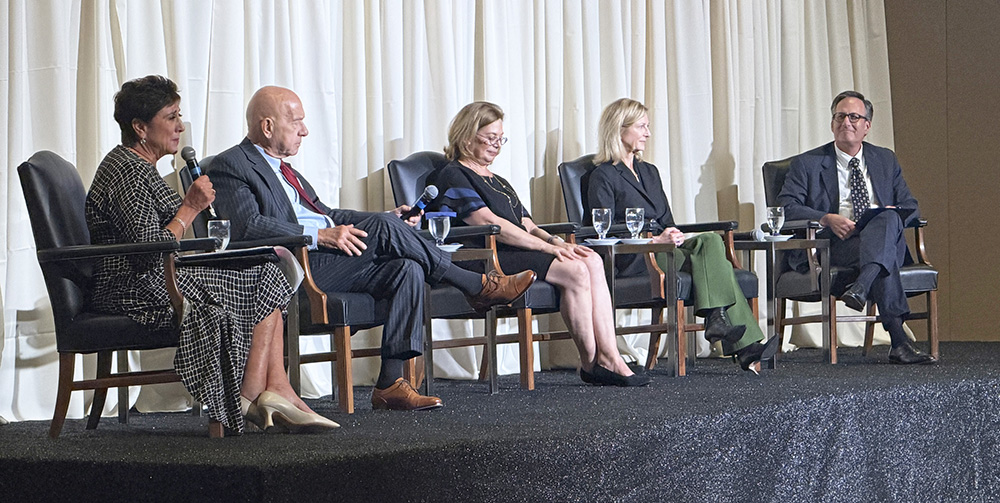
Houston leaders gathered at Congregation Beth Israel for the 2026 Lyon Cohen Symposium to talk and learn about what it means for Houston to be a “healthy” city and what ethical principles should guide the city’s future.
Moderated by former Houston Mayor Pro Tem Ellen Cohen, the panel featured Mayor John Whitmire, Rabbi David Lyon, Elena Marks of Rice University’s Baker Institute and Ann B. Stern of the Houston Endowment.
While each speaker brought their own unique perspective, the discussion consistently returned to shared responsibility, the need for unity in such a diverse city.
Fundamental characteristics of a “healthy city”
Mayor Whitmire proclaimed that health extends beyond medical care. Awareness, education and access are critical factors. He stated that collaboration and a shared goal within communities, small and big, will improve the quality of both personal and community life.
“To care for one another would be the first good practice,” he said.
Stern described a healthy city as a place where everyone can thrive.
Economic opportunity, affordable housing and civic participation should be community practices, and topics at the forefront of City Council meetings. She stressed that when people feel like they belong somewhere, and that they can contribute, communities are then better equipped to deal with changes.
Marks defines a healthy city as one where “everyone has a fair opportunity to achieve a long and healthy life.”
She noted that outcomes are shaped not just by health care but by factors such as food access, safety and civic engagement. She emphasized that creating a healthy city means addressing the obstacles that prevent some residents from accessing the resources needed to live long and healthy lives.
Rabbi Lyon framed the issue through both Jewish values and universal human needs.
A healthy city, he said, must ensure access to food, health, education and economic opportunity.
These are the foundations that allow individuals and communities to grow and flourish. Beyond resources, he emphasized urgency and moral responsibility: Communities must act to ensure dignity and opportunity for all.
Public safety, shared responsibility
When the conversation turned to public safety, Rabbi Lyon highlighted the role of faith in communities and advocating for safer environments. Initiatives like gun-safety programs and community-organizing congregations can help hold institutions accountable.
“We don’t have the funds; we don’t have the policy,” Rabbi Lyon said. “But we have the values to bring to those who do.”
He pointed to efforts opposing environmental hazards, such as when a cement-crushing plant was proposed to be built across from Harris Health’s Lyndon B. Johnson Hospital. The Metropolitan Organization got involved and said it wasn’t good for the neighborhood. This was an example of how moral leadership can influence public outcomes, reinforcing that safety is not only a policy issue but a deeply ethical one.
Homelessness
Homelessness also emerged as a major concern.
Whitmire described it as a huge priority shaped by a multitude of factors. He pointed to the role of the criminal justice system, noting that individuals released without proper support or identification often fall into homelessness. Mental health challenges, he added, further complicate the process of providing assistance.
“It’s a combination of factors, and it’s very complex,” Whitmire said.
He also stated that the city is working to address the issue through a new treatment facility near Daikin Park. Designed to take a holistic approach, the facility will aim to reconnect individuals with family, provide identification and address underlying mental health needs.
Whitmire emphasized that while some solutions are straightforward, others require long-term planning and resources.
“If you don’t acknowledge the problem, you will never fix it,” he said, adding that addressing homelessness is a shared responsibility across communities and levels of government.
Combating antisemitism through dialogue, education
The panel also was asked to address antisemitism.
“We have to find common ground. We have to be less polarized,” Rabbi Lyon said.
He warned against extremism on all sides: “Judaism does not thrive with fanatics on the right or the left.”
Rather than attempting to change radicalized individuals, Rabbi Lyon said that we have to strengthen Jewish identity through education and advocacy.
He also emphasized the importance of interfaith collaboration, alluding to longstanding partnerships among Jewish, Christian and Muslim leaders in Houston.
“We’re all G-d’s creations,” he said. “There’s no reason for me to judge you because you’re a little different.”
Broader ethical vision
As the discussion began to focus on broader measures of success, Rabbi Lyon offered a reflection on how Houston might be evaluated – not by economic output but by human growth.
“We’re small, but not insignificant,” he said. “What evidence is there that we’ve made a difference this day?”
He told the audience to approach each day with intention and accountability. Progress begins at the personal level.
Rabbi Lyon also acknowledged the contrast between the collaborative spirit inside the room and the polar opposite often experienced outside it.
He expressed optimism that communities like Houston can serve as a model for the rest of the country and maybe the world.
“A city like Houston can model this for other places,” he said.
Looking ahead
Throughout the evening, discussion returned to a common theme. The future of Houston depends not only on policy, but on people and everyone’s willingness to listen, engage and take responsibility for one another.
In a city defined by its diversity, the challenge and the opportunity are up to the people to co-exist, have patience and accept one another and to work together.