
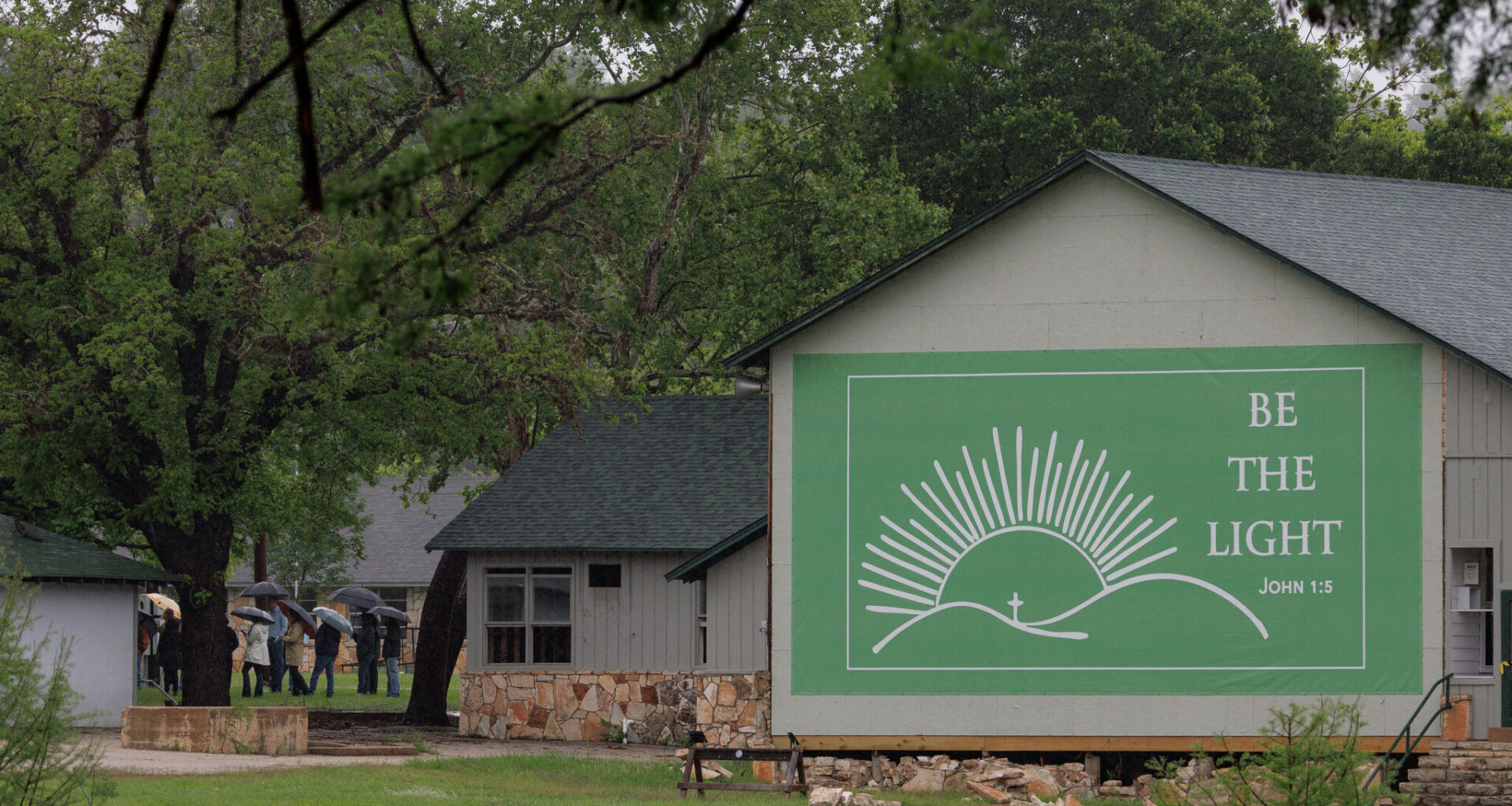
Texas state lawmakers serving on general investigating committees examining the July 2025 flooding walk the grounds of Camp Mystic during a site visit in Hunt, Texas, on Monday, April 20, 2026.
Sam Owens/San Antonio Express-News
Texas state lawmakers serving on general investigating committees walk the grounds of Camp Mystic during an April 20 site visit in Hunt, Texas.
Sam Owens/San Antonio Express-News
Any parent who read the recent guest commentary by Bolton Walters, a Camp Mystic father who nearly lost his daughter in the July 4 Hill Country flood, feels the weight of that night: the terror, the unanswered questions, the enduring grief.
His voice matters. His daughter’s story matters. It is precisely because those stories matter that we must be careful not to let grief harden into conclusions that the evidence does not yet support.
We write as parents of children registered to attend Camp Mystic this summer. We, too, are making a decision that requires trust. But trust cannot be built on a presumption of guilt. It must be built on facts, law and a full accounting of what actually happened — not a narrative rooted in unimaginable pain that provides an incomplete picture of this tragedy.
Article continues below this ad
Walters argues that Texas should not grant Camp Mystic’s license to operate until all investigations are complete. That sounds reasonable — until one examines what the law requires.
Licensing is not a moral referendum. It is a legal determination based on established standards. The state of Texas does not — and cannot — deny a license based on allegations. It must determine whether statutory and regulatory requirements are met. To hold otherwise is to abandon the rule of law in favor of public pressure.
There is no legal doctrine that permits the state to suspend or deny a license indefinitely while investigations continue absent clear, present violations. If Camp Mystic meets the requirements today — staffing, safety protocols, inspections — then the state must say so. If Camp Mystic does not meet the requirements, the state must prove it. That is how the law works.
That is how due process works.
Article continues below this ad
The part of Camp Mystic where the tragedies occurred last summer is not the area where campers would stay this summer. The Guadalupe River site wasn’t going to reopen this summer, even before the judge issued an injunction in March.
In another ruling April 16, Judge Maya Guerra Gamble noted the camp’s operators “potentially violated” a section of the Texas Administrative Code “by failing to maintain a written evacuation plan or provide documented safety training which supports a finding of negligence per se.”
That assertion is serious. It is also, at this stage, subject to debate. Testimony about a missing document is not the same as proof that no plan existed, that staff were untrained or that decisions made in the middle of an unprecedented flood were negligent under the law.
The standard is not perfection. It is reasonableness under extreme conditions. And those conditions matter.
One hundred and nineteen people died across Kerr County in the July 4 flood — not just at one camp, not just in one place and not just under one set of decisions.
Article continues below this ad
Emergency systems failed. Alerts were delayed. First responders were overwhelmed. Entire families, in their own homes, with no custodial duty to others, made life-and-death decisions with incomplete information — and many still died.
That does not absolve anyone. But it does call into question the claim that one group, in one place, making one set of decisions, could have prevented what the broader emergency response system could not.
Hindsight is not the legal standard. The law does not ask what seems obvious after a tragedy. It asks what a reasonable person would have understood in real time, with fragmented information, in darkness, as multiple waterways rose unpredictably.
Indeed, the danger of evacuation was shown by the fact that the camp’s director, Richard “Dick” Eastland, died attempting one. That alone complicates any claim that the correct course of action was clear, safe and obvious. There is a profound difference between a tragic outcome and a legally negligent decision.
O’Kelley and Paul Little are the San Antonio parents of a Camp Mystic camper.
Courtesy O’Kelley and Paul Littl
There is a deeper problem with the argument that the state must finish its investigations before making any licensing decision about Camp Mystic. It signals a costly form of prejudgment. It risks sending a message to operators of summer camps, schools or child care facilities across Texas that, in the wake of a disaster, they may be judged not only by what they knew or did but by what others later believe they should have done.
Article continues below this ad
It replaces standards with speculation. It replaces evidence with narrative.
None of this is to say the families of all 119 who died do not deserve answers. They do. Every parent does.
Answers will certainly not come from preventing the healing that hundreds of other children and families seek by returning to those camp rituals and relationships that they held so dear.
Kerrville resident Randi Webber wrote that we face a choice: to be “destroyed by blame or rebuilt by truth.” Blame is immediate. It is satisfying. It has a target. Truth is slower. It is harder. It requires restraint.
As members of the Mystic family, we have stood with families in grief. We have also witnessed how quickly grief can give rise to accusations before all of the facts are known. Both call for the same discipline: to honor suffering without surrendering judgment.
Article continues below this ad
We believe the state of Texas can do both.
Investigate fully. Demand answers. Examine every decision made that night — from Washington to Austin to Kerr County to the riverbanks themselves.
But do not suspend the rule of law in the meantime.
If Camp Mystic meets the legal requirements for licensure today, it should be allowed to open its Cypress Lake campus. If it does not, it should not. That determination must rest on evidence.
We trust Camp Mystic and the Eastlands. Even in the shadow of tragedy, we remain committed to truth, fairness and the law.
That is the standard we ask the state to uphold.
O’Kelley and Paul Little are the San Antonio parents of a daughter who attended Camp Mystic last year and plans to return this summer.