
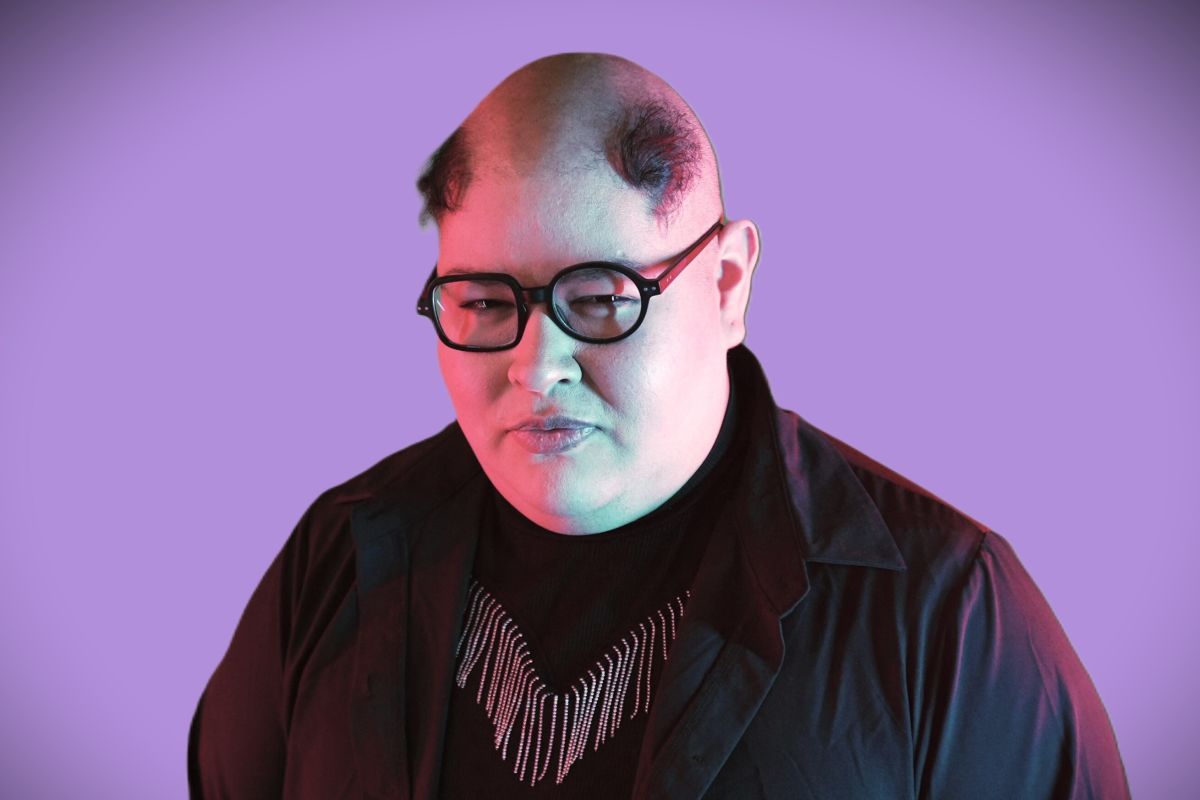
Koomah’s art and activism often intertwine with one another, but they’re still fully immersed in both worlds even outside the overlap.
At this point in their lively, interdisciplinary career, it might be easier to describe what Koomah isn’t. They aren’t apologetic. They aren’t wavering. And they’re certainly never boring.
As a visual artist, performer, zine publisher, writer, filmmaker, nonprofit volunteer, and activist for intersex visibility, dignity, and rights, Koomah carves for themself their own narrative—one devoid of deference to convention and piteousness, sometimes to the point of fetishistic martyrdom in the eyes and hands of self-labeled allies.
“In all honesty, I don’t have a very happy beginning,” Koomah says. They reference this in their autobiographical stage show, The History of a Happy Hermaphrodite, which they bring to venues across the country. “It’s been this ongoing mission to make sure that my life doesn’t end up as the kind of expected tragedy that folks would anticipate.”
Koomah grew up in an adoptive household where they “were very restricted on what we were allowed to watch.” Being intersex—which, in their experience, means “born with anatomy and chromosomes and gonads that are in between what’s considered typical for male or female”—was also considered a shameful secret rather than a straightforward biological reality. They learned to communicate with family and friends through performances of Red Skelton monologues, and began taking visual art more seriously as a means of self-expression in middle school.
“My otherness was always kind of visible to people, and especially with my adoptive family,” they say. “While I was legally supposed to be a binary sex—a binary gender orientation—I’ve always been relatively fluid in that, which led to some issues with family members who were very conservative and religious.”
It took an especially devoted teacher, Michael Zigrang, who challenged Koomah to start focusing on how drawing, painting, and other arts could provide an outlet for everything they needed to say to the world. With parental permission, Zigrang and his wife took the young Koomah to the Blaffer Art Museum and the Museum of Fine Arts, Houston, to explore the works that spoke to them most. Without time for leisurely browsing, the adults started by encouraging the budding artist to stop only when something caught their eye. Such care and attention followed Koomah into high school, where their burgeoning art career began dovetailing with a newfound passion for activism and an exploration of their fluid identities.
In 2003, they were among the students who took part in a successful, ACLU-backed lawsuit against Klein ISD to allow a Gay-Straight Alliance (GSA) on the Klein High School campus. That same year, Koomah participated in the Turned Up Volume film and performance residency at DiverseWorks, which promoted LGBTQIAP+ talent. They would also attend meetings of Hatch Youth—an organization dedicated to creating community among queer and transgender kids and teens—at the notably affirming, inclusive Grace Lutheran Church in Houston’s historic gayborhood, Montrose (Hatch now operates out of the Montrose Center). For years, Koomah’s adoptive family would drive them from their Tomball home to Montrose every Friday. “They thought it was a ‘pray the gay away’ conversion therapy group because it was held at a church,” Koomah says. “[They were] thinking that this was going to make me become a straight, cis, endosex person, which didn’t happen, obviously.”
Koomah formed a friendship with fellow intersex artist and activist Mo Cortez during these weekly fellowship meetings. Due to “shame and stigma” surrounding intersex lives, they weren’t aware of the others’ experiences until years later. The duo formed The Houston Intersex Society (THIS) in 2012 to raise awareness of intersexuality and the political and medical hurdles they routinely face. It was the first organization of its kind in Texas.
“Initially, our organization was founded with the idea that we were going to be a support group. We were going to have these meetings, and people were going to come and talk through their issues,” Koomah says. “What we found was that people did not want to do that…We realized that the need was still for education and awareness.” The team started reaching out to their contacts and began hosting presentations at universities for medical students.
THIS members knit together art and advocacy to combat misinformation, stigma, and shame. Some of their most successful projects include convincing Houston City Hall to become the first government building in the world to light up in commemoration of Intersex Awareness Day in 2015. The organization opened the first-ever intersex community center in the United States in 2023. Zines, such as Cool Intersex People, use photography, literature, and creative design to celebrate notable intersex individuals, including Olympic gold medalist and South African middle-distance runner Caster Semenya, Academy Award winner Linda Hunt, and Jackie Green Blankenship, who was Miss America 2022. These works are available at THIS booths during their appearances at local arts and culture events, such as Zine Fest Houston, and THIS members sometimes display items from its intersex history archives, such as old medical textbooks, movies, and political proclamations.
The world needs such organizations to share both the corpus of scientific literature on gender’s true complexities and allow intersex people to tell their own stories on their own terms, as opposed to being talked over or projected onto by endosex individuals. Intersexuality encompasses a wide range of biological wiring. As with other queer and transgender identities, there is no one conveniently monolithic intersex narrative to point to and say it represents the totality of experiences. As biologist Julia Serano outlines in Whipping Girl: A Transsexual Woman on Sexism and the Scapegoating of Femininity—her 2007 combination memoir and explainer on the science of gender—what constitutes gender transcends the entirely reductive lessons centering chromosomes and genitals that one receives in high school classrooms. Brain structure, hormonal balance, genetics, socialization, anatomy, and other factors also define gender.
Koomah’s rallying for legislation is separate from their work with THIS, though there’s certainly overlap between the two. Along with Cortez, they’ve collaborated with U.S. Rep. Sylvia Garcia (D-Texas), State Rep. Mary González Hernandez (D-El Paso), and others on drafting the first-ever state- and federal-level bills—including, though not limited to, 2017’s SB1342, 2019’s HB 2462 and SB 1383, and all the way through to 2025’s HB 1559. These all seek to block the nonconsensual, often medically unnecessary, genital surgeries performed on intersex children in the state foster care system. Most of the time, these kids undergo more than one procedure to “correct” a non-existent issue. Koomah cites a 2016 study in the Journal of Steroid Biochemistry and Molecular Biology concluding that these surgeries are typically performed at the average age of only 11.2 months: far too young to force a gender.
None of these proposals have passed yet, though Koomah remains proud and optimistic, considering these were the first protective intersex bills actually written by intersex people. Introducing these bills in every session increases visibility for issues that often go overlooked, even within LGBTQIAP+ circles. “I think with the intersex community, because we are kind of an afterthought a lot of times and not recognized, we have been hanging on by our fingertips for so long,” they say. “When you’re hanging on by your fingertips, you don’t go waving your hands around.” At one point, Koomah served a brief stint on late Mayor Sylvester Turner’s LGBTQ Advisory Board—an experience they were grateful for, but ultimately found a poor fit for what they sought to accomplish regarding intersex rights.
Beyond all the legislative work, they still find time to create a variety of artistic works. Koomah has won drag awards with Houston King of Kings and Houston Dyke Divas, and spent six years in the Houston Gendermyn drag king troupe. They’ve also served as the Lord, and later the Marquis, of the performing-arts nonprofit Empire of the Royal Sovereign Imperial Court of the Single Star.
Recently, Koomah appeared in DiverseWorks’s 12 Minutes Max: ESP showcase at DeLUXE Theater. There, they staged a piece in which their dreams served as political prophecies, exploring themes of “resilience and restraint” that recur throughout their oeuvre across media. “I often describe my inspiration process as like that scene from Close Encounters of the Third Kind, where he just has to make a mountain out of his mashed potatoes,” they say. “It feels a lot like a compulsion.”
A friend describes their visual art as “organized chaos,” which offers them an opportunity to speak creatively and abstractly about the same life experiences that inform their activism—efforts that require a much more straightforward, concrete rhetoric. Performances like The History of a Happy Hermaphrodite, for example, include images of the artist “chained to what [they] call ‘a metaphorical Jesus’” in a commentary on adoption and being forced to follow an unfamiliar new religion. Koomah wants to convey a message of how to slough off expectations and “free yourself to find your own thing.”
“You don’t have to be a huge organization to make change. You don’t have to be wealthy. You don’t have to have all of these degrees,” they say. “If this is something you’re passionate about, you can do it.”