
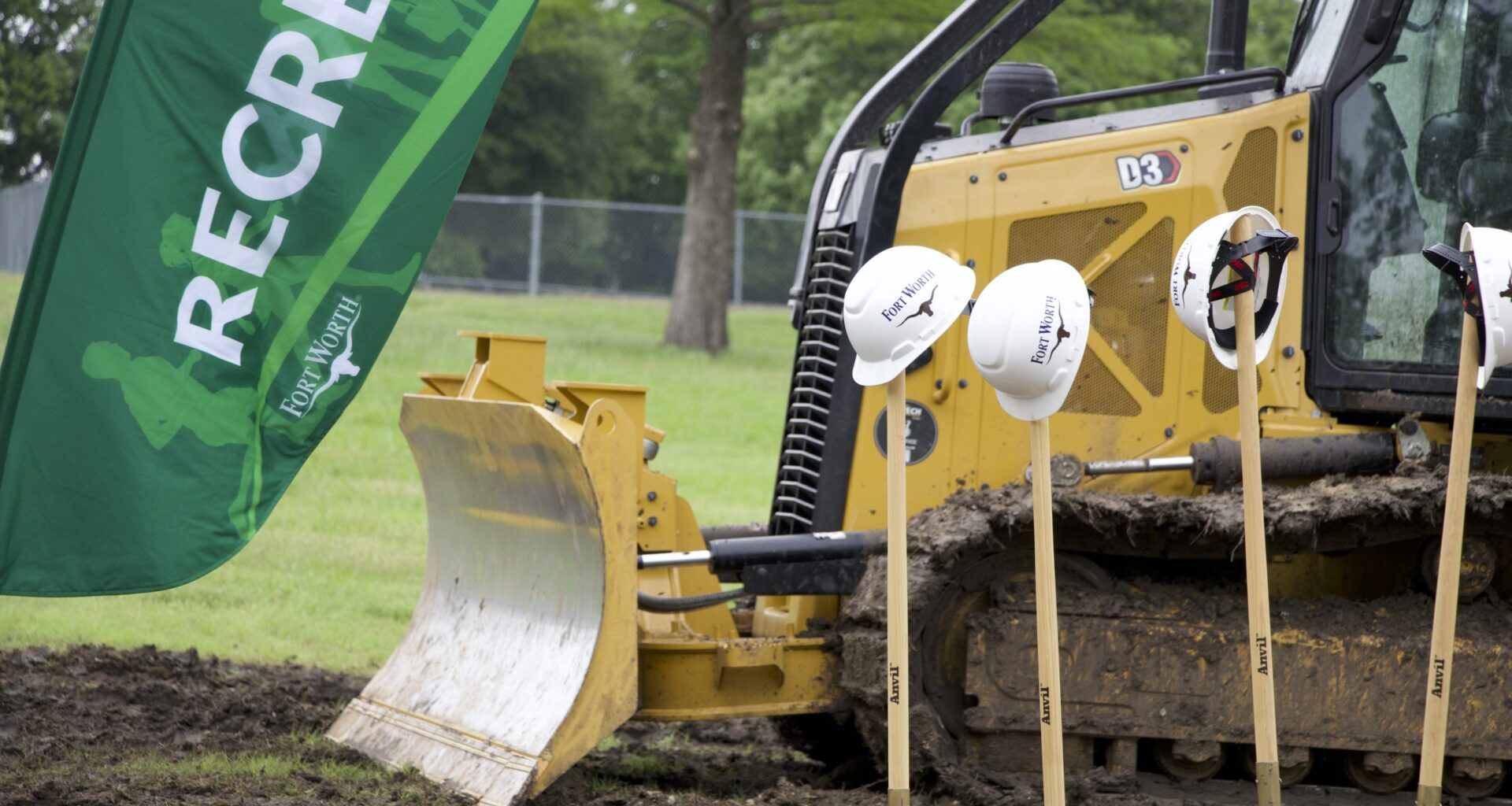
The groundbreaking of the long-awaited Bomber Spur Trail marked a full-circle moment for Fort Worth as Lockheed Martin’s F-35 fighter jets roared over North Z Boaz Park Thursday morning.
“Our history runs deep with both rails and aeronautics. We’re trying to tie all that history,” Mayor Mattie Parker said. “We’re incredibly thankful … to break ground, to celebrate what is phase one and so much more to come.”
Formerly a railroad line, the Bomber Spur was created in the 1940s to transport bombs during World War II from the Air Force Plant 4, also known as “The Bomber Plant” — today’s Lockheed Martin — to the former Carswell Air Force Base, now the Naval Air Station Joint Reserve Base.
The Bomber Spur Trail is a 7-mile biking and pedestrian route that will connect the West and Clear Forks of the Trinity River, creating a 26-mile trail system around west Fort Worth. The goal of the trail is to tie communities to other parts of the city and natural areas, including the Trinity Trails and local parks.
“This project enables new areas to access that priceless, yet free, resource,” said Streams & Valleys vice chair John Stevenson.
 Mayor Mattie Parker was joined by Fort Worth City Council members and staff April 23 for the groundbreaking of the future 7-mile Bomber Spur Trail. (Nicole Lopez | Fort Worth Report)
The trail would also provide another means for the public to access schools and jobs.
The project will be broken up into three phases to allow city officials to acquire adequate funds over time.
Bomber Spur’s first construction phase is a mile-long route stretching from Calmont Avenue to just across U.S. 377. About $7.5 million in federal and local funds are poured into the first leg alone.
The first phase was originally slated for a January groundbreaking, according to previous Report coverage.
Fort Worth officials estimate the initial leg will be completed by January 2027. The second leg of the trail called for just over $6 million in federal and local funding to further stretch the system from U.S. 377 to the intersection of State Highway 183 and West Vickery Boulevard.
Construction on the second phase will begin by April 2027 and wrap up by the same time the following year, according to a presentation from Fort Worth parks officials.
 The Bomber Spur will consist of 7 miles of trails as part of the plan spearheaded by Streams & Valleys to create a 26-mile-long trail loop in west Fort Worth. (Courtesy | Streams & Valleys)
The overall Bomber Spur project will contribute to the western portion of the 2050 Regional Veloweb, a North Texas trail system led by the North Central Texas Council of Governments, the agency responsible for metropolitan planning and allocating funds to local governments.
The veloweb contributes to the agency’s broader long-range transportation plan, Mobility 2050. The regional initiative will consist of more than 9,500 miles of trails and bike paths across 12 counties in Dallas-Fort Worth, with 1,924 of those miles already in place or funded.
Discussions around redeveloping the rails to trails began about 15 years ago, said City Council member Michael Crain, whose district encompasses Bomber Spur’s first leg.
The project required years of planning because of hundreds of parcels of land the city needed to first acquire.
“Soon, we’ll move families, walkers, runners and cyclists, giving Fort Worth new options for recreation, active transportation and safer routes to the places we all want to go,” Crain said. “It will improve neighborhood connectivity and quality of life, support nearby businesses, and help attract new investment while preserving and honoring the history.”
 City Council member Michael Crain attended the April 23 groundbreaking of the Bomber Spur Trail, whose district encompasses the project. (Nicole Lopez | Fort Worth Report)
He applauded partnering and organizations and city officials for the current progress on the trail.
“Projects like this do not happen on their own,” Crain said.
Connecting green spaces, parks, natural areas and trails has been a focus at the city since adopting the updated parks, recreation and open space master plan, GREENprint.
The document acts as a blueprint for how the city will acquire and preserve more open space, identify which areas lack in parks and how to implement trails and green spaces for more connectivity throughout Fort Worth.
“This is a project that is really important to our connectivity to the city, through the trails,” park and recreation director Dave Lewis said. “This is a long time coming.”
 Park and recreation director Dave Lewis joined Fort Worth officials April 23 at North Z Boaz Park to commemorate the groundbreaking of the Bomber Spur Trail. (Nicole Lopez | Fort Worth Report)
This <a target=”_blank” href=”https://fortworthreport.org/2026/04/23/long-awaited-rails-to-trails-bomber-spur-breaks-ground-in-west-fort-worth/”>article</a> first appeared on <a target=”_blank” href=”https://fortworthreport.org”>Fort Worth Report</a> and is republished here under a <a target=”_blank” href=”https://creativecommons.org/licenses/by-nd/4.0/”>Creative Commons Attribution-NoDerivatives 4.0 International License</a>.<img src=”https://i0.wp.com/fortworthreport.org/wp-content/uploads/2021/04/cropped-favicon.png?resize=150%2C150&quality=80&ssl=1″ style=”width:1em;height:1em;margin-left:10px;”>
<img id=”republication-tracker-tool-source” src=”https://fortworthreport.org/?republication-pixel=true&post=505926&ga4=2820184429″ style=”width:1px;height:1px;”><script> PARSELY = { autotrack: false, onload: function() { PARSELY.beacon.trackPageView({ url: “https://fortworthreport.org/2026/04/23/long-awaited-rails-to-trails-bomber-spur-breaks-ground-in-west-fort-worth/”, urlref: window.location.href }); } } </script> <script id=”parsely-cfg” src=”//cdn.parsely.com/keys/fortworthreport.org/p.js”></script>