
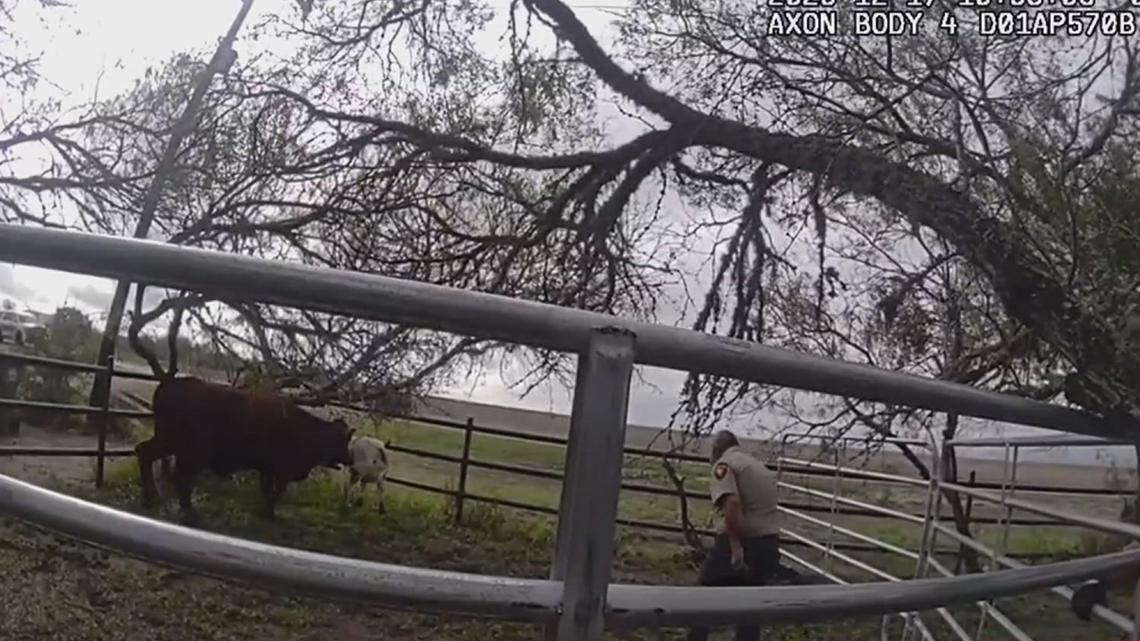
CORPUS CHRISTI, Texas — Loose livestock on South Texas roads is more than an inconvenience, it’s a growing safety risk that can turn dangerous in seconds.
Now, the Nueces County Sheriff’s Office is launching a new program designed to solve one of the biggest challenges deputies face: identifying who the animals belong to.
Deputies say calls involving loose livestock are common, especially in rural parts of the county. But the real issue often begins after the animal is found.
“Currently, if we go out there and we find an animal and we’re not able to secure it or find the owner for it, what we have to do is call our farmers to come out there and what they do is they impound the livestock,” said Sgt. Rudy Gonzáles.
That process takes time and on busy highways, time is something drivers don’t have.
In one recent case, deputies had to lure in a loose pig nicknamed “Honeybun” using a honeybun snack before they could safely remove it from the roadway.
The new Livestock Owner Identification and Contact Program aims to streamline those situations.
The concept is straightforward: create a database of livestock owners that includes contact information, property locations and even photos of animals. Deputies can then quickly reach out to owners instead of starting from scratch during an emergency.
Residents can register through the sheriff’s office online portal by submitting their information and optional photos of their livestock. Deputies will then follow up to verify details.
The program is modeled after a similar system already in place at the Jim Wells County Sheriff’s Office, where officials say it has proven effective.
“We started this program in 2017 … and it took off from there,” said Lt. Jonathan Garcia. “We have over 400 placards out at different ranches.”
Those placards help deputies quickly identify properties and livestock owners, cutting down response times and improving safety for both drivers and animals.
Nueces County officials say they hope to build a comparable network, one that keeps roads safer and reduces the need for livestock to be impounded.
Because in South Texas, a loose animal isn’t just someone’s property, it can be a hazard hiding in plain sight.