
The Richardson ISD board of trustees considered options to increase compensation district-wide, as well as revenue opportunities to reduce the district’s budget deficit, at the April 23 school board meeting.
Board members said pay raises are a “top priority” as the district prepares its budget for fiscal year 2026-27. This comes after district staff announced recommendations for budget cuts on April 2 that included eliminating roughly 95 full-time positions.
The big picture
RISD is facing declining enrollment at the same time that district budgets are becoming increasingly determined by student numbers, said David Pate, assistant superintendent of finance and support services.
Not including staff raises, Pate estimated that the district could see up to $1 million in expenditure increases in FY 2026-27. Even with the $25.7 million in efficiencies that the district found through the budget cuts, Pate said RISD is still facing a deficit of over $21 million in next year’s budget, which is only expected to grow over the next several years.
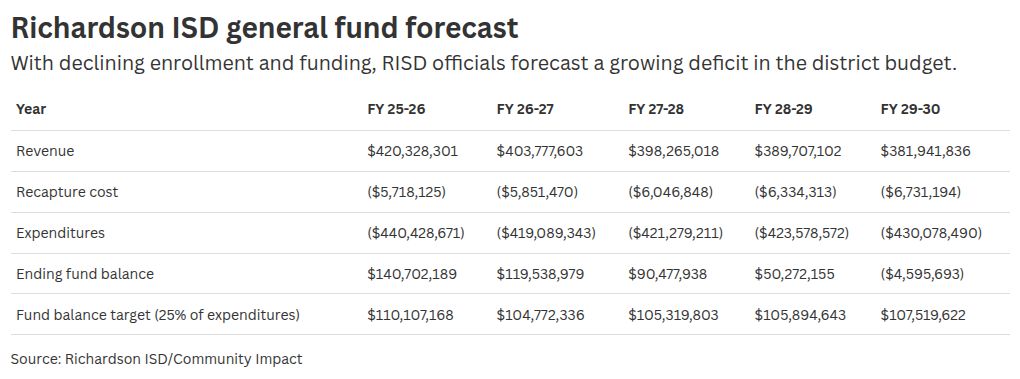
“We hit an exponential cliff in [FY] 27-28,” board president Chris Poteet said. “I mean, how many cuts can we make to make up $100 million in the next two or three years?”
Breaking it down
Chris Goodson, assistant superintendent of human resources, presented the board with several options for district-wide pay increases for teachers, librarians, counselors, nurses, central staff and paraprofessionals.
The raise proposals ranged from $1,000-$3,000 for teachers and from 2%-3% for central staff and paraprofessionals, with differences based on experience and certification. The total cost to the district ranged between $8.3 million and $10.8 million.
Roughly 90% of the district’s budget is compensation, Pate said, in order to provide the resources to achieve the district’s “north star” goal for student and teacher success.
“If we’re really going to be committed to that north star goal, then we have to really be sure we take care of our teachers,” trustee Megan Timme said. “With the outcomes that we desire, I do think this is a situation where you get what you pay for.”
RISD has seen improved teacher retention after several years of investments in teacher compensation and benefits.
Timme also highlighted the importance of central office raises as well in light of the 38 full-time central office positions that are set to be eliminated in the budget cuts.
“It’s not like the work’s getting less. We’re going to continue to shift more work on fewer people,” Timme said.
The options
District staff also presented several options for the district to access more funds and increase revenue.
“We’ve got to pull every lever that we have,” Poteet said. “We’ve got to find the change in the cushion of the couch.”
RISD has $27.2 million set aside in a permanent school fund, which Superintendent Tabitha Branum referred to at a previous meeting as a “rainy day” fund. Pate said investing some of this money in compensation could give the district more time to find further efficiencies with less impact on the general fund balance.
Pate said a potential rate increase for the district’s after school xPlore programs could also generate about a $700,000 revenue increase, as well as fund raises for program staff.
An additional option on the table is a Voter-Approval Tax Rate Election, where voters could approve a 3.17-cent increase to the maintenance and operations tax rate. Pate said this could provide a $7.7 million increase in revenue next year.
Pate said RISD has 3.17 cents available for increase because voters approved a 13-cent increase in 2018 that was then reduced by 3.17 cents following state legislative action that compressed property tax rates.
The district may not have the option to hold a VATRE after this November election, Pate said, because the state legislature could restrict districts’ ability to increase tax rates in the upcoming 2027 legislative session.
“This is really the last window of time where we have certainty that is an option,” Branum said.
Put in perspective
Branum said the district has been working to find efficiencies in the budget for several years, reducing expenditures by almost $42 million in three years.
“We have not taken this lightly. We have not put our head in the sand and pretended like we’re not in this current financial situation,” Branum said. “Every year we have continued to find as many efficiencies [and] keep them as far away from the classroom as possible, because we feel that urgency.”
But with continued funding reductions and new standards introduced by the state legislature, Branum said the amount needed to right size the budget is a “moving target.”
“And as long as we’re losing enrollment, it’s like catching a falling knife,” Poteet said.
In light of the growing deficit, Poteet said the district is “splitting hairs” on debating compensation plans with minimal cost difference.
“We don’t know what’s going to happen with this next legislative session,” board member Debbie Rentería said. “At the same time, [we’re] trying to do what we’re supposed to do and provide and keep those teachers.”
What’s next
District staff are set to share their proposed pay raise model in the first May meeting.