
The distinctive, often enchanting, blue pigment that one finds in ancient Maya architectural embellishment, murals, codices, sculpture, and other cultural artifacts, notes Kristopher Driggers, Associate Curator of Latin American Art at the San Antonio Museum of Art, was “difficult to make and source,” adding to the factors that made the color “more rare, marvelous, and saturated with meaning.”
Maya Blue: Ancient Color, New Visions, currently on view at the museum, explores the pigment’s use in eight earthenware artworks and one stucco piece, all created some 550 to 1,500 years ago. Five modernist and contemporary works in the exhibition reveal what its curator Driggers describes as the “enduring resonances” of “Indigenous knowledge and innovations.”
The exhibition’s compactness only amplifies its impact as one finds an unhurried occasion for intimate face time with the visages and accoutrements of such Maya entities as Rattle in the Form of a Female Figure and Male Figure with Headdress.
 “Whistle Figurine of a Seated Dwarf,” Mexico, A.D. 600–800, earthenware, 7 × 4 1/2 × 3 inches. San Antonio Museum of Art, gift of John and Kathi Oppenheimer, 2023.7.78
Whistle Figurine of a Seated Dwarf, museum signage informs, may have come from the Mexican state of Campeche in the Yucatán Peninsula. Three rosettes on the figurine’s turban show traces of Maya blue. Applications of the pigment that have become fragmented over time have done so due to the slow erosion of the limestone, earthenware, or other support surface. Indeed, Maya blue is a uniquely stable pigment that doesn’t fade or degrade despite centuries of exposure in a harsh tropical environment; it also resists acids and alkalines. Some believe that such turbaned figures as the little person shown here were scribes, “specialists in written knowledge and divinatory reckoning.”
 “Effigy Censer,” probable Belize, Guatemala, or Mexico, A.D. 1300–1450, earthenware, 15 1/2 × 8 1/2 × 6 1/2 inches. San Antonio Museum of Art, gift of John and Kathi Oppenheimer, 2023.7.1
Remnants of Maya blue pigment can also be seen on Effigy Censer, a figurine whose ear flares were once covered with the color. The pigment was applied in stripes on the personage’s headdress. The censer figure may, scholars believe, evoke the blessings of a bountiful harvest, as “the accordion-folded ornaments on his headdress are often worn by deities of rain and flowing water in several Mesoamerican traditions.” Anthropologist and longtime Maya blue researcher Dean E. Arnold observes in his 2024 book, Maya Blue: Unlocking the Mysteries of an Ancient Pigment, that the pigment was often ritually produced “as an offering to the rain god Chaak,” according the pigment a “sacred status.” The two long fangs of the Effigy Censer suggest a supernatural being.
 “Seated Female Figure,” Mexico, A.D. 600–900, earthenware, 8 1/4 × 4 × 3 3/8 inches. San Antonio Museum of Art, gift of John and Kathi Oppenheimer, 2023.7.74
Whistle in the Form of a Woman with Child and Seated Female Figure both feature remnants of the blue pigment on the figures’ skirts. The facial stippling and the forehead ornament of the woman with child are said to be Maya ideals of beauty. Figurines such as the seated figure were often interred in burial tombs.
 “Head of a Priest,” Mexico, ca. A.D. 600–900, jade, 2 3/8 x 1 3/4 inches. San Antonio Museum of Art, The D. Joseph Judge, M.D. Collection donated by the Judge Family, 2002.24.4
Maya Blue: Ancient Color, New Visions also includes four greenstone, or jade, pieces depicting male figures with elaborate headdresses. One is identified as the head of a priest. The word for jade in Maya hieroglyphics is yax tun, which means blue-green stone. While the shades of Maya blue that are probably most often associated with the term range from a brilliant turquoise to a sumptuous azure, Arnold notes that it can also be green or bluish-green.
The pigment was first “discovered” at the Maya archeological site of Chichén Itzá by chemist H. E. Merwin in 1931. In time, it was given the name Maya blue and found to be a mixture of indigo and a special clay called palygorskite, sometimes with copal incense (from tree sap) added to the mix. “Unlike other ancient pigments,” writes Arnold, “Maya Blue is not organic or inorganic….Rather, [it] consists of both an organic component [indigo] and an inorganic component [palygorskite] combined into a single hybrid material…. Now considered the first ever nanostructured artificial organic-inorganic hybrid material, its exceptional stability has inspired much research for designing new such materials. It is one of the world’s most unusual pigments.”
 Clarissa Tossin, “Ch’u Mayaa” (still), 2017, HD single-channel digital video, color, stereo sound, 17:56 minutes. Smith College Museum of Art, SC 2018.60.
While musing upon the mien of the Maya figures, museum visitors are soothed and stirred by the flute and storm sounds of the soundtrack for Clarissa Tossin’s 2017 video, Ch’u Mayaa, which plays in a nearly 18-minute loop on the museum wall. Filmed in Los Angeles at Frank Lloyd Wright’s 1921 Mayan Revival style Hollyhock House, the work’s purpose, Tossin stated in a 2019 Radcliffe Institute lecture, was to reappropriate the building “as a temple, imbuing it with a dance performance based on gestures and postures found in ancient Mayan pottery and murals.” In this way, the artist continued, the home, now owned by the City of Los Angeles, could be “resignified as belonging to the Pre-Columbian, Mesoamerican architectural lineage.” Ch’u Mayaa, Tossin added, “means ‘Maya Blue’ in K’iche’, one of the Mayan languages spoken in L.A. today.”
Choreographer and performer Crystal Sepúlveda engages with the Mayan Revival residence, wearing a leopard print unitard, turquoise sneakers, and, at times, a diaphanous shift colored for the sun and a Maya blue sky. Her features mirror many of the countenances seen in the ancient artworks on display. As Tossin noted, the dancer moves like a Maya figure come to life. At one point in the video, her hands and arms dance an inadvertent duet with a dart-stop, dart-stop lizard moving across the architectural exterior. In another, as she retreats backwards into a portal, the vanishing blue of her shift echoes the fragmented blue of the garments worn by the ancient figurines. Ch’u Mayaa is captivating.
Sandy Rodriguez‘s 2019 hand-processed watercolor on Amate paper, Healer No. 1: Treatment for romadizo, a viral infection of the upper respiratory, speaks to Maya blue’s medicinal traditions. Dean E. Arnold writes that both palygorskite and indigo “had a variety of healing properties,” as did copal resin. Rodriguez’s watercolor depicts the contemporary application of dew drops, which, exhibition signage details, “was used in mixtures for curing respiratory illness in newborns.” Rodriguez, who created the Maya blue pigment for the dew drops herself, found the healing method in the Florentine Codex. The Amate paper utilized in the painting is made in Puebla from barks and spices by multigenerational Otomi families. After the arrival of conquistadors, production of the paper had been outlawed.
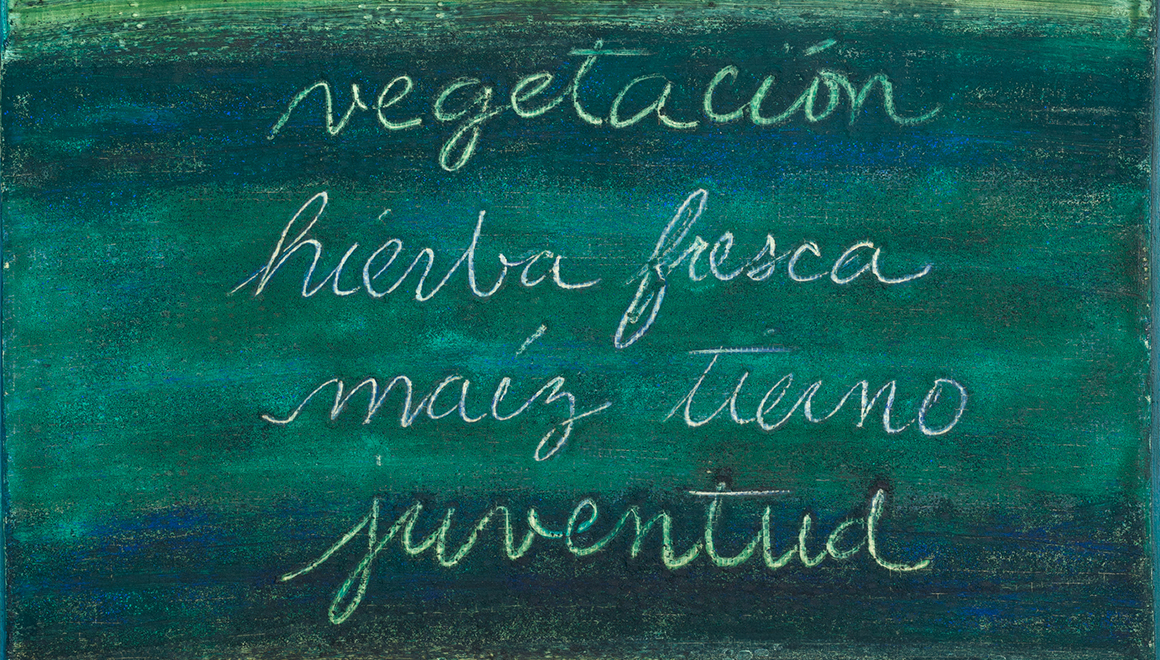
 Rolando Briseño, “Verdeazul,” 1998, oil and pigment
Rolando Briseño underscores the agricultural dimension in the exhibition’s subtheme of yax tun with an oil and pigment piece on a prepared dish towel entitled Verdeazul, which means blue-green. Incised on a field of raw, powdered blue and green, not yet fully processed, are the Spanish words for water, vegetation, fresh herbs, sweet corn, youth, abundance, and food. The San Antonio-based artist often probes colonialism’s continuing manifestations through gastronomic cultural exchange. Verdeazul conveys a sense of cool refreshment, effervescence, a dazzling flag in a blue parade. It conveys Maya blue.
Maya Blue: Ancient Color, New Visions is on view at the San Antonio Museum of Art through May 10, 2026.
Author’s note: Clarissa Tossin speaks about and shows excerpts from Ch’u Mayaa at the 25 minute mark in this lecture.