
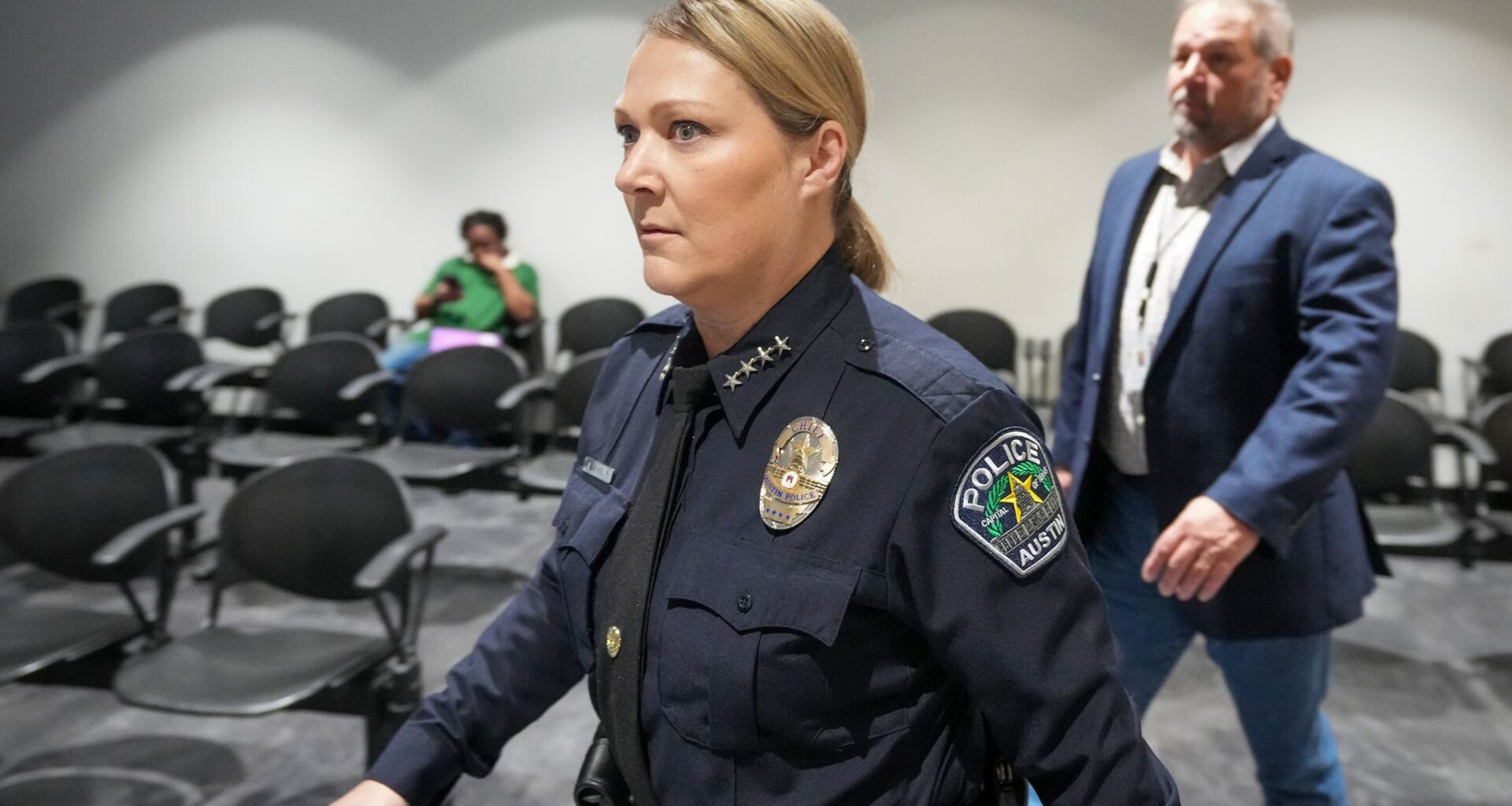
Austin Police Chief Lisa Davis arrives at the Blackwell-Thurman Criminal Justice Center in Austin on Feb. 19, 2026.
Jay Janner/Austin American-Statesman
The city of Austin and Gov. Greg Abbott late Friday reached a deal to end a political standoff that threatened millions in state funding over how police handle federal administrative immigration warrants.

Through a compromise after multiple meetings with Abbott’s top staff, the city agreed to modify a policy Police Chief Lisa Davis enacted last month that preserves flexibility in how and when police must contact U.S. Immigration and Customs Enforcement when they identify a person wanted only for being in the country illegally.
Article continues below this ad
Jay Janner/Austin American-Statesman
Austin Mayor Kirk Watson
Aaron E. Martinez/Austin American-Statesman
The most substantive revision involving administrative, noncriminal warrants involves a one-word alteration: Rather than saying officers “may” call ICE in such instances, the updated policy says they “should, when operationally feasible.”
The amended policy, which takes effect immediately, provides other caveats. It says officers do not have to make more than a single attempt to contact ICE and instructs that they should not prolong a lawful detention to contact ICE. It adds that if ICE asks them to continue holding a person, officers and supervisors must evaluate how long it will take for federal agents to respond and the urgency of the request, including whether the person is considered dangerous.
“Officers shall not take an unreasonable amount of time in assisting in these matters,” the new policy says, adding that an on-duty watch commander will determine a reasonable amount of time based on factors including whether the person is known to be dangerous.
Article continues below this ad
The policy further states that if officers are unable to contact ICE at a scene, they must do so “as soon as possible.”
Austin Mayor Kirk Watson at an Austin Police Department press conference in March.
Sara Diggins/Austin American-Statesman
“The city and state have come to an agreement that the Chief believes is practical for our day-to-day policing, will not create undue harm for residents who are the subject of noncriminal, administrative warrants, and preserves important public safety funding,” Austin Mayor Kirk Watson said. “The newly amended General Orders take into account the practicality and reality of policing in Austin while also satisfying some of the concerns raised by the Governor’s office.”
Article continues below this ad
“We were able to get to a point that I certainly felt comfortable that officers have flexibility in the field to make decisions they need to make,” Davis said.
In a statement, Abbott’s office said the governor “has been clear: cities in Texas must fully comply with state law and cooperate with federal immigration authorities to keep dangerous criminals off our streets. The Austin Police Department has updated its policies to ensure its personnel will cooperate with [the Department of Homeland Security]. The funding hold is now lifted, and the Governor expects full contract compliance moving forward.”
Schuyler Cottrell yells a question at Police Chief Lisa Davis during a town hall to address community concerns about Austin police officers cooperating with federal immigration agents at Govalle Elementary School in Austin on Feb. 5, 2026.
Mikala Compton/Austin American-Statesman
Davis first revised the police department’s policy around ICE interactions in March, following public backlash to the way Austin officers responded to a domestic disturbance 911 call in January.
Article continues below this ad
Officers discovered the mother who placed the 911 call had an ICE administrative warrant out for her arrest and contacted the federal agency to detain her. The woman was later deported along with her child.
The March policy revision prohibited officers from arresting or detaining someone solely on the basis of an administrative warrant. If an officer encountered an administrative warrant, the policy instructed them to call a supervisor to seek permission before contacting ICE to apprehend the person.
Austin is one of several major Texas cities that have faced similar threats that could cost them millions in state grants for key services unless they altered policies centered on cooperation with ICE.
In Houston, Abbott’s office threatened to revoke $114 million in state grant funding if city officials did not change an ordinance the Houston City Council passed earlier this month that instructed officers to wait no more than 30 minutes before releasing a person and returning to their normal duties.
Article continues below this ad
Houston City Council members voted Wednesday to amend the ordinance to say officers should wait “as long as reasonably necessary to complete the legitimate purpose of the initial stop or investigation,” which the Houston Chronicle reports is the guidance Houston officers received prior to the City Council passing its ordinance earlier this month.
Abbott’s office targeted $32 million in state grant funding in Dallas. The Dallas Morning News reported Thursday that the Dallas Police Department revised guidance to its officers, allowing them to assist ICE agents in immigration operations, ask a detained or arrested person about their immigration status and share that information with ICE.
Texas Governor Greg Abbott, left, speaks to Austin Mayor Kirk Watson, right, after a press conference at Austin-Bergstrom International Airport on Dec. 12, 2025.
Aaron E. Martinez/Austin American-Statesman
Over the past week, Austin officials and Abbott’s staff have been in constant communication, sharing drafts of proposed language over the phone, via email and in multiple in-person meetings.
Article continues below this ad
During the discussions, Austin leaders said they became concerned the city could stand to lose more than the $2.5 million in grant funding Abbott’s office initially threatened to revoke.
Davis said Wednesday the city could lose up to $20 million in state grant funding in the coming years — at a time when the city’s financial staff is projecting a growing budget deficit that will require deep spending cuts.
Davis also said the frequency with which officers encounter such instances is low — only 1 in 8,500 calls for service involves immigration issues.
Council Member Chito Vela, a former immigration attorney who represents one of Austin’s most heavily immigrant districts, said the new policy closely resembles the police department’s March policy and is as far as the local policymakers can go under state law.
Article continues below this ad
“In Texas, I cannot adopt the immigration policy I would like to,” Vela said. “But this new language still maintains officer discretion on when to call ICE. It will allow us to preserve our public safety resources because the Austin Police Department should not be spending time enforcing civil immigration laws.”
In a joint statement, Council members Mike Siegel, Vanessa Fuentes, José Velásquez and Zo Qadri sharply criticized the new policy, saying it will make Austin less safe.
“Complying with Abbott’s demands does not make Austin safer,” the council members said. “It overburdens scarce police resources, pulls officers away from violent crimes, and turns local law enforcement into a tool for federal immigration enforcement.”
Article continues below this ad
The members said Davis and other city leaders secured a better deal than what Abbott initially offered, but that they would “explore all options” available to “reverse this disheartening decision.”