
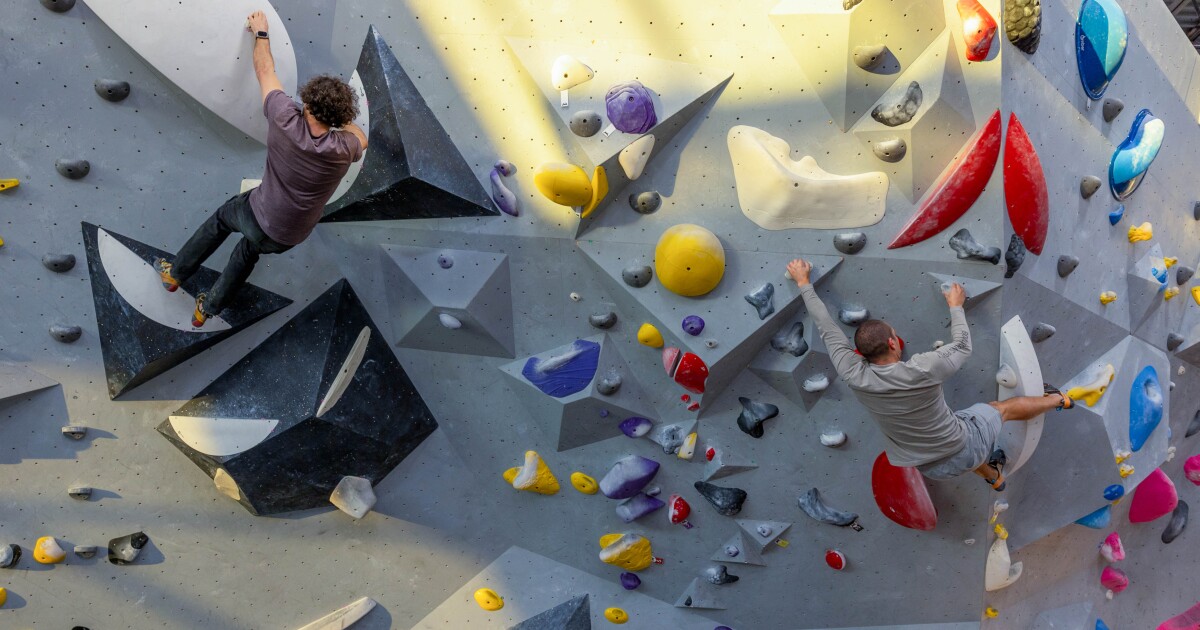
In a world where people primarily find social lives online, there is a growing need for spaces where people can gather.
“People are craving community,” said Grace Nicholas, chief operating officer of Crux, a locally owned climbing gym in Austin. “They’re like, ‘How can I find this without going to a bar and drinking?’”
Nicholas has been climbing for more than 15 years and was first introduced to the sport in high school. Since she first got on a wall, nearly half a dozen climbing gyms have opened across Austin. It has also become an Olympic sport.
“ Climbing has been around for decades,” she said. “Then, once it became an Olympic sport, I think it really cemented that this isn’t a sport that’s gonna fade off.”
Now, Nicholas said, a lot of people have either heard about the sport or have been curious to try it out themselves.
Maybe you’ve come across videos on your social media feed or have seen climbing in documentaries like Free Solo or The Alpinist. You may have even watched some climbing at the 2020 and 2024 Olympics.
One thing people of all levels can agree on: It’s a full workout for the body and the mind.
“You’re trying to figure out the puzzle,” Nicholas said. “You just get that little rush, and it’s kind of addicting.”
Whether you’ve never heard of the sport or are looking for a new spot to try, here’s a guide on where to find indoor and outdoor climbing in and around Austin.
Russell Crawford
/
KUT News
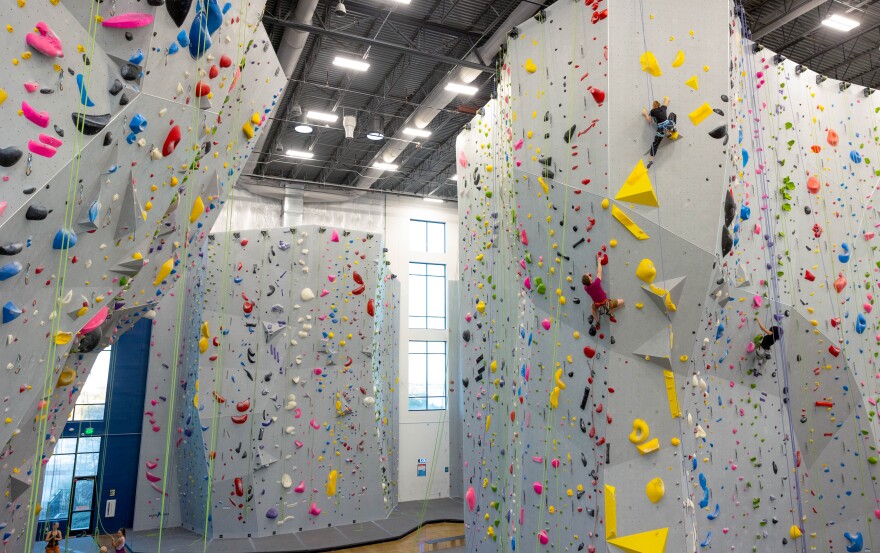
Top rope and lead climbing walls at Mesa Rim. The gym’s tallest walls reach 55 feet.
Indoor rock climbing
“Climbing gyms have had a profound impact on the sport of rock climbing and have made rock climbing so accessible,” said Alyx Olander, an employee at Mesa Rim climbing gym. “So many more people [can] experience climbing, even if it’s just for a birthday party or a first date or from a Groupon.”
She says indoor climbing started as a way for people to get better at outdoor climbing, but now it’s a sport of its own.
One of the main ways indoor climbing differs from outdoor is gyms will swap out the rock paths, or “problems,” on the wall every few weeks. This is what Olander does in their work as a route setter and has been doing it for 11 years. They said it’s a creative process, and they draw a lot of inspiration from what they climb outdoors.
“It’s like working as a chef in a kitchen,” Olander said. “But for us, every day, the food we’re trying to make is different than the day before.”
The best climber is one that’s excited to climb, Olander said, and one of the least intimidating ways to start your climbing journey is in a gym.
Climbing gyms have large padded floors underneath walls and are generally more friendly to first-timers. You can also rent the necessary equipment to get on a wall, including shoes, chalk and a belay device.
There are three main types of indoor climbing:
Bouldering: Climbing without ropes or harnessesTop-roping: Climbing with a rope that has an anchor set up at the top of the wall, requires a partnerLead: Climbing with a rope and feeding it along anchors as you go up the wall, requires a partnerAuto-belay: Climbing with a rope that can be done without a partner
Most climbing gyms charge for a day pass, so climbers can stay as long as they want and use all the amenities. If you have a friend who has a membership at a climbing gym, feel free to bug them for their guest passes — they probably have some up for grabs at the beginning of each month.
Austin Bouldering Project
Climbing types available: Bouldering
Day pass: $18 to $25
Adult monthly membership: $85 to $95
Bouldering Project has locations all across the country and has two gym locations in Austin at Springdale and Westgate. ABP is a bouldering-only gym, which means there are lots of soft floors and the walls are between 13 and 15 feet tall on average.
The routes at ABP have difficulty levels labeled by color. This can make it easier to spot a route’s difficulty level from afar, but it also means certain types of rocks, or “holds,” will be reserved only for higher levels.
If a cluster of blue pockets has caught your eye, you probably won’t use those holds until you can climb at higher levels. But you can always give more difficult climbs a try and can be pleasantly surprised by how far you get.
That being said, each ABP color spans about three grades, so if you’re going color by color, you may end up climbing more difficult routes than you’d expect.
Crux Climbing Center
Climbing types available: Bouldering, top rope, lead and auto-belay
Day pass: $12 to $26
Adult monthly membership: $69 to $95
Crux has two locations in Austin. The Central Austin location has bouldering, and the Pflugerville location has bouldering, top rope, lead and some auto-belays. The South Austin location is set to open soon at 220 Ralph Ablanedo Drive. A location in Houston’s Second Ward is also in the works and expected to open later this year.
The difficulty levels at the climbing gym are categorized by a small picture of an animal on each route. This means climbers can’t judge a route by its “grade,” or difficulty, and have to get up close to check the level.
The Pflugerville location has 58-foot climbing walls, top ropes, a lead climbing roof and several auto-belays.
A membership at Crux grants you access to all locations.
Mesa Rim
Climbing types available: Bouldering, top rope and lead
Day pass: $22 to $29
Adult monthly membership: $79 to $99
Mesa Rim is known for its extensive ropes section and has one location in Austin where you can find all types of climbing. If you want to check out the walls before going, there’s a virtual tour available.
The problems, like at Crux, have colored markers on each one. The tallest walls in the top rope and lead climbing section reach 55 feet, but there are smaller, more beginner-friendly walls that start at 30 feet and some slabs at 45 feet.
UT Gregory Gym
Climbing types available: Bouldering; top rope and lead are offered during class times
Day pass: $10
Monthly membership: $20
The University of Texas at Austin has its own rock climbing wall inside Gregory Gym that has 2,600 square feet of climbing space.
Unlike the rest of the gym, a membership to the climbing section is not free for students, but they can check it out for free. UT students and RecSports members can get one complimentary day pass per academic year.
The gym also offers climbing classes, for those who want to learn or sharpen their skills, and free rental shoes and chalk for those with a climbing pass.
The gym has limited hours with times varying by day of week and semester, with more times available in the afternoon during the fall and spring.
The smaller gym means there’s a pretty close-knit community of student climbers of all skill levels.
Russell Crawford
/
KUT News
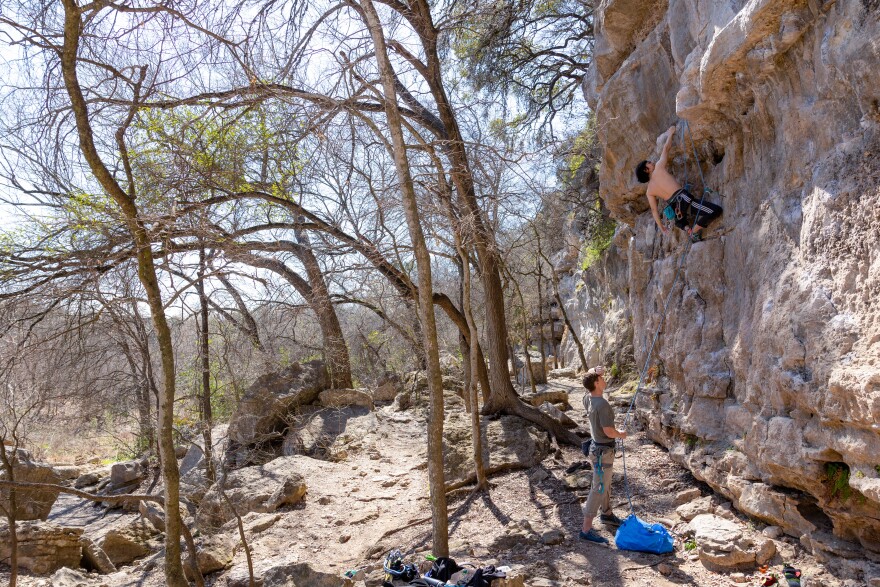
Tim Ramsay, left, watches as David Yang climbs a route named Trash Can Man on the Gus Fruh wall at the Barton Creek Greenbelt.
Outdoor climbing
Sometimes it’s nice to get out of the chalk-filled air of the climbing gym and out into nature.
“ It’s a very meditative practice,” Alex Wang said. “It’s nice to have those days alone, where it’s just you and either a piece of rock or wall and your partner.”
Wang has been climbing for about eight years and started learning how to boulder at Austin Bouldering Project. From there, he started going outdoors and picked up tips from climbers he would run into.
“ Maybe 80% of my friends are climbers,” Wang said. “ On the weekends, sometimes if the weather’s really good on the weekdays after work, we’ll just go out and climb outside. We’ll go to Gus Fruh, we’ll do a lot of bouldering there, or McKinney Falls.”
While it may seem a little more intimidating than a gym, there are plenty of beginner-friendly outdoor spots. The Mountain Project is a great tool for finding specific routes and their difficulty levels.
These outdoor places are not businesses with rental shoes at the ready, so climbers will often rent protective pads from local gyms or from REI to place under boulders. You can also make the investment and buy your own.
Instead of top-rope and lead climbing, you’ll find “sport” and “trad” climbing outdoors. Sport climbing includes placing clips into pre-placed bolts in the wall, like top rope and lead climbing in the gym. Trad, or traditional, climbing can be even more difficult. It involves placing your own anchors along a wall.
Outdoor climbing can be dangerous, so don’t go alone. Make sure to always bring belay buddies or someone to help adjust your crash pads if you’re bouldering.
It’s important for outdoor climbers to treat the outdoors with care and make sure to leave no trace while spending the day at local parks. That means not leaving any trash or pet waste behind and cleaning up any spilled chalk.
Weather can also impact outdoor bouldering. Summers can be brutal if you’re climbing in a place without shade, but Wang said winters can be even trickier with your hands getting numb from the cold.
“ Some people have electric hand warmers or chalk bags that have a built-in hand warmer,” he said. “Wear layers that are easy to take off.”
He said the ideal temperature for outdoor climbing is anywhere between 40 and 60 degrees.
Barton Creek Greenbelt
About eight minutes from downtown, the Barton Creek Greenbelt is the closest and most popular spot for outdoor climbing in the Austin area. Some favorite spots are Seismic Wall, Gus Fruh and Bull Creek. There are hundreds of routes along the greenbelt for bouldering, sport, top rope and some trad climbing.
The area is easily accessible, with parking options along the Greenbelt. There are also lots of beginner-friendly routes for climbers looking to try outdoor climbing.
The Greenbelt is open year-round for climbing from 5 a.m. to 10 p.m.
McKinney Falls State Park
McKinney Falls is about 20 minutes from downtown and mostly has bouldering routes. There’s a day pass fee of $6 to enter the park for those who are 13 and older. Park officials recommend making a reservation in advance for weekends, school breaks and holidays.
Climbers say the bouldering grading at McKinney Falls is a little more difficult than in other spots around Central Texas, so make sure to warm up beforehand.
McKinney Falls is open year-round from 8 a.m. to 10 p.m.
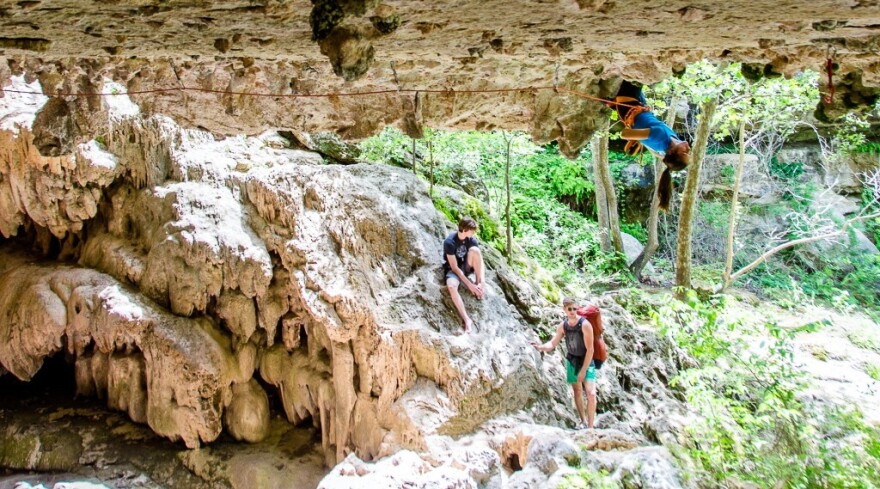
Reimers Ranch is near Dripping Springs and is known for its rope climbing.
Reimers Ranch
Reimers Ranch is near Hamilton Pool and north from Dripping Springs, about 45 minutes away from downtown Austin. Reimers Ranch has some top-notch rock climbing, with more than 300 routes. A majority of the walls overlook the Pedernales River, which makes for an amazing post-climb dip in the summer.
The Reimers family used to own the land before selling it to Travis County, which currently operates the parkland. Nicholas said she and other long-time climbers remember learning how to climb there and saying hello to Milton Reimers and his wife.
“ We’d pull up and he’d come out of his house and ask us for our waivers,” she said. “After school, I’d have fourth period off and we’d climb till the sunset.”
Reimers Ranch has mostly sport, top rope and some trad climbing. For bouldering, check out the Reimers Ranch North Boulders, which can be found in an area of the ranch called the Dugout. It has several good warm-up and beginner-friendly routes.
The ranch is open year-round from 7 a.m. to sunset, and a day pass is $5 per person, cash only.
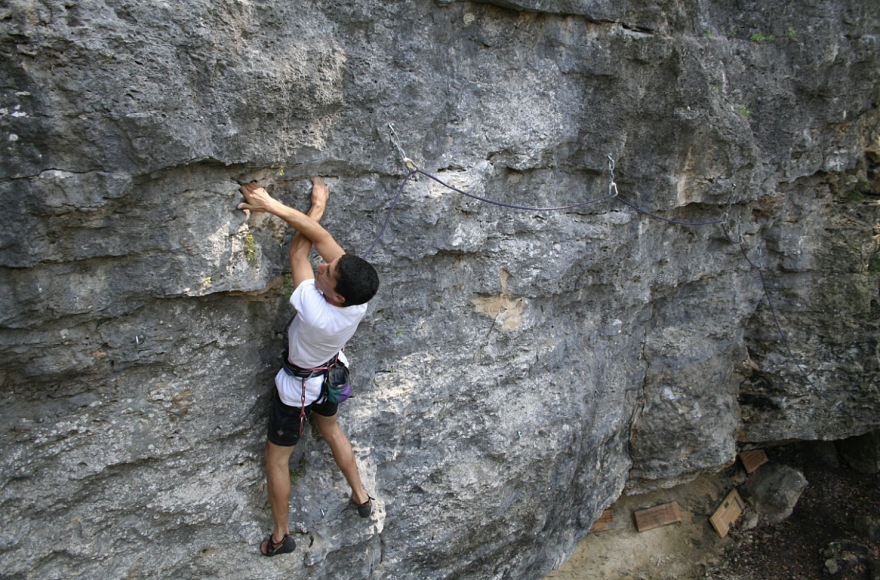
A person climbs at Monster Rock.
Monster Rock
Monster Rock is a park owned by the nonprofit Texas Climbers Coalition. It’s a little north of Reimers Ranch, in Spicewood along the Pedernales River.
The climbing area is made up of two large walls that face each other, which makes for some really interesting climbs in the corridor. Monster Rock is a lot smaller than other outdoor climbing spots, and most of the routes are shaded.
There are dozens of sport and top rope walls with a wide range of difficulties. On the Dungeons and Dragons Wall, you’ll find routes named “Ray of Disintegration,” “Mindflayer’s Tentacles” and “Gelatinous Cube’s Deadly Solvent.”
Texas Climbers Coalition is responsible for the property and maintains all the hardware on the walls. Getting to the climbing area can be a little tricky and requires you to climb down a metal ladder with all your gear.
Monster Rock is open year-round.
Enchanted Rock
This requires a road trip. The Enchanted Rock State Natural Area is about a two-hour drive from downtown Austin, but the climbing there is so worth it.
The granite rock can be a little rough on your skin, so bring extra tape.
Enchanted Rock has mostly trad and bouldering routes. There are also top rope and sport climbing options. While you’re at it, you might as well hike to the top of Enchanted Rock, which some consider to be a rite of passage for Texans.
The park accepts reservations for day passes and often fills up in advance, so buy one ahead, especially for weekends or holidays.
A day pass is $8 for those 13 and up and can be purchased a month in advance.