
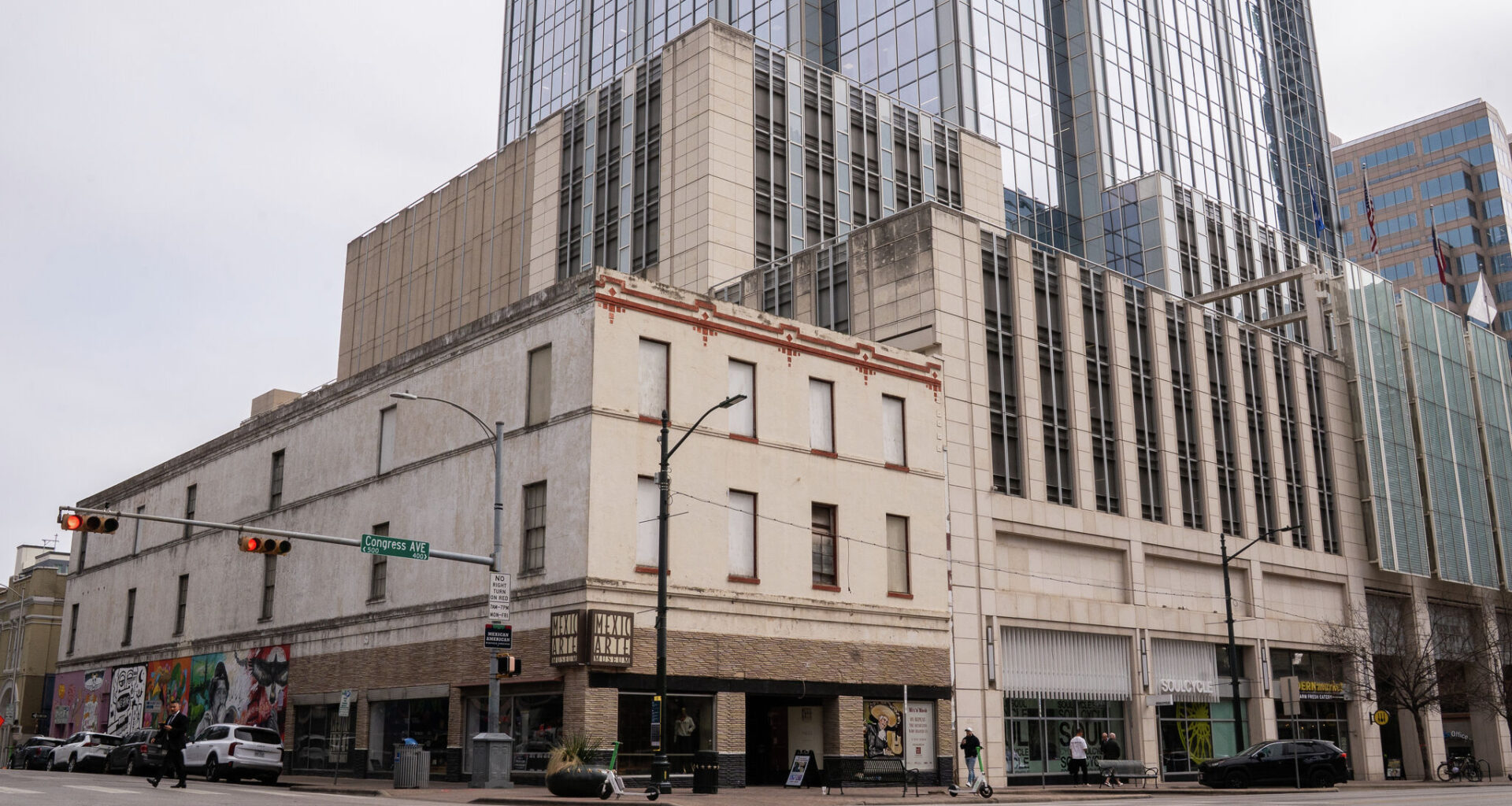
Mexic-Arte Museum on Congress Avenue in Austin is pictured Friday, Feb. 20, 2026. The cultural center has spent two decades awaiting renovations to the deteriorating, city-owned building, delayed in part by insufficient bond funding. The structure dates to 1910.
Sara Diggins/Austin American-Statesman
For more than a decade, the intersection near Priscilla Glover’s Zilker home has been a hazard.

As the neighborhood has grown, more drivers run the four-way stop. Glover has grown used to the sound of T-bone collisions — tires screeching, then an unmistakable crunch.
Article continues below this ad
Eve and Callum Jones, visitors from the UK, stroll through the galleries at Mexic-Arte Museum in Austin, Friday, Feb. 20, 2026. Mexic-Arte museum is seeking an increase in bond money as the City of Austin grapples with a $1 billion backlog in bond funding.
Sara Diggins/Austin American-Statesman
A sidewalk is seen closed in Mueller along 51st Street in Austin Wednesday, Feb. 25, 2026.
Mikala Compton/Austin American-Statesman
“We’re desperate for a turning signal,” she said. “It’s just not safe.”
In 2016, it seemed relief was coming. That November, Austin voters approved a $720 million bond to improve safety and transportation in neighborhoods including those along South Lamar Boulevard, which would add a traffic light at Glover’s intersection.
Ten years later, the light still isn’t there. Neither are many of the other upgrades included in the South Lamar Corridor Project, which is one small piece of a much larger problem.
Article continues below this ad
Across the city, more than $1 billion in voter-approved bond funds — including money for Glover’s stoplight — remain unissued. Some of the oldest projects on the list date back to 2006, despite a city policy that calls for project proposals that can be completed within six years of voter approval.
One is the renovation of a city-owned building downtown that houses the Mexic-Arte Museum, a cultural center where leaders have been waiting for about 20 years for repairs so they can secure an accreditation that will allow them to safely display coveted art relics.
“You’d think if they have the money and they have the will, it would get done,” Glover said.
Article continues below this ad
The bond backlog has become a major political liability as cash-strapped city leaders weigh asking voters to approve another bond package this November.
Historically, the city has been able to count on Austin voters to approve bond packages, no matter the size or state of the economy. Of the nine elections held since 2006, only one bond has failed in whole — another in part. One selling point is that the impact to tax bills isn’t always immediate, with rates rising only after bonds are issued.
But last year, voters overwhelmingly rejected a city tax hike known as Proposition Q. The outcome was a wake-up call for city leaders who are grappling with a budget crisis compounded by a state law that doesn’t allow them to raise taxes more than 3.5% per year without voter approval.
Mayor Kirk Watson is trying to get out ahead of the potential backlash as city staff prepare a bond recommendation for City Council consideration in May in large part by blaming past administrations for poor planning.
Article continues below this ad
An aerial view shows South Lamar Boulevard on Friday, Feb. 6, 2026. The South Lamar Corridor Improvements project has been delayed, and the city has more than $1 billion in unspent voter-approved bond funds.
Jay Janner/Austin American-Statesman
“There’s discussion about having a bond election this year,” Watson wrote in his latest newsletter. “I want us to approach the discussion with some sense of past mistakes and pain those mistakes may be causing.”
Mueller: A 15-year wait
About nine miles northeast of Zilker, Mueller residents have been waiting since 2012 for improvements to East 51st Street — including sidewalks, bike lanes, drainage upgrades and traffic-calming features.
Article continues below this ad
Andrew Clements, president of the Mueller Neighborhood Association, said residents bought into a detailed vision presented by the city.
“They presented us a design years ago,” Clements said. “In fact, they went through a whole visioning process with us, and we were really happy with the vision.”
The wait, he said, has been “a real disappointment.”
Andrew Clements, chair of the Mueller Neighborhood Association, discusses the lack of progress in infrastructure creation in Mueller along 51st Street in Austin Wednesday, Feb. 25, 2026.
Mikala Compton/Austin American-Statesman
The reasons for the delay are many, but the main one is that plans have evolved. A city update to drainage rules after the 2012 election required a redesign of the underground storm system to reduce flooding. Other changes reflect updated transportation and environmental standards.
Article continues below this ad
The city also fired the design vendor at some point due to poor performance. When the new firm came in, they had to redo much of the design work.
City spokesperson Brad Cesak said the project’s design phase is ongoing and expected to be about 90% complete by late April, with construction bids anticipated in spring 2027.
A cyclist rides along 51st Street in the Mueller neighborhood in Austin Wednesday, Feb. 25, 2026.
Mikala Compton/Austin American-Statesman
Clements said those changes haven’t been communicated to residents, leaving those most impacted by the new plan in the dark.
Article continues below this ad
Cesak said he believes the new design “remains substantially consistent” with the original vision but that the city will hold another open house for residents this summer and will answer questions about any changes.
For Clements, who previously managed city and school bond projects, the scale of the backlog is striking.
‘No one is going to jail’
Experts — and city officials — largely agree on the root problem of the $1 billion bond backlog: projects were approved before they were fully defined.
Article continues below this ad
“An overarching theme,” said city spokesperson Andrew Cantu, “is that they were put forward at a concept level that hadn’t been fully vetted for scope, schedule and budget.”
Kaiba White, a member of the city’s bond oversight commission, said initial cost estimates were often too low.
“By the time they were ready to move forward, things had changed and costs had increased,” she said.
Mayor Watson has pointedly criticized the city’s past approach, describing “insufficient planning done in advance.” The backlog, he has said, could force the city to change its financial policies, which currently require most previously approved bonds to be issued before calling a new election.
Article continues below this ad
Southern Methodist University law professor Christine Hurt also said prolonged delays could affect Austin’s bond rating if investors lose confidence in the city’s ability to manage debt.
Other than that, experts say there are few formal consequences.
“The bonds can float out there almost indefinitely,” said Brian Smith, a political scientist at St. Edwards University. “No one is going to jail and — provided the city doesn’t spend it on something else without permission — everything is OK.”
The political consequences are a much bigger threat, Smith added, particularly in the wake of the failed Prop Q election. That’s why Watson is trying to “get out ahead of that,” he said.
Article continues below this ad
“Kirk Watson is a very strategic politician, and he realizes that with the failure of Proposition Q, this could really derail anything in the future that he tries to pass as mayor, anything that he wants to do,” Smith said, describing Watson’s blame of previous administrations as an easy out.
Pedestrians walk along Aldrich Street in the Mueller neighborhood in Austin Wednesday, Feb. 25, 2026.
Mikala Compton/Austin American-Statesman
In an interview with the American-Statesman, Watson said he’s worked hard to chip away at the backlog and pointed to recent major projects — like the Wishbone Bridge and a stabilization project at Roy G. Guerrero Park — that he said were completed ahead of time and on or under budget.
Under his tenure, the city also created an entire department — Capital Delivery Services — to move such projects forward, he said. The city has now earmarked all but $379 million in outstanding bond projects.
Article continues below this ad
Still, he acknowledged the bad optics and declined to say whether he will support a 2026 bond. Recently, he pushed for the creation of a “decision tree” to help council make the right call and to make the process more transparent. The framework is notably similar to one that led to Prop Q.
“I think that’s going to lead us to the right result if we do it the right way,” he said.
While the backlog hasn’t yet increased taxes, costs will rise as bonds are issued. The average homeowner’s annual debt service is expected to increase from about $450 to $512 next year.
White said the city may need to prioritize completing smaller, achievable projects rather than holding out for ideal — but unaffordable — outcomes.
Article continues below this ad
“The reality is there’s not enough bonding capacity to do everything,” she said.
Mexic-Arte Museum: Funding shortfall stalls progress
The rear, alley-facing wall of the Mexic-Arte Museum at 419 Congress Ave. in Austin is seen Wednesday, Feb. 25, 2026. The museum is seeking to expand into the building’s upper floors.
Jay Janner/Austin American-Statesman
Downtown, the Mexic-Arte Museum illustrates a different problem: not delay, but insufficient funding.
Article continues below this ad
Voters approved $20 million in bonds in 2006 and 2018 to renovate the museum’s aging 1910 building. But a full reconstruction would cost about $39 million.
Rather than spend the money on partial fixes, museum leaders have held off.
“It’s no use putting on Band-Aids,” said founder Sylvia Orozco.
Sylvia Orozco, the Founder of Mexic-Arte Museum at the museum in Austin, Friday, Feb. 20, 2026. Mexic-Arte museum is seeking an increase in bond money as the City of Austin grapples with a $1 billion backlog in bond funding.
Sara Diggins/Austin American-Statesman
Without additional funding, the project would produce only a shell and a usable first floor, leaving three upper floors unfinished.
Article continues below this ad
“Just think what that would look like,” Orozco said. “What does that say about Austin?”
The building shows visible deterioration, and only the ground floor is open to the public. About 7,000 pieces of art remain in storage due to lack of space.
Infrastructure limitations also affect the museum’s ability to borrow artwork. Accreditation standards require strict climate control and handling conditions.
The front wall of the Mexic-Arte Museum at 419 Congress Ave. in Austin is seen Wednesday, Feb. 25, 2026. The museum is seeking to expand into the building’s upper floors.
Jay Janner/Austin American-Statesman
The museum once housed the first painting of Texas – a 1700s work showing the destruction of Mission San Saba after Indigenous resistance to missionaries. Taken from Mexico, it later surfaced at Mexic-Arte in the 1980s before the Mexican consulate reclaimed it. The museum now hopes to borrow it back for a new exhibit but faces strict loan criteria.
Article continues below this ad
“They won’t lend you work if you don’t have the conditions,” Orozco said.
The museum is expected to relocate temporarily to the Austin History Center, with demolition planned next spring.
The Mexic-Arte Museum at 419 Congress Ave. in Austin is seen Wednesday, Feb. 25, 2026. The museum is seeking to expand into the building’s upper floors.
Jay Janner/Austin American-Statesman
Looking ahead to 2026
Back in Zilker, work has finally begun on long-delayed bond projects, but Glover is still waiting on her stoplight. For other residents, the results so far have been underwhelming.
Article continues below this ad
Down the street from Glover, Drew Zerdecki was delighted when the city finally installed a roundabout at an accident-prone intersection outside his home. But he said it is too flat and close to the ground — so close that drivers often can’t tell what it is.
“There’s no sign in the middle of that roundabout, so a lot of people just don’t know what to do,” Zerdecki said. “Big trucks just end up going the wrong way through it or over it, because there’s just insufficient roadway.”
Cesak, the city spokesperson, defended the roundabout as a recent success in the “large and complex” South Lamar Corridor Project, which he said is expected to be completed in 2032.
Whether the fledgling progress on long-overdue projects will help convince Austinites to support another bond this fall is unclear.
Article continues below this ad
In Mueller, Clements said he would likely support a future bond despite delays.
“I think people don’t vote for these bonds when they don’t see progress,” she said.
Article continues below this ad
Zerdecki is more skeptical.
“I’ve lost faith in the city’s ability to deliver,” he said.