
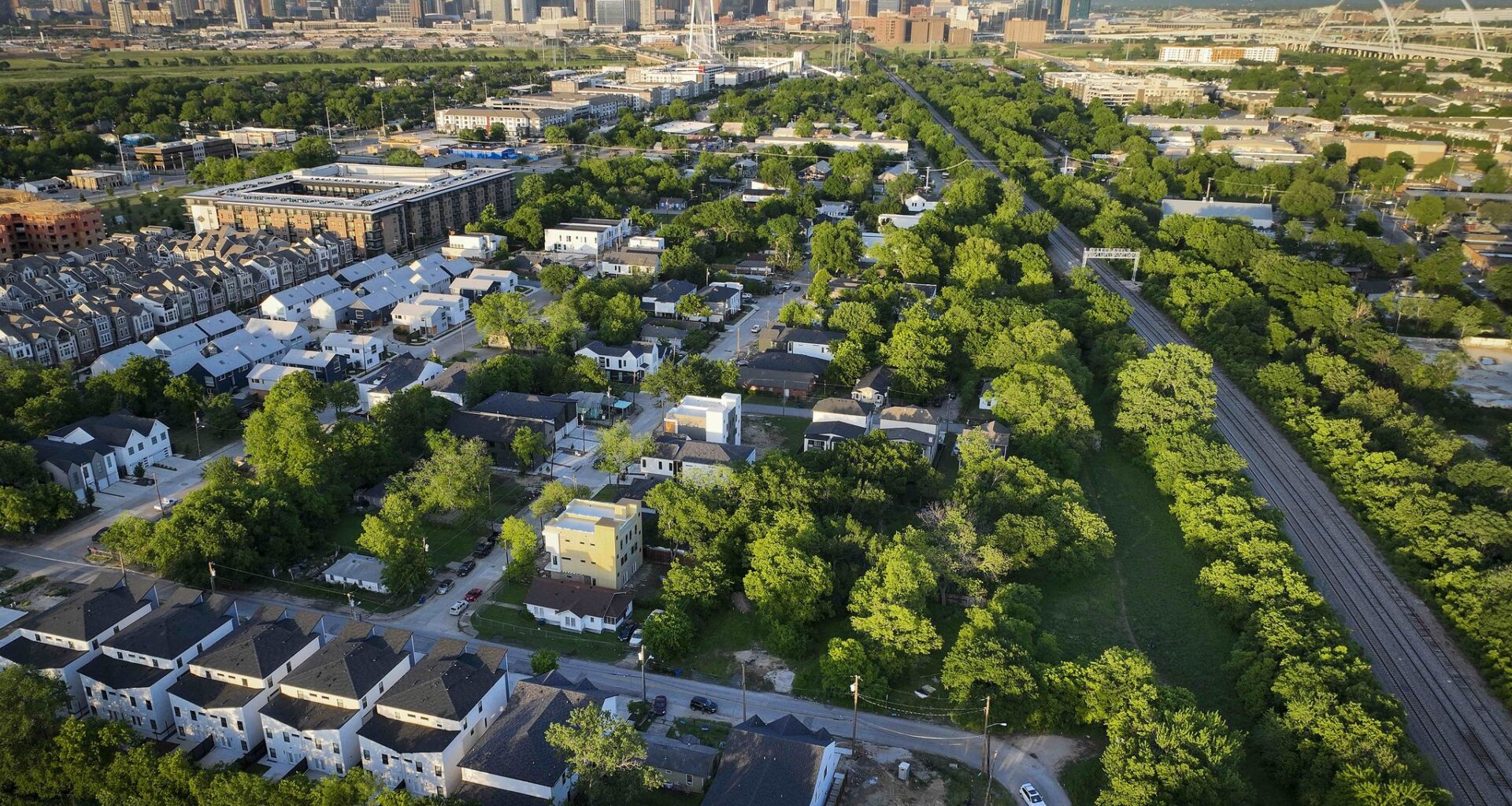
Aerial view of the Gilbert-Emory neighborhood looking toward the downtown skyline on Sunday, April 30, 2023 in Dallas.
Smiley N. Pool/Staff Photographer
The average North Texan’s ability to afford an average home in North Texas has been on the decline since 2012 as home prices surged ahead of wages.

The chasm between who could afford to own a home in North Texas and who could not has widened as the number of lower-cost housing units dropped. However, rapid economic growth and strong housing demand masked this trend until mortgage rates jumped in 2022.
Article continues below this ad
Recently released census data indicate population growth in the metropolitan area has slackened compared to a swell on the outskirts. Despite real estate indicators implying improved affordability, problems remain as workers who form the backbone of the region’s economy, along with young families and older adults, struggle to stay in the area.
Keeping housing affordable for different groups is crucial to securing the long-term growth and development of the region, real estate experts told The Dallas Morning News.
North Texas needs to create towns and cities to meet people in all phases of life so that there’s a place for them to retire, to have a home with a big family, to get started or to rent, said Timothy Bray, director of the Institute for Urban Policy Research at the University of Texas at Dallas.
Make Dallas News a preferred source so your search results prioritize writing by actual people, not AI.
Add Preferred Source
”That’s what the stronger cities are doing,” he said.
Article continues below this ad
Corporations need people, said Sriram Villupuram, an associate professor of finance and real estate at the University of Texas at Arlington, spotlighting North Texas’ emergence as a leading talent hub with strong workforce development.
“But if people are not moving and the affordability is simply not here, then it’s going to be very hard for us to invite companies and people to stay here,” he said.
The state of housing affordability in North Texas
Since 2012, the average closing price for a home in the Dallas-Plano-Irving region more than doubled (up 138%) from $172,000 to $410,000, peaking at $425,000 in 2023, according to the Texas Real Estate Research Center’s Housing Affordability Index.
Article continues below this ad
The housing affordability index is, in simple terms, the average person’s ability to afford an average home without sinking into overwhelming debt. The index considers additional savings for a 20% down payment and an allotment of 25% of the person’s income for monthly mortgage payments.
In 2023, to sufficiently qualify for a mortgage on a median-priced home without becoming cost burdened, a home buyer in the Dallas-Plano-Irving area had to earn roughly $105,700 according to the index. That was equivalent to the area’s median family income at that time.
About half of the families in the area could not afford to buy a typical home without feeling financially burdened.
That estimate does not include the additional cost of about $84,000 for a 20% deposit based on the median home price and other expenditures such as insurance, taxes and fees tacked onto the final price tag for homebuyers.
Article continues below this ad
The pressures eased in 2025 when housing costs started to correct. But amid geopolitical tensions with Iran, trade tariffs and immigration, uncertainty grips the housing market despite a positive outlook for this year.
“The only silver lining is that for the first time in five years, income growth is higher than home price growth,” said Villupuram, adding though it’s not a U-turn yet, the pressures of housing affordability are easing.
At the end of 2025, affordability improved slightly, according to the index. The earnings threshold to afford a home decreased to about $97,500, a little lower than the median income for the Dallas metro area.
Article continues below this ad
However, that still means homeownership is out of reach for the other half of the population earning below the middle of the income distribution, said Villupuram.
Furthermore, homes at or below the median home price are now hard to find.
By comparison, the threshold in 2014 was an estimated $20,000, less than a third of the area’s median income at the time.
The risks of unaffordable housing
When the housing market weakens, consumers become more cautious, said Enrique Martínez García, deputy director at the Federal Reserve Bank of Dallas. With fewer people buying new homes, population growth in the area slows – affecting the general demand for all goods and services, ultimately leading to rising unemployment.
Article continues below this ad
“I don’t want to give the impression that North Texas is particularly exposed in any way – in fact it shows great upside potential,” Garcia said. “But one has to consider risks.”
Even if the housing market is holding up well, pockets of vulnerability remain. “I am particularly concerned about low-income housing access, and first-time homebuyers seem to be particularly squeezed in the current environment,” he said.
Lower-income residents can afford less of the market in Dallas-Fort Worth than they can at the national level, said Joel Berner, a senior economist at Realtor.com, attributing this to severe income disparities in the region.
“If you just look at the median earner in the median home, Dallas actually looks better than the national average,” he said. “But if you start to look below the median, because there’s so much income disparity, there’s just not a lot of options for the [lower-income] buyers to become homeowners.”
Article continues below this ad
Buying a house is part of the American dream – a pathway to savings and wealth, said Ted Wilson, principal at Dallas-based Residential Strategies, Inc.
But skyrocketing home prices have priced out several first time home buyers from achieving this.
Garcia described housing affordability and wealth disparities as two sides of the same coin.
“Almost mechanically, if you owned your house [before the surge in prices and rates], you’ve had a very significant increase in your wealth, and if you didn’t, you missed out,” he said.
Article continues below this ad
The market is also in a situation where higher-income households now compete with lower-income households for the same homes, bidding up the selling price.
“In Plano, for example, when I looked at listing prices in 2021, they stood at around $650,000 while the final sale price was $720,000,” said Villupuram. “There was severe overbidding.”
As mid- or higher-income folks can’t afford housing of a certain rung, it produces a downward pressure that prices out those at the bottom.
He added that those living in lower priced, smaller homes know if they get out they won’t be able to afford anything else. “So they’re all really tied,” he said. “And that makes it very difficult for the bottom half to afford anything.”
Article continues below this ad
What North Texas stands to lose
Households priced out of the metro area include blue collar workers, retired residents on fixed incomes and young or starter home families, said Berner. They are forced to the suburbs and exurbs or into staying renters in central areas.
“Starter home communities are now further and further out, and the net effect is that schools are closing in places like Plano,” Bray said. In the outer rings of the metro area, school enrollment is rapidly increasing.
Article continues below this ad
He called these “bubbles,” or demographic shifts, as large numbers of families with kids move in at the same time, altering commuter and growth patterns in the region.
That was the challenge facing Dallas years ago, he said. When low- and working-income families started to put money away for housing, they had to leave Dallas and move to Grand Prairie and Mesquite.
“In a way, you sort of shackle your ability to grow and adjust to financial forces,” he said, “because that whole chunk of your economy and populace leaves when they’re ready to move up.”
Embracing density
Home prices are sticky, said Villupuram. Once they go up, it’s difficult to bring them down.
Article continues below this ad
“So we really need to think about where else we can fix structural issues,” he said, adding the recent growth spurt of townhomes under construction in the metro area is a positive sign for affordable housing.
The Cooper Bishop Arts Apartments line W. Eighth St between Llewellyn and Adams, Dallas, November 21, 2025. Sisters Ninette and Marguerite McDonald who live across the street sold their family’s apartments for the development.
Tom Fox/Staff Photographer
“We still don’t talk about condos in many parts, but moving from single family to townhomes is some progress,” he said, adding the region needs to accommodate denser housing.
It’s not that builders don’t want to build more condos and townhomes, said Wilson.
Article continues below this ad
Higher land and construction costs aside, one of the biggest hurdles developers contend with is NIMBYism, he said, referring to local residents’ not-in-my-backyard stance toward certain kinds of development because they fear a rise in crime, lower property values or other perceived adverse effects.
“Believe me, they would sell as many of them [lower priced townhouses and condos] as they could,” Wilson said, “But when you come to their area and say, ‘Hey we want to put these special districts in and get smaller housing so it’s more affordable,’ people suddenly say, ‘Well, we don’t want that here, go do it somewhere else.”
“If you embrace growth, then you’ve got to also embrace density. It’s both or nothing,” Villupuram said. Homes outlive people, he added, so once single family homes are laid out, “it will take generations” to course correct.

By signing up, you agree to our Terms Of Use and acknowledge that your information will be used as described in our Privacy Policy.
As North Texas now expands more westward, these are lessons to learn from the east side, he said.
Article continues below this ad
“Think about the next 20 years, 30 years ahead instead of the next four or five years to catch the growth,” he said. “Think long term.”
This reporting is part of the Future of North Texas, a community-funded journalism initiative supported by the Commit Partnership, Communities Foundation of Texas, The Dallas Foundation, the Dallas Mavericks, the Dallas Regional Chamber, Deedie Rose, Lisa and Charles Siegel, the McCune-Losinger Family Fund, The Meadows Foundation, the Perot Foundation, the United Way of Metropolitan Dallas and the University of Texas at Dallas. The News retains full editorial control of this coverage.