
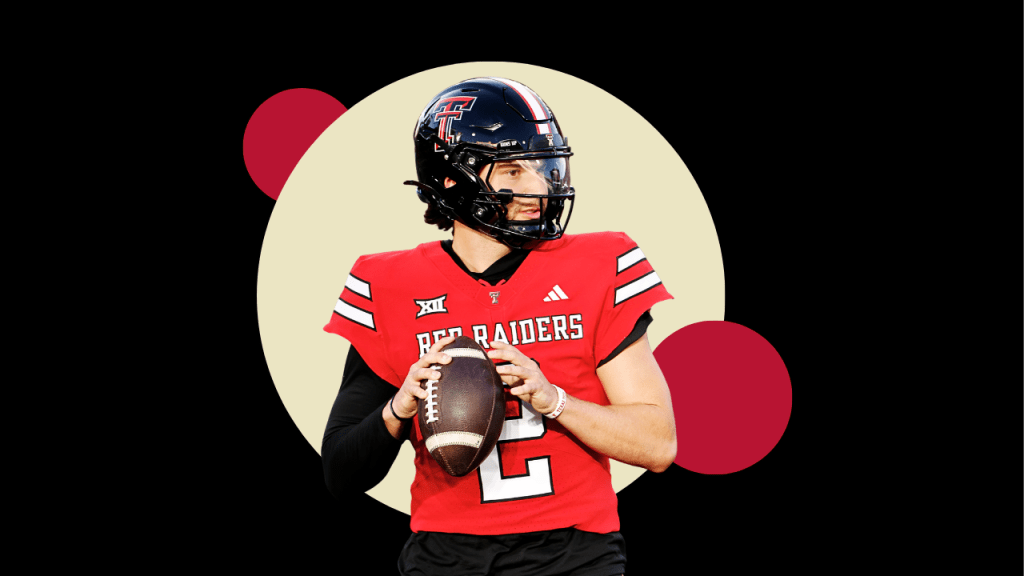
Texas Tech quarterback Brendan Sorsby has taken an indefinite medical leave to participate in a residential treatment program for a gambling addiction, the school announced on Monday.
Sorsby, who was ranked by ESPN as the top transfer prospect in the nation when he left Cincinnati for Texas Tech this offseason, is under NCAA investigation for allegedly making bets through a gambling app, with some bets on Indiana football while a freshman backup at the Big Ten school in 2022. According to ESPN, Sorsby is believed to have bet on Indiana winning games, and none of the bets were on games in which he played.
In a statement, Texas Tech said the school is committed to supporting Sorsby through his recovery process and to ensuring his long-term health and well-being. The QB was reportedly set to earn more than $5 million in an NIL deal in Lubbock. He is currently a defendant in a lawsuit brought by Cincinnati, which accuses him of breaching his two-year NIL contract with the Bearcats by transferring.
The NCAA prohibits athletes from betting on sports, and players can face a range of punishments that include season suspensions and a permanent ban. The association last year weighed the possibility of allowing athletes and coaches to bet on pro sports but decided against that change in the wake of high-profile betting scandals involving NBA and MLB players. While college athletes can’t bet without running afoul of NCAA rules, their classmates can legally bet on sports provided they’re of betting age in one of the 39 states, along with Washington, D.C., and Puerto Rico, where sports betting is legal.
While the major pro leagues have entered into lucrative partnerships with sports-betting and prediction-market companies, the NCAA has consistently expressed opposition to gambling on sports. This is particularly true of NCAA president Charlie Baker. Sports betting can tempt athletes to manipulate games or lead them to face harassment from gamblers upset with their performance.
The NCAA’s opposition to betting was apparent last month when it sued DraftKings for trademark infringement and dilution in using “March Madness,” “NCAA Sweet Sixteen,” “Elite Eight,” “Final Four” and other famous expressions for which the NCAA has secured registrations from the U.S. Patent and Trademark Office.
The NCAA sought an injunction in part over worries that “money damages cannot repair the damage done when millions of sports fans—and, critically, college students and young adults who are particularly susceptible to gambling harm—are exposed to the false suggestion that the NCAA has authorized, endorsed, or affiliated itself with DraftKings’ gambling platform.”
A judge denied the injunction but endorsed many of the NCAA’s arguments.
In response to a question about the Sorsby investigation, an NCAA spokesperson told Sportico that “due to confidentiality rules put in place by NCAA member schools, the NCAA will not comment on current, pending or potential investigations.”
At the same time, the spokesperson stressed that the NCAA “takes sports betting very seriously and is committed to the protection of student-athlete well-being and the integrity of competition.”
The spokesperson added that the NCAA “works with integrity monitoring services, state regulators and other stakeholders to conduct appropriate due diligence whenever reports are received.”
The Sorsby development is the latest warning sign that as legalized sports betting has become more popular—especially with college students and other young people—problems are surfacing. In 2023, a study commissioned by the NCAA found that 67% of college students living on campus had engaged in sports betting, 41% had bet on their school’s teams and 35% had used a student bookmaker.
The prevalence of sports betting has led to more concerns that betting is addictive in ways that pose significant harms.
As Sportico exclusively reported last month, the Public Health Advocacy Institute (PHAI) at Northeastern University School of Law in Boston is leading litigation, Sage & Thompson v. DraftKings et al., that depicts sports betting as a public health crisis. The case maintains that exposure to sportsbook apps, particularly those that feature live, in-play wagering options known as microbetting, negligently causes severe gambling addictions.
An analogous argument, albeit in the context of children and teenagers, was recently brought against Meta and other social media companies. At issue were their platform designs, including infinite scrolling and manipulation of algorithmically tailored feeds of photos and videos, to get people hooked and not turn off the app. A jury sided with the plaintiffs.
Sports gambling involving college athletes is, of course, not a new phenomenon. Nor is it necessarily surprising, given that there are more than 500,000 athletes at the roughly 1,100 member schools. Thousands of other personnel involved in sports, including coaches, trainers and student employees in athletic departments, can gain insider access to information, such as player injuries, which can prove valuable in betting.
There’s also a long history of sports betting scandals in college sports that predates the U.S. Supreme Court’s ruling in Murphy v. NCAA (2018), where the Court ruled it was unconstitutional for Congress, through the Professional and Amateur Sports Betting Act of 1992, to compel states to deny sports betting when there was no accompanying federal standard.
There have been scores of game-fixing and point-shaving scandals, notably involving the 1950 NCAA champion City College of New York, the 1978–79 Boston College men’s basketball team, and, in the 2000s, Arizona State men’s basketball. Last year the NCAA determined that more than 20 former Division I basketball players bet against their own teams, changed the way they played or funneled inside information to further wagers.