
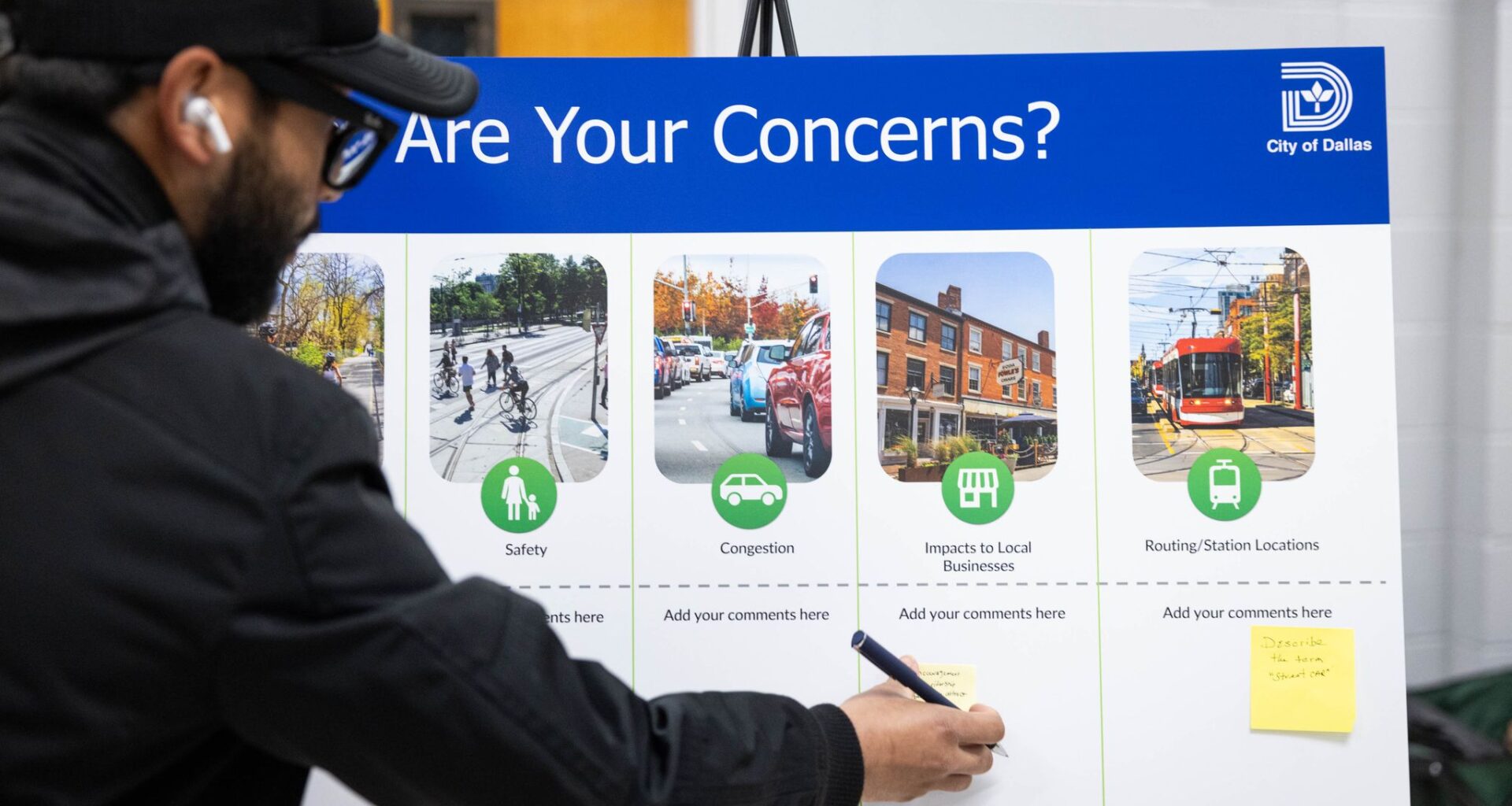
A new Dallas streetcar, connecting Fair Park in South Dallas to the convention center being reimagined downtown, could be on the horizon as city leaders take their first steps in gathering feedback.
The project is still in very early stages. It’s unclear how much the city-owned streetcar would cost or how it would be funded. It’s not expected to rely on Dallas’ general fund, which faces a multimillion-dollar shortfall. The streetcar would likely have a contracted operator, whether it’s DART or another entity.
The city’s transportation department is taking public comments until May 6 to help assess the project.
Council member Adam Bazaldua, who represents South Dallas, called the idea a rare opportunity for the area. He said he thinks funding is within reach. He’s hoping the city will put the millions it expects to receive back from a new agreement with Dallas Area Rapid Transit toward the effort.
“I don’t think that this is a pipe dream type of project,” Bazaldua said. “This is actually going to act as a proof-of-concept of how we can better invest the dollars that previously were allocated to DART to help move Dallasites.”
With many details undetermined, Bazaldua and the city’s transportation director, Gus Khankarli, said at a community meeting last week this is the earliest the city can seek feedback. A high-level evaluation of the idea is expected to be complete in the summer, according to the presentation.
“This is the fundamental starting point that will allow us to launch to the next steps,” said Khankarli, who noted the city is working on high-level planning and not a detailed engineering analysis.
According to the maps presented, the streetcar would leave the convention center headed south down Botham Jean Boulevard, turn east and head up Martin Luther King Jr. Boulevard before arriving at Fair Park, where it turns around. The city found it best to have a track going in each direction of the route.
Related: Could Dallas’ Fair Park get a hotel, other amenities in plan to generate revenue?
Bazaldua said it was too early to give a full estimate of the streetcar’s cost. The infrastructure cost could be about $10 million to $15 million per mile of streetcar track. Expenses for the vehicle itself would be separate.
“There’s going to be a lot of variables to go into how we can make this the most advantageous funding stack for the city to even accomplish it without tapping into the general fund,” he said.
Current projects to revitalize South Dallas could work in tandem with the streetcar.The Dallas City Council also authorized an agreement in March to receive $211 million from Dallas Area Rapid Transit over the next six years. The hope is that the cash will go toward eligible transportation programs.
Related: South Dallas plan crafted to protect community as needed development takes hold
This project would be focused on local transportation rather than a regional model like DART, Bazaldua said. He added that the project also could involve the North Central Texas Council of Governments, with funding sought from the federal government and the Texas Legislature.
“When we start, kind of, manifesting our own city destiny, and think about how we can move neighborhoods in Dallas, that’s going to be different,” Bazaldua said.
While some community members at the meeting said they liked the idea, they noted how much more would need to happen for this streetcar to become a reality.
The city has received more than 120 responses to its survey. That survey, along with the presentation, can be found on the transportation department website.
This reporting is part of the Future of North Texas, a community-funded journalism initiative supported by the Commit Partnership, Communities Foundation of Texas, The Dallas Foundation, the Dallas Mavericks, the Dallas Regional Chamber, Deedie Rose, Lisa and Charles Siegel, the McCune-Losinger Family Fund, The Meadows Foundation, the Perot Foundation, the United Way of Metropolitan Dallas and the University of Texas at Dallas. The News retains full editorial control of this coverage.