
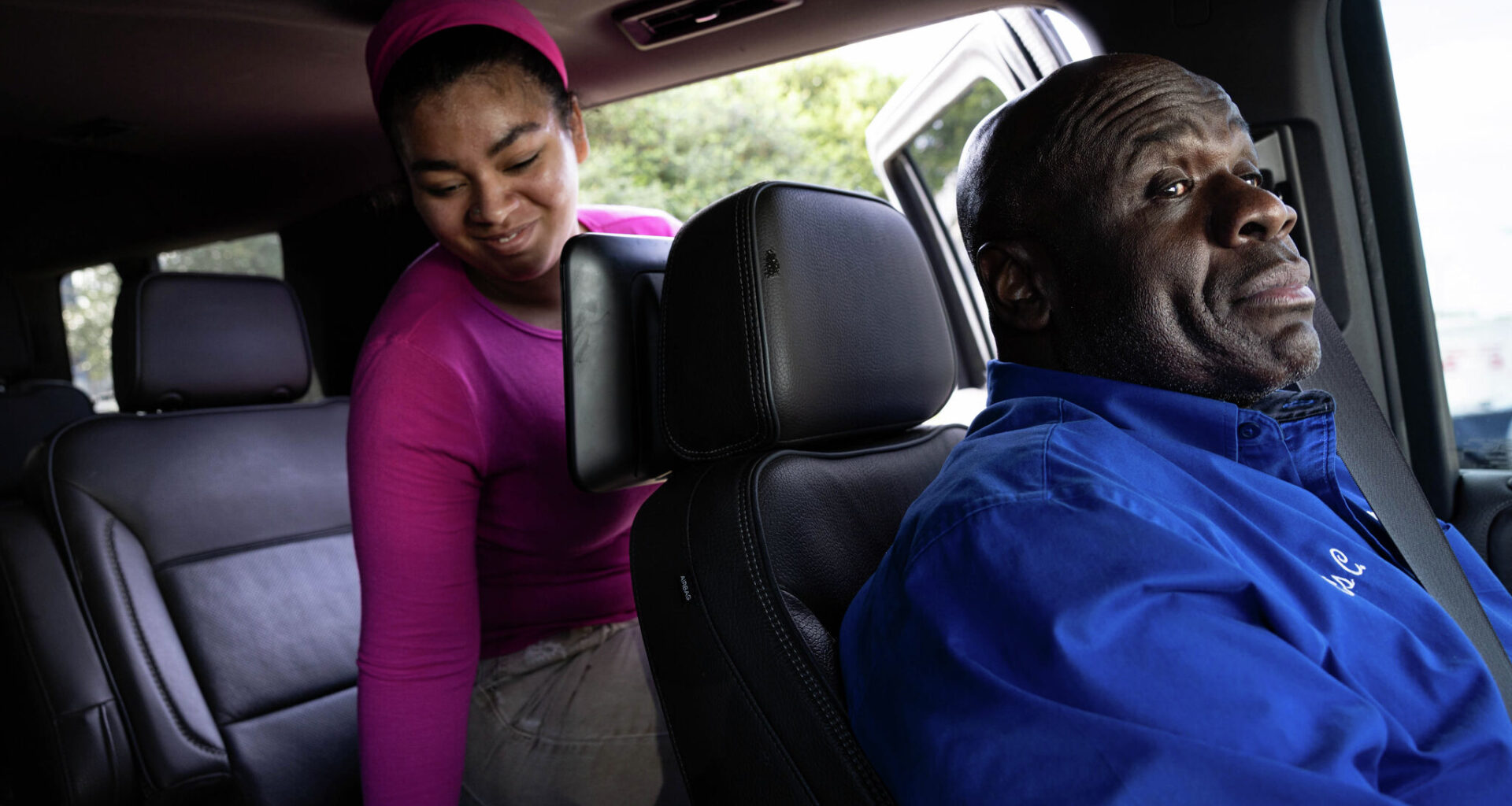
For Brianna Lambert, the math is simple. No ride equals no job.

On a recent Thursday evening, shortly before 6 p.m., the 20-year-old climbed into the back seat of a black GMC Denali, a full-size SUV with room for seven, outside a strip of businesses near Stanton Optical in DeSoto. Driver Curtis Corbins steered southeast toward Ennis, where Lambert works at the Sterilite plastics manufacturing factory.
Curtis Corbins, driver, founder and owner of Southern Dallas Link, returns to the Shops at RedBird after transporting a passenger to her job in Ennis on April 9, 2026.
Angela Piazza/The Dallas Morning News
Curtis Corbins, driver, founder and owner of Southern Dallas Link, watches passenger Brianna Lambert approach his SUV in DeSoto on April 9, 2026. Corbins transported Lambert to her job in Ennis.
Angela Piazza/The Dallas Morning News
Curtis Corbin, driver, founder and owner of Southern Dallas Link, drives passenger Brianna Lambert to her job in Ennis on April 9, 2026.
Angela Piazza/The Dallas Morning News
It is one of several pickup runs he makes to connect residents in southern Dallas County to jobs that are not on a bus or train line.
Article continues below this ad
Transportation is one of the biggest barriers facing workers in southern Dallas County, according to advocates and regional planners. Many entry-level workers, seniors and single parents struggle to reach jobs, job training, and school because Dallas Area Rapid Transit and other transit options run too infrequently, or not at all, for their needs. When owning a car is out of reach, those transit holes turn a short trip across Dallas into a major obstacle.
Thousands of southern Dallas residents are stuck in low-wage jobs or miss out on opportunities because they cannot reliably reach employers beyond the transit network. Shuttle solutions show how targeted transportation can turn a job into a pathway out of poverty.
Related: For more on the impact of growth in North Texas, visit dallasnews.com/futurentx.
Make Dallas News a preferred source so your search results prioritize writing by actual people, not AI.
Add Preferred Source
Corbins and his company fill the gap by providing direct, predictable automobile commutes that higher‑wage workers take for granted. They get southern Dallas workers to jobs that offer better pay and the chance for upward mobility while employers get access to a larger workforce.
Article continues below this ad
C. Lee Transportation, which operates 35 vehicles and employs 63 drivers, provides up to 250 rides a day for residents heading to warehouses, medical offices, and job sites. He contracts directly with companies, who deduct a transportation fee from employees’ paychecks. The cost for most commuters, for example, a round trip Dallas between Ennis, is about $30 per day. Senior rides average $25 per round trip.
The consistency, speed and directness of the shuttle service helps workers keep jobs they would otherwise lose due to missed or unavailable transit connections, providing stability, income and access to career and economic advancement.
As the region grows in population and sprawls even more, workers will face greater challenges in finding affordable ways to get to their jobs and training programs.
Traffic along Interstate 35 E in southern Dallas county.
TOM FOX/80801
“Whether it’s public transit like DART, or just the ability to get a private vehicle or use a rideshare or other opportunity … the further that job is from where you live, the harder it’s going to be to get there,” said Jessica Galleshaw, Dallas’ deputy director and chief opportunity officer in the Office of Housing and Community Empowerment.
Article continues below this ad
For workers like Lambert, Corbins’ shuttle business is an extension of the transit system. He picks people up from train stations and neighborhood stops, then drives them to warehouses and job sites that receive limited or no service from DART.
She started using Corbins’ service on her first day at Sterilite, after hearing about the shuttle from another client of his. She’s been a client for nearly a year and said the shuttle allows her to work overnight so she can study during the day.
Lambert is a sophomore at the online school Penn Foster. She’s interested in starting her own makeup company, but for now, she rides in Corbins’ SUV to the Ennis factory to keep a steady paycheck coming.
“I’m really grateful,” Lambert said about Corbins’ company. “It’s been a big part of my journey right now. I feel like it saves me a lot of time and a lot of worrying.”
Article continues below this ad
Corbins set up his contracts by networking with plant managers and training providers, explaining the employee retention and performance boost associated with reliable rides, and offering to handle all logistics from pickup points to work sites.
Most riders sign up through their employer, a training program, or a social service provider. New clients then call Corbins to get assigned to a pickup route and shift schedule.
On a recent Friday, Corbins’ day began at DART’s Ledbetter Station at 5:52 a.m. He pulled up in his SUV to meet the first riders of the morning. Pleasant Grove resident Bakari Holman, 22, and Oak Cliff resident Ahniyah Jackson, 19, climbed in for the trip to their jobs at Sterilite.
Jackson, a floorhand at Sterilite, said the distance to Ennis made the job feel out of reach until she found the shuttle. Holman said that before he started using Corbins’ service, his commute involved taking a DART train into downtown Dallas, then paying for an Uber ride to reach the warehouse, since DART doesn’t run to Ennis. Holman said he often arrived late and sometimes missed work due to train delays or missed connections.
Article continues below this ad
“It really helps a lot financially,” Holman said. “I went from spending $120 a day to spending $30.”
Curtis Corbin, driver, founder and owner of Southern Dallas Link, speaks with Davoi Anderson about his book tour while waiting for passengers at the Sterilite warehouse in Ennis on April 9, 2026.
Angela Piazza/The Dallas Morning News
By 6:25 a.m., Corbins had dropped Holman and Jackson at the warehouse and waited for his next riders to get off work. By 7 a.m., Sterilite workers from the night shift streamed out of the plant as a manager greeted them with fist bumps. At 7:06 a.m., Lambert stepped into the SUV. Minutes later, Grand Prairie resident and warehouse packer Dion Meredith, 32, joined the route.
Corbins dropped Lambert at the Stanton Optical location in DeSoto at 7:37 a.m., then took Meredith to an Exxon station in Red Bird at 7:55 a.m., where Meredith could make his connection home.
Article continues below this ad
At different points during the day, all of Corbins’ clients said they probably wouldn’t have their job without his transportation service.
“This transportation allows people to get connected with a better paying job,” Corbins said. “A lot of times, most of your good paying jobs are not on the bus line.”
Tale of two cities
Dallas City Council member Lorie Blair, who represents southeast Dallas, said she would not call her area an exact “transportation desert” where transit is completely absent. She calls it a “transportation‑limited community” where residents get where they need to go, but it may take more time and money.
Article continues below this ad
She described disparities between northern and southern Dallas as “a tale of two cities.”
“The North [has] always had, and the South has always struggled to get. We’re still in that struggle. We have food deserts, we have transportation deserts, we have medical deserts.”
In her own district, she said, “I can’t go to the east side of my community and even find a bus, because they don’t run in that part of the city, because we don’t have infrastructure for the buses to run on.”
Dallas City Councilwoman Lorie Blair helps prepare packaged food for distribution during a food and toy distribution event at University of North Texas at Dallas on Friday, Dec. 19, 2025.
Angela Piazza/Staff Photographer
Those gaps show up along every step of the path to a stable career, including school, job training, interviews and commutes. Officials say it’s not just cost, it’s infrastructure.
Article continues below this ad
“Even though Dallas College provides free DART passes for students, we know that DART’s not a perfect solution,” said Eric Ban, executive director of the Economic Mobility Center, which coordinates workforce partnerships and access programs like Dallas County Promise, an initiative for high school seniors that covers any remaining tuition after financial aid. “Oftentimes students still struggle to get from point A to point B.”
C. Lee Transportation’s origin
Corbins said he started driving residents in his own vehicle in 2015 after learning many of the good jobs in southern Dallas were not on a bus line. Corbins was homeless and living out of a vehicle his friend let him borrow. Looking for steady work himself, Corbins organized rides to help others and rebuild his own foundation.
He met people at train stations, then drove them to jobs and medical facilities public transit did not reach. He also borrowed vehicles from friends to put his daughter, Brooklin, and son, Demarkus, behind the wheel to serve more people.
Article continues below this ad
Early referrals came from the United Way of Metropolitan Dallas and community partners. United Way also supported his work through a boot camp. Hunt Consolidated, through the Communities Foundation of Texas, donated funds and vans. Enterprise offered six months of free use for 15 passenger vehicles. (United Way and the Communities Foundation of Texas are supporters of the Future of North Texas initiative at The Dallas Morning News).
His efforts eventually led to C. Lee Transportation and his related nonprofit, Southern Dallas Link. C. Lee Transportation manages the daily shuttle operation, while Southern Dallas Link handles grant and donation fundraising to subsidize or fully cover rides for those in need.
At one point, Corbins became a subcontractor for a company that contracted with DART. But when that contractor lost its agreement with DART, Corbins lost that work too in September 2024.
Corbins said he is working to contract with a new company that holds a DART contract, while building his own mix of agreements with businesses, clinics, and training programs.
Article continues below this ad
“There’s a lot of poor people that can’t get good jobs,” he said. “Warehouses are losing people because of transportation.”
He also sees medical transportation gaps for older adults. He launched the Golden Riders campaign to offer free rides for seniors, then later added a booking app for trips in his service area.
For senior medical trips, clinics arrange for his service so riders can get to and from appointments at no cost to them. He also transports mothers in subsidized housing to medical and phlebotomy training so they can obtain better jobs.
Curtis Corbin, driver, founder and owner of Southern Dallas Link, parks in front of the Shops at RedBird and waits for a passenger in Dallas on April 9, 2026.
Angela Piazza/The Dallas Morning News
The work is personal for Corbins, who recently wrote a book about his path to entrepreneurship. Prior to picking up Lambert, he spoke on the phone with Candace Wicks, his inspiration. The retired teacher lost her legs and most of her fingers and uses a scooter. She sits on the city of Dallas Commission on Disabilities advisory board to advocate for medical and senior transportation.
Article continues below this ad
“I just get encouraged every time I pick her up. She just reminds me, you ain’t got no excuse. So what! Don’t make excuses, make moves,” he said, alluding to his book title.
Corbins also plans to launch a “SO WHAT MOVEMENT” initiative during his book signing at The DEC Network, located at the Shops at Redbird, on April 30 at 5:30 p.m. The initiative involves webinars and a podcast to help people find their resilience and combat procrastination.
Corbins recalled a single mother who came to his service while living in extended stay hotels with three young children and working three fast food jobs at about $8 an hour.
With regular shuttle rides, he said, she landed a job paying about $30 an hour, moved her family into stable housing, bought a car and eventually purchased a house. That means she can spend more time with her kids, he said.
Article continues below this ad
As he continues to serve residents, Corbins said he tries not to turn anyone away.
“We don’t decline,” he said. “My thing is to make sure everybody that wants a ride gets a ride.”
He said the main limits are funding, time and the complexity of keeping a small fleet running every day. Vans need maintenance. Drivers’ schedules have to sync with shift changes and clinic hours. Calls for help come in faster than his team can answer.
Clouds reflect off the windshield of an SUV driven by Curtis Corbin, driver, founder and owner of Southern Dallas Link, while he waits for passengers at the Sterilite warehouse in Ennis on April 9, 2026.
Angela Piazza/The Dallas Morning News
On that Friday morning run, Corbins’ service turned a long, uncertain trip into a ride that took less than an hour. It was time his riders did not have to spend juggling transfers, walking along highways or wondering whether a missed bus might cost them a shift.
Article continues below this ad
Corbins hopes his efforts will move more people into self-sufficiency.
“This allows them to go from having to take a job making maybe $10, $11 an hour, to where now they’re connected with a job making $25 an hour, which helps them in their journey, I like to say, from poverty to prosperity.”

By signing up, you agree to our Terms Of Use and acknowledge that your information will be used as described in our Privacy Policy.
For many families, that move is the difference between just scraping by and finally reaching stability. According to the Living Wage Institute, a single adult in Dallas County now needs to earn about $23 an hour, which is roughly $48,500 a year, just to cover the basics such as food, housing, child care, and transportation, without public assistance or going into debt.
Article continues below this ad
In other words, workers are able to make that jump with the help of Corbins’ shuttle. He gives them a shot at security, a new chance to build a life, and a reason to believe getting to work can help them move forward.
This reporting is part of the Future of North Texas, a community-funded journalism initiative supported by the Commit Partnership, Communities Foundation of Texas, The Dallas Foundation, the Dallas Mavericks, the Dallas Regional Chamber, Deedie Rose, Lisa and Charles Siegel, the McCune-Losinger Family Fund, The Meadows Foundation, the Perot Foundation, the United Way of Metropolitan Dallas and the University of Texas at Dallas. The News retains full editorial control of this coverage.