
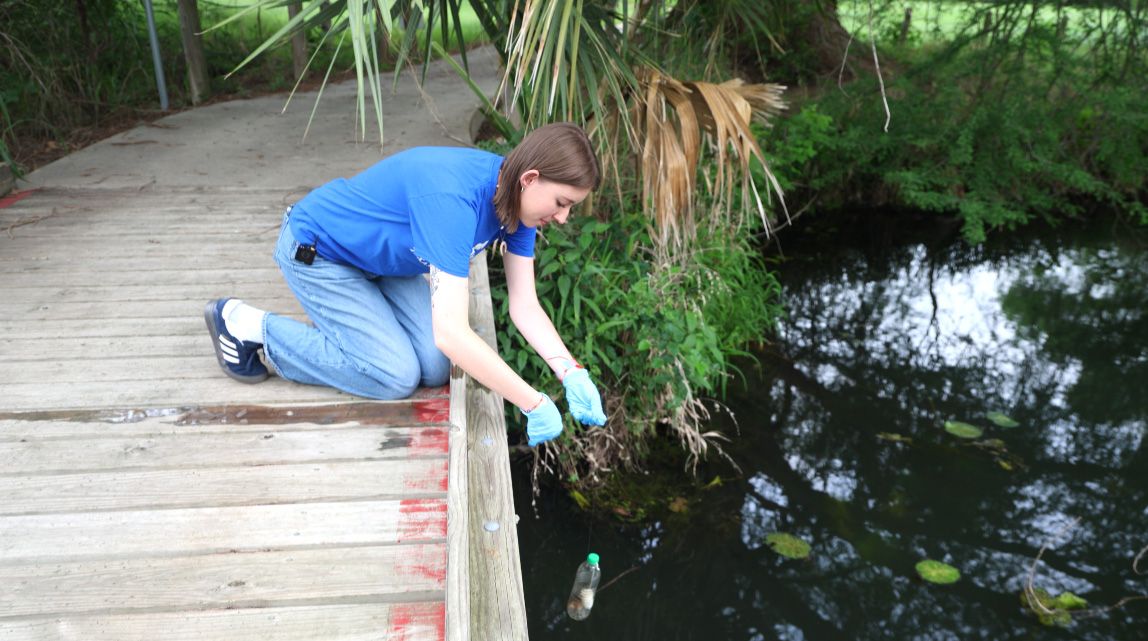
SAN MARCOS, Texas — Along a Central Texas waterway, a group of volunteers is using an unlikely tool to help detect pollution: a cotton tampon.
Through a program at Texas State University, community scientists are monitoring local waterways for signs of wastewater contamination using a method known as “tampling.” The approach tests for optical brighteners, synthetic chemicals commonly found in everyday products like laundry detergent and paper goods.
“I’m interested in the optical brightener training just because it gives me a chance to expand my scientific skill set,” said Kyla Perry, a community scientist involved in the program.
The initiative is part of Texas Stream Team, a statewide effort that trains volunteers to collect water quality data. Participants place a cotton sampler in a bottle and submerge it at designated sites, returning a day or two later to analyze the results.
“You go to your assigned site, leave it out for 24 to 72 hours, then come back and retrieve your sample and analyze it in a lab,” Perry said.
Program leaders say the method is both simple and effective. Optical brighteners, often used to make fabrics and paper appear whiter, can enter waterways through wastewater systems. Their presence can help indicate possible human sources of contamination when paired with bacteria testing.
“They are synthetic dyes that you will find in your everyday household products,” said Aspen Navarro, deputy director of watershed services at The Meadows Center for Water and the Environment. “They’re almost everywhere.”
With more than 190,000 miles of waterways across Texas, officials say expanding monitoring efforts is critical. Community scientists help fill gaps where professional testing may be limited.
“You can never have too many eyes on the ground,” Navarro said. “We always need more data when it comes to our waterways.”
For Perry, one of the biggest surprises was how easy the process is.
“I was most surprised about how simple it was and how cost effective,” she said. “I think it’s really accessible.”
Still, the findings can be serious. A positive result for optical brighteners may point to pollution entering a waterway, prompting further investigation.
“It’s always very concerning whenever you get a hit,” Perry said, “because that means there are optical brighteners somewhere in your waterway.”
In some cases, volunteers have helped identify environmental issues early, including fish kills and potential illegal dumping, according to program leaders.
“They’re kind of the first alarm system,” Navarro said.
Organizers say the program is free and open to the public, with training opportunities available across the state. The goal is to empower more residents to take an active role in protecting local water resources.
“We need it to survive,” Navarro said. “Everything runs on water.”