
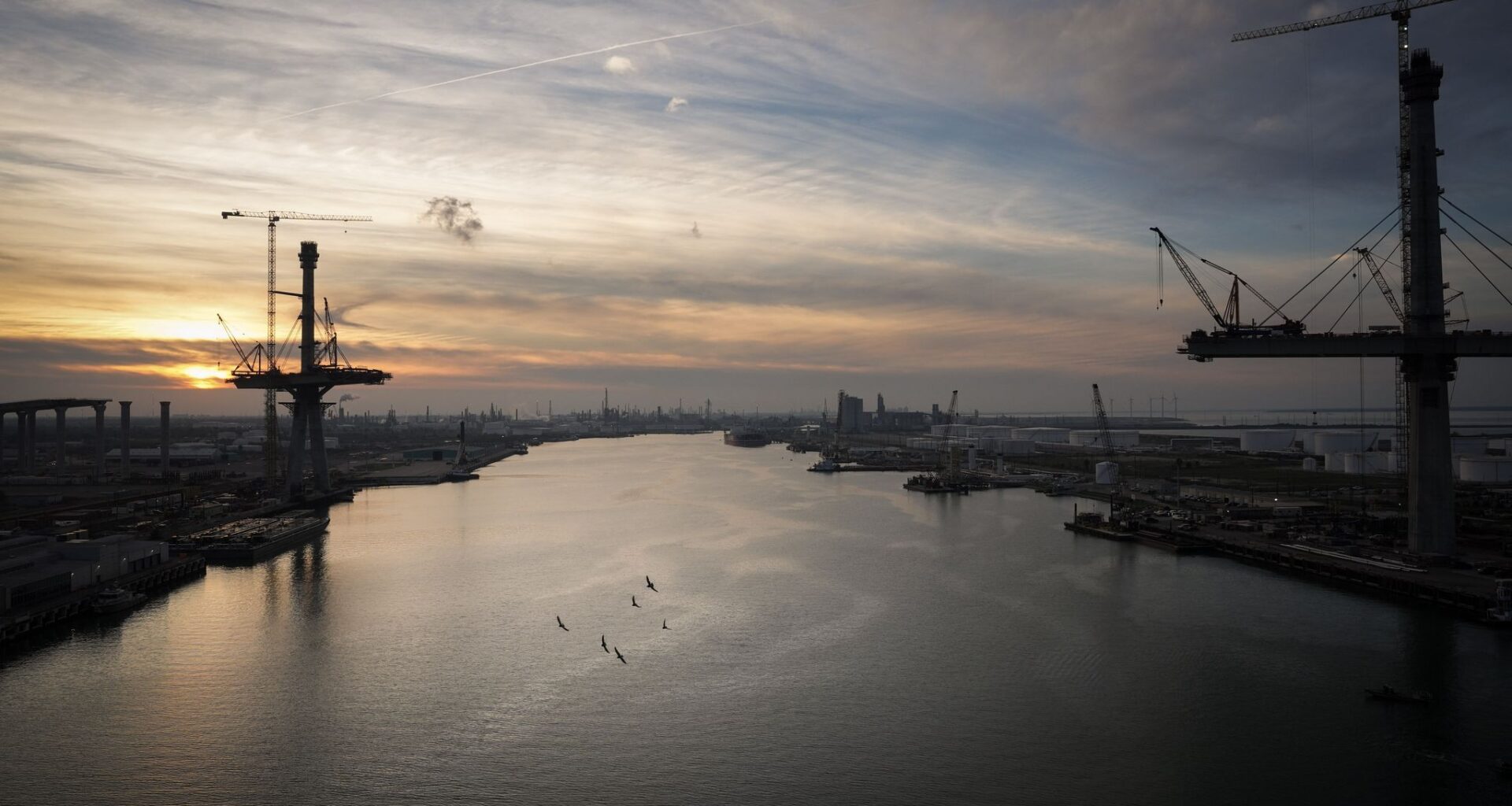
Birds fly over the Port of Corpus Christi as the sun sets Thursday, Nov. 16, 2023, in Corpus Christi, Texas.
Jon Shapley/AP
Months after Texas Gov. Greg Abbott blasted local leaders for backing out of a plan to build a desalination plant on the Corpus Christi ship channel, the state declined to help finance another, larger desalination facility that could similarly ease the region’s growing water crisis.
Early this year, the Nueces River Authority applied for a $140 million low-interest loan from the Texas Water Development Board to jumpstart planning and design for the larger project, which would be located on Harbor Island but intake water and discharge brine via a pipeline extending two miles offshore. That distance would help minimize the project’s impact on marine life and ecology, according to research.
READ MORE: Corpus Christi will likely face emergency water restrictions this fall, staff warns
Article continues below this ad
It’s unclear why the state denied the loan. The water board, whose members are appointed by Abbott, did not respond to specific questions about the project’s scoring. John Chisholm, the deputy executive director of the Nueces River Authority, said the decision was “very surprising.”
“Our project is going to bring much-needed water to an area that is really suffering right now,” Chisholm said. The river authority is now working to find other funding sources to move the project forward.
The move comes as Corpus Christi is experiencing historic water shortages amid rising demand from industry and a record drought. The city is likely to begin forcing residents and businesses to curtail their water use by 25% starting in September.
Neither of the two proposed plants would help the immediate crisis, but seawater desalination has been pitched as essential to the region’s longterm future, including its ability to continue serving and attracting petrochemical plants.
Article continues below this ad
Last year, the Corpus Christi City Council canceled a construction contract for the ship channel desalination project, known as the Inner Harbor plant, even though it had Abbott’s backing. The city had already been awarded $757 million in low-interest loans from the state for that plant, though it hadn’t received all of the money when it canceled the contract.
BACKGROUND: After pivotal vote, Corpus Christi is on the brink of a water shortage: ‘The clock is ticking’
The plant’s proposal has faced fierce opposition from environmental groups, who say discharging the salty brine that results from desalination directly into the shallow bay, rather than farther out at sea, would harm the fragile ecosystems that support endangered species and tourism. Proponents of the plant dispute that claim.
Gathering seawater and discharging the resulting brine farther offshore “is by far the best alternative in terms of impact to marine life and the ecology of the system,” said Greg Stunz, the senior executive director of the Harte Research Institute at Texas A&M University-Corpus Christi.
The Harbor Island project has faced its own set of complications, including years of legal and administrative challenges and a recent internal claim that a top river authority official inflated how much of the plant’s future water had been committed and paid for. (The river authority board said it had hired legal counsel to investigate the matter.)
Article continues below this ad
Andrew Mahaleris, a spokesperson for the governor, said the state had already made “significant investments to ensure Corpus Christi has the water resources it needs to serve citizens.”
“TWDB has committed to funding $757 million for the Inner Harbor Desalination Plant,” he said in a statement. “Governor Abbott will utilize all necessary tools to ensure the Corpus Christi area has a safe, reliable water supply.”
Chisholm said the river authority is currently seeking a developer for the project, and the Texas Commission on Environmental Quality will consider its discharge permit application next month.
But it is unclear how the multi-billion-dollar endeavor will be funded. Chisholm said he was looking to the Trump administration for help.
If built, the plant could produce 100 million gallons of fresh water daily, half of which would be earmarked for Corpus Christi. The project wouldn’t come online until at least 2029.
Article continues below this ad
Abbott threatened to withhold state funds from Corpus Christi last fall after the city council pulled out of the Inner Harbor project. At a campaign rally in March, he criticized the council’s handling of the crisis and threatened a state takeover of the city.
“We can only give them a little time more before the state of Texas has to take over and micromanage that city and run that city to make sure that every resident who goes to the water tap and turns it on, they’re going to be getting water out of their faucet — not because of what local leaders are doing, but because of what the state of Texas will do,” Abbott said.
The river authority had requested the $140 million from the State Water Implementation Fund for Texas, or SWIFT, which was created by the legislature in 2013 and overseen by the water board. SWIFT loans have lower interest rates and longer repayment terms, reducing the overall cost of water infrastructure projects for utilities and ratepayers.
The board had previously approved every loan application it received. But this year, facing a surge in demand for water infrastructure and inflation-driven cost increases, it only gave initial approval to 10 out of 23 applications. That represents $2.5 billion in loans out of $4.2 billion that it was asked to fund.
The projects that are likely to be funded include a water transmission pipeline proposed by the San Patricio Municipal Water District, which serves customers around Corpus Christi; an expansion of an existing groundwater project to supply utilities in Hays and Caldwell counties; and a new water treatment facility in Texarkana. Final funding commitments will be made in the fall.
Article continues below this ad
“Previous boards have chosen to fund all eligible projects in each of the past 12 cycles,” TWDB board member Brady Franks said in April, when the board approved the list of 10 projects. “And I understand that decision because those projects are less expensive today than they would be tomorrow. But … this year we will have to draw the line.”
The board announced this month that the state is likely to need to invest $174 billion in water infrastructure over the next 50 years to keep up with demand. SWIFT is currently one of the main ways it funds projects outlined in the state water plan.
Water experts almost uniformly praise SWIFT as a funding mechanism, pointing to the $17 billion worth of projects that have been financed from the legislature’s initial $2 billion appropriation. Projects are scored and ranked based on criteria like water supply needs, population served, project readiness, cost-effectiveness, and regional significance.
In November, voters approved annually allocating $1 billion from sales tax revenue into water projects. Half of that will go into SWIFT and the New Water Supply Fund for Texas.
But that money won’t be available until late 2028, said Sarah Kirkle, the director of policy and legislative affairs at the nonprofit Texas Water Association. That’s because the water carve-out only kicks in once sales tax revenues exceed a certain threshold.
She warned that delaying water projects would only make them more expensive. “When you end up delaying a water plan project to a future year, it almost certainly means that local ratepayers are going to have to shoulder increased costs, and there’s going to be delays in the delivery and timeline of new water supplies for those communities,” she said.