
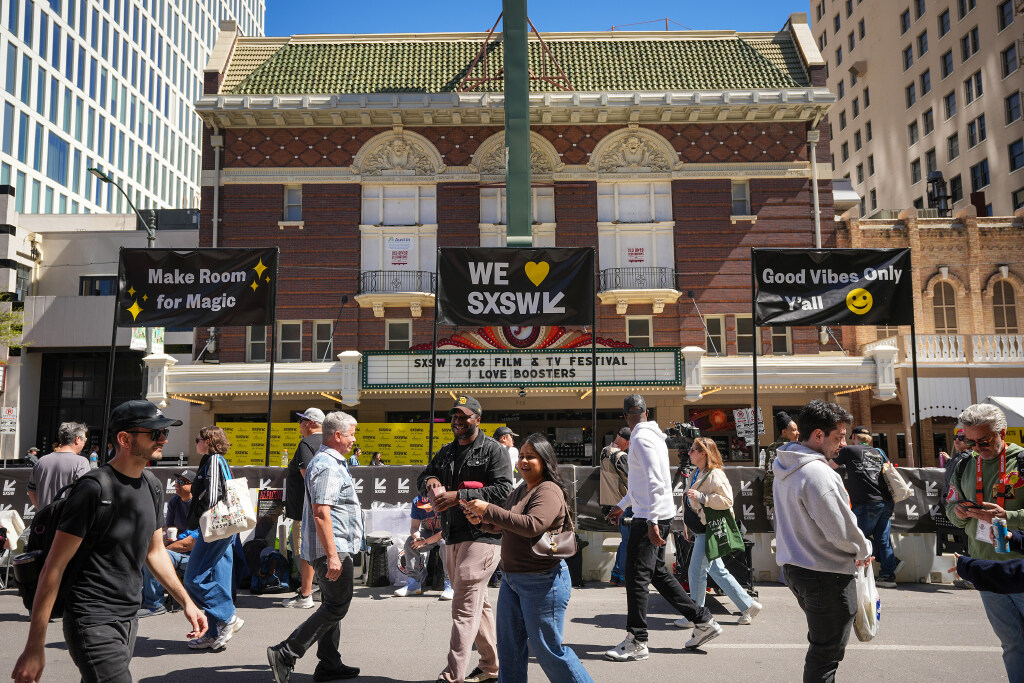
Festivalgoers walk along Congress Avenue in front of the Paramount Theatre, which hosts several red-carpet movie premieres during the South by Southwest Conference & Festivals. The festival is still a big driver of traffic and business for downtown establishments, many of which rely on the increased business from SXSW.
Jay Janner / Austin American-Statesman
This year’s South by Southwest Conference & Festival was certainly different.

Cut from its usual 10 days to seven, the 40th iteration of SXSW had only one weekend. It was spread across multiple downtown venues rather than being anchored at the Austin Convention Center. And, data now suggests, the new format didn’t bring the sort of economic boost Austin has come to expect from the event.
Article continues below this ad
Hotel occupancy and short-term rental bookings both dipped, with the second half of the festival generating some of SXSW’s worst numbers since the pandemic. Average foot traffic downtown took a significant nosedive. Alcohol sales also slipped.
Despite the slowdown, though, the festival remains an economic necessity for many downtown businesses — some of which are struggling since the convention center was closed last year for demolition and reconstruction.
“It’s been hard, I won’t lie,” said Heather Potts. “I can literally stare at a hole in the street in front of my businesses. We’ve had to get creative. But without SXSW, I don’t know how us or other small businesses would’ve fared.”
Article continues below this ad
Masked country singer Orville Peck performs a free concert at the Rivian Electric Joyride on Congress Avenue during the South by Southwest Conference and Festivals on March 14 in downtown Austin. Despite a drop in foot traffic, the festival remains an economic necessity for many downtown businesses.
Jay Janner/Austin American-Statesman
MORE: The best and worst of SXSW: Lainey Wilson’s cool country, line frustrations, a proposal
Every March for the past 15 years, she and her team have hauled everything out of her Cedar Door restaurant to make room for Fast Company magazine to turn the establishment into the “Fast Company Grill,” one of the most sought-after SXSW events every year. About five years ago, her next-door Foxy’s Proper Pub began hosting Inc. Magazine’s “Founders House.”
Article continues below this ad
“It’s a lot,” Potts said of the work to convert the establishments. “We load everything out, help our clients load everything in and turn around to do it again a few days later. But SXSW, that’s kicking off our high season. It’s extremely important to us, especially this year.”
The two businesses are at East Second and Brazos streets, right next to the massive convention center construction site. Since the center was shut down, Potts said, her revenue is down significantly, so SXSW — in any form — was a welcome relief.
“Yes, it looked different and it felt different,” she said. “We didn’t organically always see the hustle and bustle or foot traffic on the street, but our attendance was stellar. Every year for us does better, I mean we saw a few thousand people every day.”
Foot traffic and attendance decline
Downtown Austin saw reduced foot traffic during SXSW 2026, according to cell phone data from the Downtown Austin Alliance and Placer.ai.
Article continues below this ad
An average of 164,400 people visited downtown each day during the festival, about 7,400 fewer than in 2025. Saturday recorded the highest population since 2019.
People wait in line to visit the Paramount+ Lodge on March 14 during the 2026 South by Southwest Conference and Festival as the festival. The festival drew an average of 164,400 people downtown each day, a significant drop from last year’s totals.
Mikala Compton / Austin American-Statesman
SXSW has not yet released its official attendance totals but said numbers are on par with 2025, when attendance reached about 309,000. That’s below pre-pandemic levels, when the festival regularly reported more than 400,000 attendees.
Article continues below this ad
Typically, the average daily population during SXSW has increased marginally each year since the festival went virtual during the pandemic in 2021.
“I think we’ve all just had to be more intentional,” Potts said. “Fast Company and Inc., they really focused on curating intentional programming to bring people to the activations, so they didn’t rely on foot traffic.”
RELATED: See photos of the best events, music, movies and more in Austin
Mixed impact across restaurants and small businesses
Results varied for local businesses across downtown.
Article continues below this ad
Le Café Crêpe, located at East Second Street and San Jacinto Boulevard, said SXSW is typically a major revenue period, but foot traffic fell short this year.
Hideout Coffee House, a café and event space on North Congress Avenue, saw a 30% dip in sales during its final SXSW before closing at the end of March.
Across the city, the slowdown showed up in broader spending as well. Austin businesses reported about $104 million in alcohol sales in March 2026, roughly $6 million less than the same period last year, according to state mixed beverage gross receipts data.
Festival attendees order drinks, work or take a rest at the SXSW Innovation Clubhouse in Brazos Hall on March 12. During the month of March, Austin businesses reported selling roughly $104 million worth of alcohol, a drop of roughly $6 million from a year before.
Sara Diggins / Austin American-Statesman
Other businesses elsewhere downtown reported stronger results.
Article continues below this ad
For Stewart Jarmon, co-owner of Bill’s Oyster, this year marked the restaurant’s strongest SXSW since opening in May 2023.
The restaurant welcomed hundreds of festival attendees, many of whom returned multiple times.
“Yeah, some of our regulars shied away during the festival, but we had a lot of SXSW attendees coming through our doors,” Jarmon said. “We were a little worried about the Convention Center and the seven-day run, but we more than made up what we thought.”
Jarmon said the restaurant, near West Third and Lavaca streets and just blocks from several SXSW event spaces, saw a nearly 19% increase in sales compared to last year’s festival.
Article continues below this ad
“I think our food and service makes people return to us, but I am so thankful for our location,” Jarmon said. “We don’t have to deal with the convention center.”
Hotels and short-term rentals see uneven demand
Some hotels reported stronger activity during the condensed festival period. Arrive Austin, a boutique hotel on East Sixth Street, previously told the American-Statesman it saw increased demand this year. Visit Austin data showed hotel demand during the first seven days of SXSW rose 12% compared to the same stretch last year, partly because those dates aligned with the first weekend of spring break.
But that early increase did not offset the loss of the festival’s second weekend.
Article continues below this ad
Hotels sold roughly one-fifth fewer rooms, resulting in about $10.5 million less revenue citywide, according to Visit Austin.
“This was a year of significant transition,” said Visit Austin President and CEO Tom Noonan, who cited the absence of the convention center and broader economic conditions.
South by Southwest Festival attendees wait in line at Esther’s Follies on March 15. Despite longer lines and a more spread out festvival this year, SXSW saw less foot traffic downtown.
Sara Diggins / Austin American-Statesman
Midweek performance lagged. Monday through Wednesday saw some of the lowest occupancy rates of the festival. Wednesday’s downtown occupancy rate was just over 50%, compared to nearly 70% the same day last year.
Article continues below this ad
Downtown hotel revenue per available room averaged about $346, down more than 4% from last year’s $361, according to Visit Austin. Rates peaked at about $517 on Friday before dropping to $137 by the final day.
Short-term rental activity followed a similar pattern.
Airbnb and Vrbo bookings rose during peak days — up 20% on Friday, 15% on Saturday and 6% on Sunday compared to last year — but overall bookings declined about 19% due to the shorter festival, according to AirDNA.
Article continues below this ad
The Austin Convention Center will remain under construction through next year’s festival, and SXSW plans to continue its seven-day format.
SXSW EDU is scheduled for March 13–16, 2027, with the main festival running March 15–21.
Even with smaller crowds and a more fragmented footprint, the festival remains a critical economic driver for downtown businesses navigating a changing landscape.
“We’d love the two weekends back,” Potts said. “We would love the festival to go longer, and as an owner of an Irish pub, the loss of St. Patrick’s can be tough. But we’re weathering the storm of no convention center. SXSW is a significant revenue driver for us, for everyone really. SXSW may have been smaller in scale and scope but its impact really wasn’t.”
Article continues below this ad