
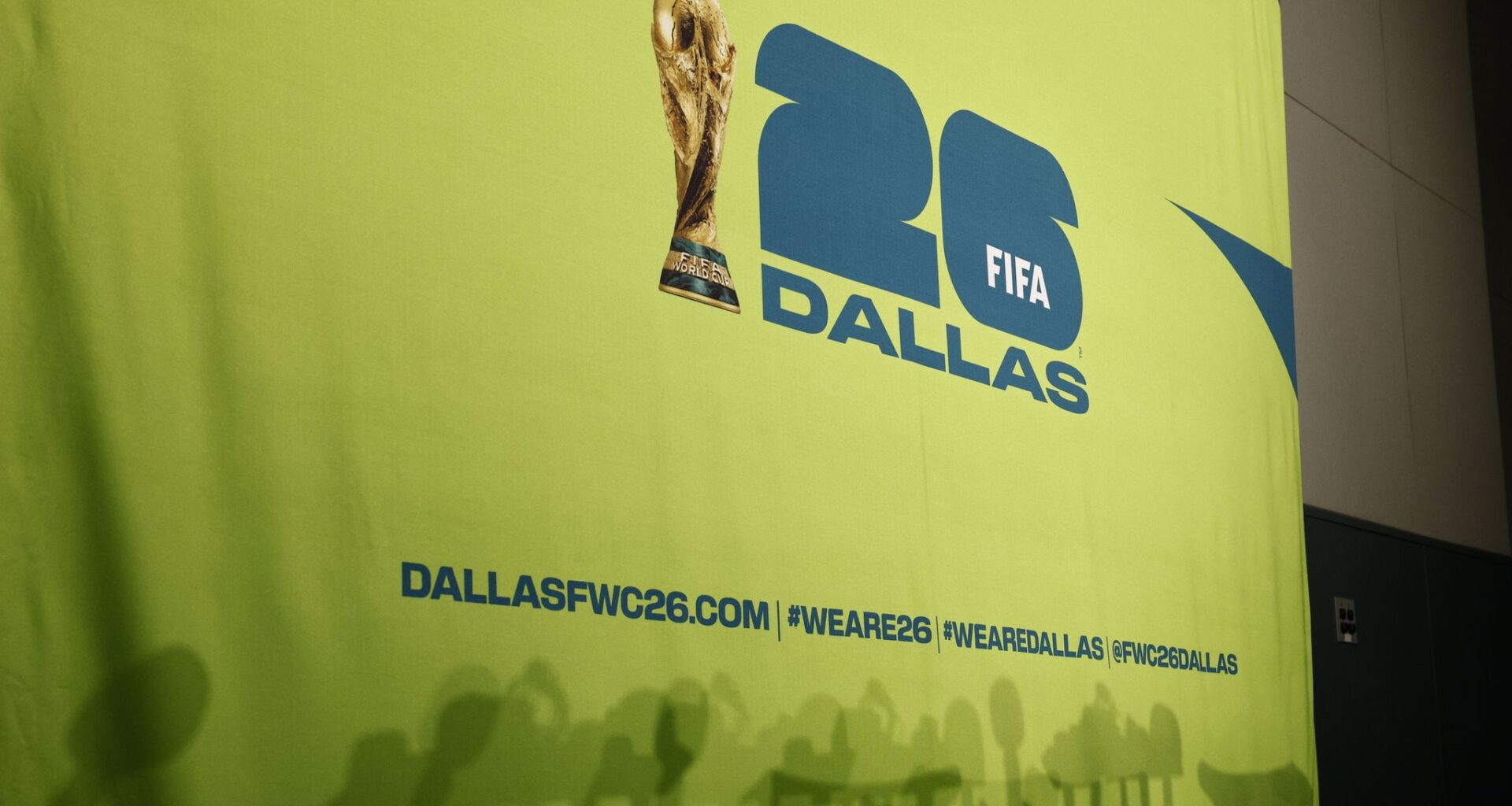
A 2026 FIFA World Cup Dallas logo is seen before a news conference at AT&T Stadium, Thursday, Jan. 15, 2026, in Arlington.
Elías Valverde II/Staff Photographer
North Texas made the World Cup roster. Now it has to play by FIFA’s rules.

Dallas and its partners must handle everything outside the lines: security, transportation, emergency response and operations.
Article continues below this ad
When FIFA takes over the AT&T Stadium in Arlington for matches beginning in June, it controls access, branding and the match-day environment.
That split turns the run-up into a long pregame, with Dallas largely responsible for making it work and FIFA stepping in to control the main stage.
The work is laid out in more than 240 pages of a World Cup hosting agreement and related documents reviewed by The Dallas Morning News, offering one of the clearest looks yet at how responsibilities are divided.
Make Dallas News a preferred source so your search results prioritize writing by actual people, not AI.
Add Preferred Source
After The News filed a request for the records, Dallas asked the attorney general whether parts of its FIFA agreements could be withheld. The state ordered release, allowing limited redactions for financial and proprietary details.
Article continues below this ad
The documents show FIFA pays certain fees, including stadium rental, but Dallas, as the “host city authority,” agreed to cover its obligations, mostly at its own expense.
“Unless otherwise explicitly stated…the host city authority shall be responsible to bear all costs and expenses incurred by the host city authority for the fulfillment of its obligations,” the host agreement says.
Details redacted
The stadium agreement between the U.S. Soccer Federation and AT&T Stadium’s operator lists a $2.45 million rental fee, though much of the surrounding financial details are heavily redacted.
Article continues below this ad
City Council member Chad West said the World Cup presents a balance, with real costs but potential gains for small businesses and sales tax revenue.
“A huge part of this is just the excitement of having this event here,” West said.
West said his main concern is transportation, particularly how people will get around.
Many fans are from cities “where you can walk or take public transit,” he said. “In Dallas that is not an option for most parts of the city and certainly not the region.”
Article continues below this ad
The agreement splits transportation duties, with most public-facing responsibilities falling to local authorities.
The host must provide game-day transit capable for large crowds, while also managing transit hubs, signage and traffic controls across the region.
FIFA, meanwhile, covers dedicated transportation for its own officials, staff and teams.
The agreement requires Dallas to deliver security “in accordance with applicable standards,” working with local and federal agencies to establish controlled perimeters, screening points and restricted zones around the stadium and event sites.
Guests take photos of the people involved in creating the official FIFA World Cup Dallas Host City Poster during an unveiling event at Klyde Warren Park in Dallas, Texas, on April 17, 2025.
Jason Janik/Special Contributor
It also requires a “clean stadium,” stripping out outside advertising and controlling what can be seen and sold not just inside the venue, but throughout a broader surrounding area including neighboring buildings, parking lots and streets.
Article continues below this ad
FIFA controls major game-day revenues, including ticketing and merchandise.
The agreement also gives FIFA exclusive rights to media, marketing and other commercial revenues tied to the World Cup.
Other obligations
If anything breaks down, it’s supposed to show up early, with advance testing designed to expose problems before kickoff.
Article continues below this ad
As for Dallas’ other obligations, it must:
Support fan festivals, media operations and training sites, coordinating permits, agencies and services across the region.
Protect FIFA’s commercial rights, restricting unauthorized ads and blocking “ambush marketing.”
Coordinate transportation plans for teams, media and VIPs, including designated routes, access points and traffic controls.

By signing up, you agree to our Terms Of Use and acknowledge that your information will be used as described in our Privacy Policy.
Teodoro Benavides, a University of Texas at Dallas professor and former Dallas city manager, said such deals often favor organizers like FIFA, which keep most revenue while shifting costs to host cities.
Article continues below this ad
“They’re kind of being forced by the economics to go to places that already have all the infrastructure already built and they don’t have as much downside risk,” Benavides said.
Organizers estimate a $1.5 billion to $2.1 billion impact, but whether visitors come, stay and spend in Dallas is uncertain.