
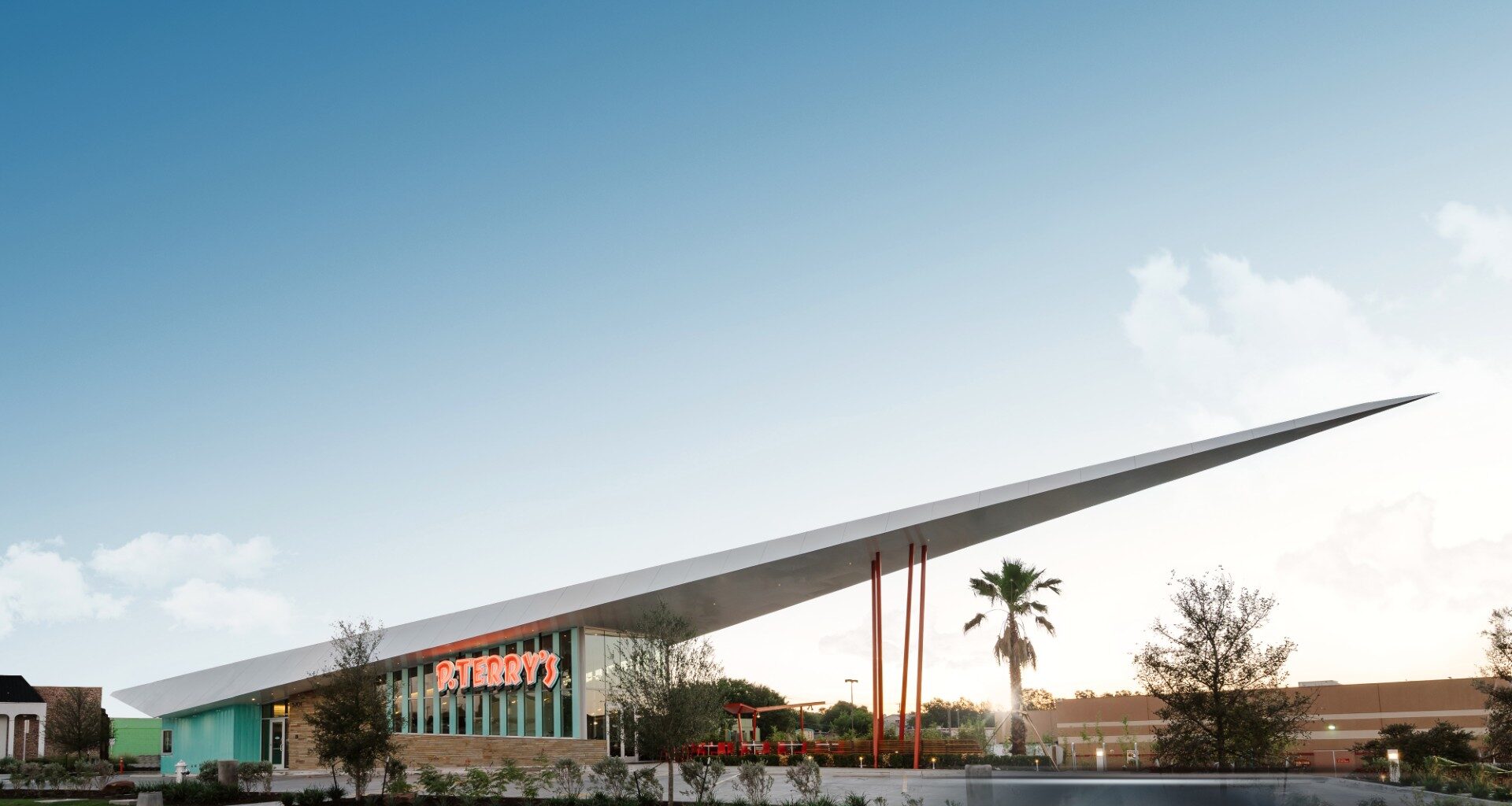
The flagship P. Terry’s burger stand in Austin, Texas.
Image courtesy of P. Terry’s
No two P. Terry’s burger stands seem to look alike, and they certainly don’t look like any others either. But there’s a reason for that.

We’ve all come to expect the box-like, rudimentary fast-food joints that seem to resemble giant ant traps. Take away the tall signs with their varying logos, and you’d have trouble telling a Whataburger from a Burger King or a Wendy’s. When it’s a P. Terry’s, however, you just know.
Article continues below this ad
“Patrick Terry never lived in California, but he was always drawn to Californian architecture, midcentury modern, how that Spanish style meshes together with Route 66 gas stations,” P. Terry’s senior vice president Monty Montgomery tells Chron.
They often look like something out of the Jetsons, or what you’d find from a California World’s Fair in the 1950s: upswept roofs, bold curves and cantilevered structures that have that midcentury space age optimism and abundance written all over them. The P. Terry’s flagship location in Austin features a triangular roof that seems to pierce the sky. Another recently opened in Cypress is modeled on the USS Enterprise from Star Trek. They’re both just burger stands, though it looks like liftoff is imminent.
Looking to Mack Eplen’s Driveateria, and out West
Co-founder Patrick Terry grew up in Abilene, Texas, loving Mack Eplen’s, the legendary burger joint and “Drivateria” that was a hotspot from the 1950s through the 1970s, eventually shuttering all their locations by the late 1990s. Terry wasn’t just a fan of the lemon ice box pie; he loved the design as well.
Article continues below this ad
“His dream was to always have a burger stand … He went into Michael Hsu’s Office of Architecture here in Austin, brought in his Googie architecture books, and was like, ‘This is what I want to do,'” Montgomery said.
The origins of Googie architecture
What is Googie architecture? It’s more than just a silly name. The futurist style originated in Southern California in the 1950s as an echo of that atomic, space age optimism, with a burgeoning car culture thrown in.
You could often find it in roadside businesses such as motels and gas stations, with swooping curves and geometric shapes that all suggested motion. Many of the buildings looked like boomerangs and flying saucers, and used glass, steel and neon signs to add to the effect. The name links back to Googie’s Coffee Shop in Hollywood, designed by Googie forerunner and architect John Lautner.
Article continues below this ad
“Patrick and his wife Kathy worked with Michael Hsu, put their heads together, and came up with this timeless design,” Montgomery said. The first P. Terry’s opened in 2005 at the corner of South Lamar and Barton Springs in Austin, Texas.
The Cypress, Texas spot modeled after the USS Enterprise Star Trek ship.
Image courtesy of P. Terry’s
The company now has 38—far more than the singular P. Terry’s the couple initially planned. But as the company grew, Patrick Terry remained committed to the architectural style.
“[Patrick] wanted each location to be unique in its own way, as long as it met those features: the straight lines, the natural quarried stone, the western red cedar, and lots of glass for natural sunlight coming in,” Montgomery said.
Article continues below this ad
Today, P. Terry’s has numerous locations in the Austin metro area, recently expanded to San Antonio, and has a few currently open in the Houston area, including two in Richmond, one in Spring, and another coming to Houston proper at 4815 Katy Freeway, down the road from St. Thomas High School.
Patrick takes a part in designing each new one. “Once it’s up on the screen, Patrick rolls up his chair, and says ‘I like this, I don’t like that. This isn’t quite as abstract as I want it to be,'” Montgomery said.
Abstract is certainly the keyword. The P. Terry’s burger itself is a classic drive-in offering structured like your traditional burger. The buildings are anything but, seeming to reach to the sky as if beckoning aliens to grab a bite.
Article continues below this ad
It leads one to wonder what the burgers might look like if they were constructed with Googie architecture as well. You’d probably need a knife and fork.