
The Athletic has live coverage of 76ers vs. Celtics Game 7.
LOS ANGELES — Long before these Houston Rockets’ once-promising season came to a petering end with a Game 6 loss to the Los Angeles Lakers on Friday, people around the NBA wondered aloud why a team that looked so good on paper visibly lacked cohesion and chemistry on the court.
On March 20, barely a month removed from allegations that he had been heavily critical of current teammates on a social media burner account, the star who was brought in last summer to take the team to greater heights pushed back on that emerging national narrative.
“How was the body language tonight? Was it good?” Kevin Durant famously and facetiously asked after a win over the Atlanta Hawks. “How was the vibes? Good vibes?”
He questioned those critical of his own on-court body language and came to a conclusion.
“It’s good when you win,” Durant said that night. “When you get a loss, though, the floodgates are going to open.”
Last season, the Rockets were a young, scrappy team on the rise that surged to the No. 2 seed in the Western Conference. But their youth caught up to them in the first round of the playoffs, as the veteran Golden State Warriors upset them in a rock-fight seven-game series. After spending months sending signals that they wouldn’t accelerate their timeline by trading young stars to chase Durant, the Rockets changed course and acquired the former league MVP last summer. The goal: Add elite scoring to their ferocious defense and compete for a title right away.
Durant, 37 years old when the season began, showed surprising durability in his 18th NBA season — playing 78 games and finishing No. 2 in the league in total minutes. But when Houston needed him most, he missed five of its six playoff games with injury, including Friday’s 98-78 closeout loss.
Left to fend without their veteran leader, the Rockets were snakebitten by a familiar foe — their youth — and coach Ime Udoka declared it can no longer be an excuse.
“Grow up,” Udoka said after his team lost Friday’s Game 3, despite having the ball and a six-point lead with 33 seconds left. “You’re not young anymore. You’ve been to the playoffs once (before). (These are) horrendous mistakes.”
So after another first-round exit, this time in humiliating fashion following aggressive win-now moves, what’s next for these tortured and tantalizing Rockets?
They must decide whether to double down on a roster with clear concerns or perhaps go all in — yet again — by chasing another superstar this summer when Giannis Antetokounmpo, Kawhi Leonard or Donovan Mitchell could be up for grabs.
But those choices can’t be made until the Rockets make sense of what happened here first.
Was this a case of bad fortune, with season-ending injuries to two of their most valuable veterans and culture-setters, point guard Fred VanVleet and center Steven Adams? Did the Durant ailments prove too much to overcome? Or, amid all the frustration and dysfunction displayed over the past seven months, was there something deeper?
What we do have now is an answer to Durant’s rhetorical question: The vibes were definitively not good. And in Houston, the floodgates burst wide open.
The Rockets head into the offseason with most of their core under contract, but general manager Rafael Stone will have to be precise with his decisions. Houston’s roster has 10 players under contract and just under $22 million in room below the projected first-apron payroll threshold.
Durant signed a two-year, $90 million extension last summer, but he has a $46 million player option for the 2027-28 season, which will raise some questions about his long-term future. Durant will be 38 next season, and he’s already expressed a desire to write the final chapter of his career in Houston.
The most pressing free-agent decision going into the offseason may center on what comes next for 24-year-old forward Tari Eason, who is set to hit restricted free agency. He’s been a key piece for Houston the past two seasons with his disruptive defensive presence, but his offensive impact — particularly from the 3-point line — fell off a cliff during the second half of the season.
The Rockets and Eason’s representatives came close to inking a long-term extension before the deadline last October that could’ve reportedly been in excess of $100 million, but they ultimately decided to come back to the negotiating table this offseason.
After the trade deadline, Stone called Eason “an enormous contributor” and added that the Rockets “look forward to having a great future with him. He’s a big part of our plans.”
Yet, this Rockets roster could get very expensive in the coming years after adding an Eason extension to the other big contracts already on the books.
Bringing back Eason could potentially put the Rockets in a position to have five players on next year’s salary cap making north of $20 million and eight earning at least $10 million annually. That doesn’t even include the lucrative extension young star Amen Thompson is expected to sign this summer, potentially a five-year deal worth more than $250 million.
Ownership has shown a willingness to shell out the money to construct a competitive roster, but Stone will have to be strategic in how he puts all the pieces together.
VanVleet will be another player to keep an eye on this offseason. He has a $25 million player option for the 2026-27 season. He could just bank that money as he continues his recovery from a torn ACL. But there’s also a chance the 32-year-old could negotiate a new deal with Houston to provide some short-term cap flexibility in exchange for a few additional years of security.
Durant also took $30 million less than his max extension last offseason to help Houston build the roster around him.
The obvious priorities for the Rockets going into the offseason are finding more reliable outside shooting and ballhandling, but players with those skills rarely come cheap.
While Udoka will certainly be under fire for the part he played in the collapse, he signed a lucrative multiyear extension last summer that most league observers believe should shield him from being fired. The third-year Rockets coach is still considered one of the NBA’s elite defensive coaches, with this latest version of his team still finishing sixth in defensive rating despite losing their most impactful defender, Dillon Brooks, in the Durant deal (they were fifth last season). The offense — and the question of how to fix it — is another matter altogether. Perhaps the best answer to this question is going out and acquiring another superstar talent to pair with Durant this summer.
Durant, of course, was supposed to be the solution to that longstanding problem.
The decision to add Durant last June was a calculated risk by the Rockets, who had seen their young core nearly double its win total in Udoka’s first season (from 22 to 41) en route to a 52-win campaign last season. For all of Durant’s greatness, there was an unavoidable truth that came with adding a star player in his late 30s to a roster full of 20-somethings: Expectations would rise, and the proverbial runway would shrink.
Yet the first-round loss to Golden State served as a reminder that Houston still needed an elite perimeter scorer, with 23-year-old Jalen Green’s struggles during that seven-game series serving as a failed job interview for that crucial position. The Rockets finished 12th in offensive rating during the regular season (115.8 points per 100 possessions), then saw a steep decline in the series against the Warriors (104.9). Less than two months later, they did the deal with the Phoenix Suns that brought Durant to Houston while sending Green, Brooks and the No. 10 pick in the 2025 NBA Draft (Khaman Maluach) to Phoenix.
Just like that, this up-and-coming team in the West had morphed into a full-fledged contender featuring premier talent both young and old. The pressure, in turn, was on.
As Durant has publicly discussed, he chose the Rockets in the process that brought him to town just as much as they chose him. The Suns had nearly traded him to Golden State without his knowledge at the February 2025 trade deadline, only for Durant to kill the deal by making it clear he had no interest in a Warriors reunion. This Rockets move, in that sense, was a case of him righting that wrong while showing a level of belief in what Houston had already built.
“When people can just hang your career in the balance like that and just choose what they want to do with your career, (it’s) a nerve-wracking feeling,” Durant said at an event the day the deal went down. “But being able to kind of dictate what you want to do, and being with a team that values you, I’m looking forward to it.”
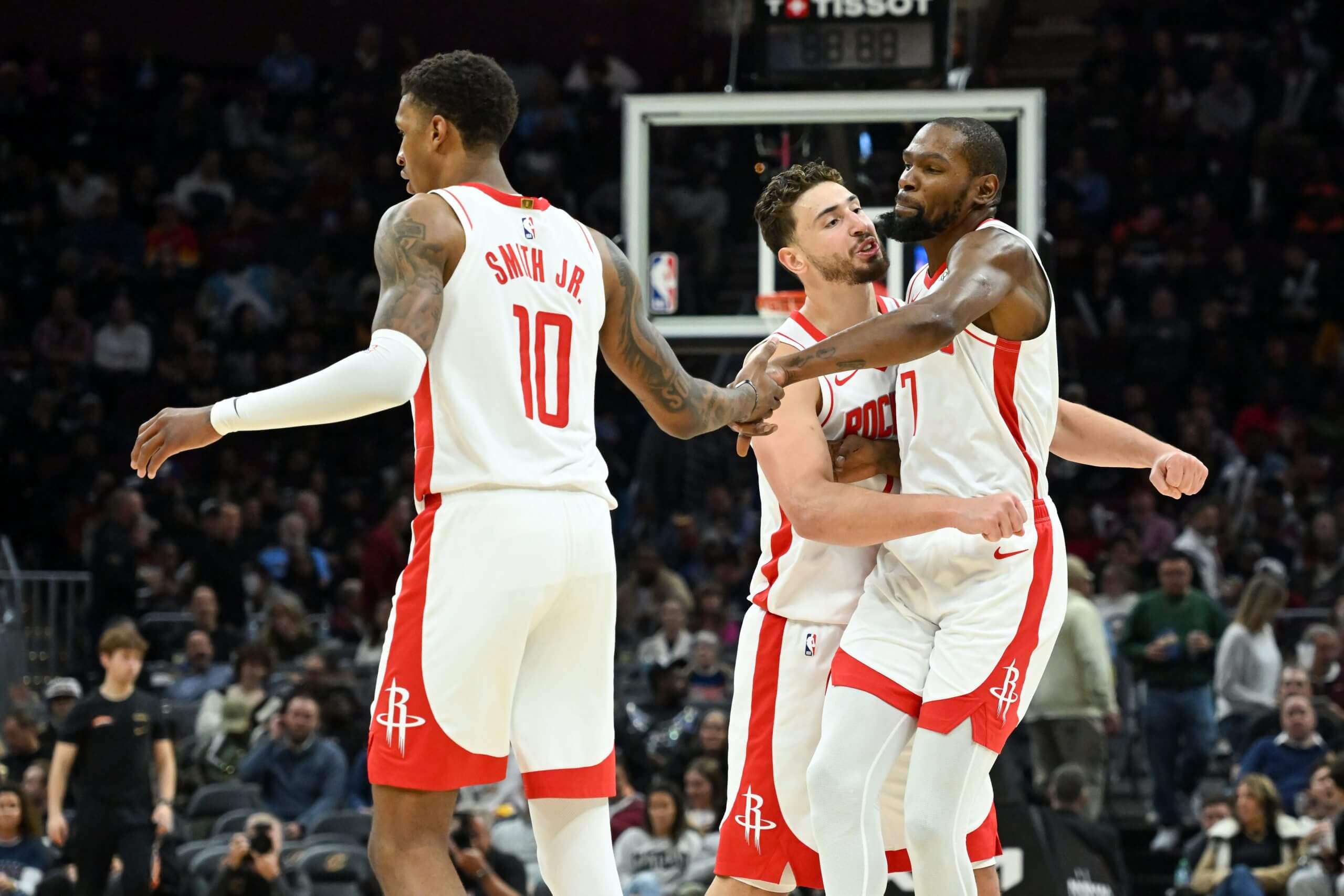
Jabari Smith Jr. and Alperen Şengün were two teammates criticized by a burner that was alleged to belong to Kevin Durant. (Nick Cammett / Getty Images)
For Durant and his new team, the mood would shift in a major way from there. VanVleet tore his ACL during a late-September minicamp in The Bahamas, creating a playmaking void that would be felt so profoundly at season’s end. Adams, whose ability to create second chances offensively helped mask Houston’s offensive deficiencies, saw his season end on Jan. 20 with an ankle injury that required surgery.
Less than a month later, amid a stretch in which the Rockets lost seven of nine games entering the All-Star break, allegations surfaced that Durant had criticized teammates — including sharp jabs at Alperen Şengün and Jabari Smith Jr. — while using a burner account on X.
Several league sources with close ties to Rockets players indicated the social media situation was a significant distraction, one that was never truly resolved internally. Durant never discussed the matter in any detail publicly, saying only that he was “not here to get into Twitter nonsense.” Privately, league sources said his teammates agreed to keep the matter in-house while focusing on basketball. It is unclear whether Durant ever clarified to his teammates if the account belonged to him.
“My teammates know what it is,” Durant said during a media session with reporters. “We’ve been locked in the whole season.”
On the court, Durant did his part. He was one of just five players who averaged 26 points, five rebounds and four assists in the regular season, joining an elite group that also included All-Stars Jaylen Brown, Luka Dončić, Nikola Jokić and Antetokounmpo. But when it came to chemistry, the Rockets seemed to struggle from beginning to end.
The most painful part — one he surely didn’t see coming — came at the end.
After becoming the first player 37 or older to log 2,800-plus minutes since Clifford Robinson in 2003-04, Durant endured a series of unfortunate events that sidelined him when it mattered most. The knee injury that kept Durant out of Game 1 against the Lakers was a fluke accident, with one of the team’s two-way players bumping knees with him in practice as they both went for a loose ball. Durant returned in Game 2 but suffered a sprained right ankle in the second half of that loss that ultimately forced him to miss the remainder of the series.
As if his team’s Game 3 collapse wasn’t dramatic enough, skepticism around the Durant-Rockets union reached a fever pitch due to Durant’s decision not to sit on the bench with his teammates during that pivotal loss. Instead, he elected to continue the treatment on his injured ankle at Toyota Center while the game was going on. Udoka defended Durant’s decision the following day, saying, “He was back there getting treatment, getting the ice and doing things you can’t do on the bench.” The fact that he wasn’t able to return in the series, in the end, was as good a sign as any that the rehab needed to try and get back was intense.
As always with Durant, deciphering the noise around his relationship with the organization and his teammates can be complicated.
Case in point: Houston’s Game 4 blowout win (115-96). Durant, still sidelined by the ankle injury, spent the entire evening supporting his teammates on the bench as they avoided the sweep. As Thompson shared afterward, Şengün had given a motivational speech before the game that seemed to inspire them all. The vibes, as they were, looked undeniably good.
“It’s funny hearing certain things where you’re just like, ‘Where the hell did this come from?’” Udoka told The Athletic after Game 5 when asked whether his group was connected enough this season to be competitive at the highest levels. “For us, from Year 1 (when he got there in the 2023-34 season), we’ve always been a competitive team. So that’s a given. We’ve got a bunch of dogs that are competitive and fighting. We rarely get blown out.
“But the young guys have kind of been battle-tested now. And for us, (competitiveness) is not even a question. Like I said, I don’t think anybody in the locker room or with our team pays attention to any of that (discussion) because you just laugh at it, like, ‘Where the hell is this coming from?’ It’s the total opposite of what it is, so that’s the way we think about it.”
But in the end, even accounting for the injuries, these results fell well short of expectations. And the Durant partnership, quite clearly, didn’t deliver what either side envisioned.
One of the great ironies of this Rockets season is that, despite having one of the greatest scorers in league history still performing at an All-NBA level, Houston’s effectiveness on offense was an issue. It ultimately played the biggest role in the team’s demise against the short-handed Lakers, who were missing their two top scorers in Dončić and Austin Reaves.
There were times when the Durant-Şengün pick-and-roll shone, and the backcourt combination of Thompson and Reed Sheppard showed great promise as they took on bigger playmaking roles with VanVleet sidelined. When this group was moving the ball and the shots were falling from the perimeter, they looked dangerous enough to make noise in the West.
The issue was that those explosive stretches were far outnumbered by stagnant isolations that left some of Houston’s dynamic athletes standing around while Durant and Şengün, a fellow All-Star, attacked one-on-one matchups.
Durant and Şengün routinely carried a heavy load, made tougher by tight spacing that stemmed from the team’s limited outside shooting. Not to mention, the lack of a proven point guard to settle the offense without VanVleet.
The Rockets finished the regular season ranked eighth in offensive rating, but that number can be somewhat deceiving because Houston relies so heavily on offensive rebounds to create second-chance points. Per Cleaning the Glass, Houston ranked No. 19 in points per play on half-court possessions, and that number dropped even more once Adams’ season came to an abrupt end.
While VanVleet’s absence may have been more glaring because there was no obvious backup plan, Adams’ injury was similarly devastating because he is such an essential part of their biggest strength.
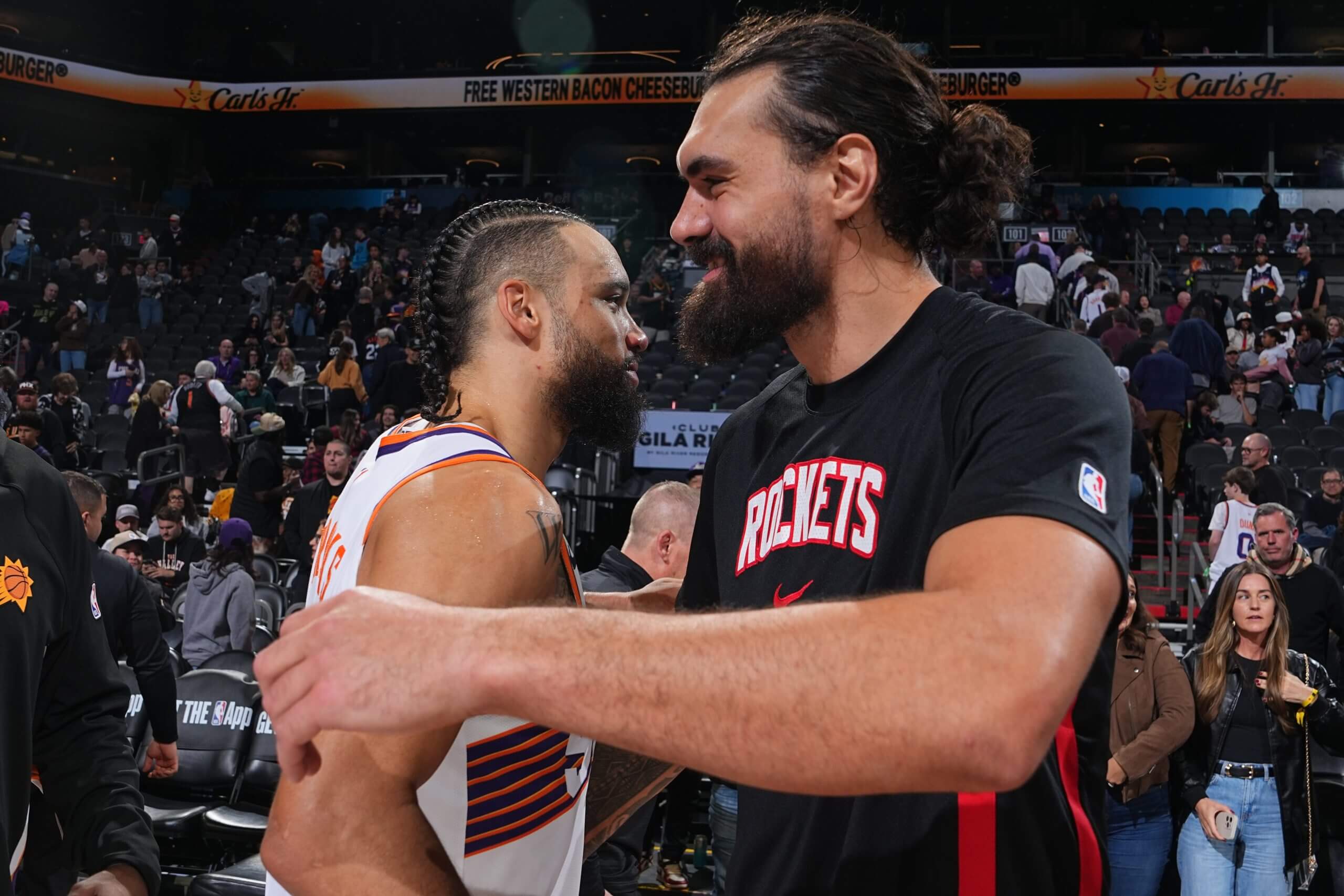
Steven Adams, seen hugging former teammate Dillon Brooks, was a notable absence for the Rockets at points of the season. (Garrett Ellwood / NBAE via Getty Images)
Even in his 12th season, Adams was one of the most dominant forces in the league on the offensive glass. With him in the lineup, the Rockets were on pace to put up record numbers in second-chance opportunities. Before his ankle injury, Houston was grabbing an offensive rebound on 41 percent of its misses, an unprecedented number. But once Adams was gone, that number dropped to 36.5 percent, still very good but nowhere near as overwhelming.
Without those added possessions, it exposed just how inconsistent the Rockets were at generating — and converting — quality offense.
Houston’s lack of cohesion and shot makers was most apparent during late-game situations, when the pace slowed down and it became slightly easier to force the ball away from Durant. Ultimately, this may go down as Houston’s most glaring weakness, which, once again, is baffling for a Durant-led team.
Repeatedly throughout the season, Houston’s offense would come to a screeching halt in clutch situations, and it led to them throwing away several games that were within their grasp.
The Rockets blew a 25-point lead in an overtime loss to the New Orleans Pelicans on Dec. 18; a 14-point lead in the fourth quarter of an overtime loss to the Sacramento Kings on Dec. 21; a 13-point lead in the fourth quarter of a loss to the Portland Trail Blazers on Jan. 9; and a 16-point lead in the fourth quarter of a loss to the New York Knicks on Feb. 21. They also became the first team to ever give up a 13-point lead in overtime during a loss to the Minnesota Timberwolves on March 25.
The most appalling collapse came at the end of Game 3, when the Rockets became just the second team in the last 30 years to blow a six-point lead with less than 30 seconds left in a playoff game. Udoka’s harsh words for his team after the game came as somewhat of a surprise, but it was partially fueled by pent-up frustration over his team’s repeated failures in these situations. Friday’s loss dropped the Rockets to 1-8 in overtime games this season.
“I don’t know if you want to say youth or scared of the moment or whatever’s the case,” Udoka said. “It’s obviously a weakness of ours to close out and finish.”
Part of the calculus for Houston coming into this season was that its young core was good enough to compete for a title immediately once a player of Durant’s caliber was added to the equation. That clearly turned out to be untrue.
Şengün was an All-Star for the second time in his career, but his inconsistency, especially on the defensive end, was a persistent issue. Thompson made an obvious jump in Year 3, but he wasn’t ready for all the responsibilities that come with being a full-time point guard. Sheppard had some great stretches during the regular season, but he looked overwhelmed by the speed, physicality and added pressure of the postseason.
After falling into a 3-0 hole against the Lakers, the Rockets responded. With Durant ruled out, Şengün gathered his teammates the morning before Game 4 and delivered an impassioned speech that unified the group. His words played a major role in Houston finding new life in the series and winning Games 4 and 5 with relative ease. Yet, the lack of consistent offensive production came back to bite the Rockets again once the Lakers closed the series out in Game 6.
Now, a major question looms as the Rockets try to balance the pressure of putting a championship-level team around Durant in his final years while continuing the development of the young core that’s been assembled in Houston over the past five seasons:
Can they do both?
“I do firmly believe in continuity. I think there are real advantages to teams that have continuity,” Stone said after standing pat at February’s trade deadline. “This group does not have that. I think time should be our friend in that respect.”
Along with all the concerns about keeping this team together despite the off-court drama, there will be some tough questions to answer about whether getting VanVleet and Adams back in the mix will be enough to put the Rockets on the same tier as the West elite.
Once Durant is in the building, the win-now mandate is obvious. But can Durant and the Rockets, with this current core, actually live up to those expectations? Should Houston prioritize chasing the limited window that comes with a 37-year-old superstar, even if it means chipping away at these young players that they’ve built up over the past few seasons?
If the Rockets decide to chase another star-level talent this summer — like so many rival executives believe they will — they are well positioned to do so. But whether it’s chasing Antetokounmpo, or perhaps Leonard or Mitchell, that approach runs the risk of backfiring if they come up short while sending the wrong kinds of signals to this current core.
Then again, it was quite clear at season’s end that protecting the feelings of players is not among the Rockets’ chief concerns. There are bigger questions to answer.