
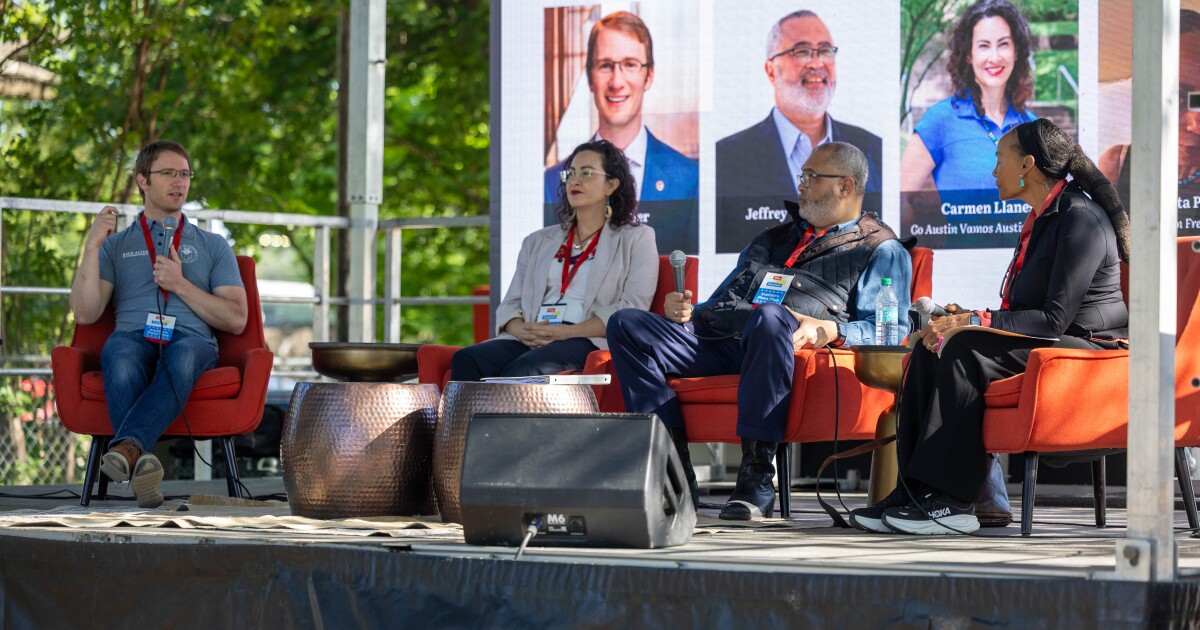
Austin has made some strides in improving housing affordability in recent years, but gaps in deeply affordable and middle class options persist, according to a panel of local leaders who spoke at the inaugural KUT Festival on Saturday.
The panel, moderated by Alberta Phillips of the Austin Free Press, included Austin City Council Member Ryan Alter, Travis County Commissioner Jeff Travillion and community organizer Carmen Llanes, executive director of Go Austin Vamos Austin.
Each was asked to answer the same question: Who can afford to live in Austin today?
“Unfortunately, you have to be very wealthy or very poor to live in Austin today,” Travillion said, pointing to the existence of income-restricted affordable housing. “The difficulty is for teachers, for government employees … for regular folks.”
Many of those “regular folks,” Travillion said, also have to weigh whether strong schools, health clinics and public transportation are available in the areas of Travis County where they can actually afford to live.
Alter argued that Austin still has the most work to do with deeply affordable housing; only 1% of the city’s housing stock is affordable for folks who make 30% of the median family income, he said — around $133,800, for a family of four. But 17% of the local population falls into that lower income bracket.
However, Alter also said there are reasons to be optimistic that Austin is becoming more affordable for a larger part of the population, and credited the city with being more intentional about instituting plans to prevent displacement of long-time residents as Austin grows.
“The city has undergone dramatic reductions when it comes to housing prices, and those things have happened because of deliberate actions to make housing more available in more places,” Alter said. “When we have more housing, it naturally lowers the cost throughout the income brackets and allows for more people to stay here instead of being pushed out to Buda and Kyle and Round Rock.”
But Llanes challenged the idea that Austin’s affordable housing policies, including the Density Bonus 90 program, have successfully created more housing stock for the demographics that actually need it. She also argued that the policies haven’t meaningfully prevented displacement. In many cases, she said, Austin City Council has incentivized wealthy investors instead of typical community members.
“We’re not really watching where that goalpost is,” Llanes said. “Despite that, we still have a lot of communities who are cohabitating and who are making it work in the city despite increasing struggles — and we do have a lot of vacancy of super expensive apartments.”
Llanes pointed to the City Council’s 2025 approval of a zoning change that allowed an existing affordable apartment complex called Acacia Cliffs to be redeveloped. The developer is required by the terms of the DB90 program to offer a percentage of the new complex’s units at an affordable rate — but critics have said the project will result in a net loss of affordable housing.
Alter said the situation with Acacia Cliffs presented the council with a difficult choice, and that the developer could have moved forward without any affordable housing if the city had not allowed the rezoning. However, he said he supports changes to the DB90 program.
“I think we are using the tools we have to the best of our ability,” he said. “We are trying to reform DB90 because it’s not working like we want it to. We need to have more tiers, more flexibility so it’s not just this blunt hammer.”
Austin City Council is expected to vote on a new proposed density bonus program later this month.
Support for KUT’s reporting on housing news comes from the Austin Community Foundation. Sponsors do not influence KUT’s editorial decisions.