
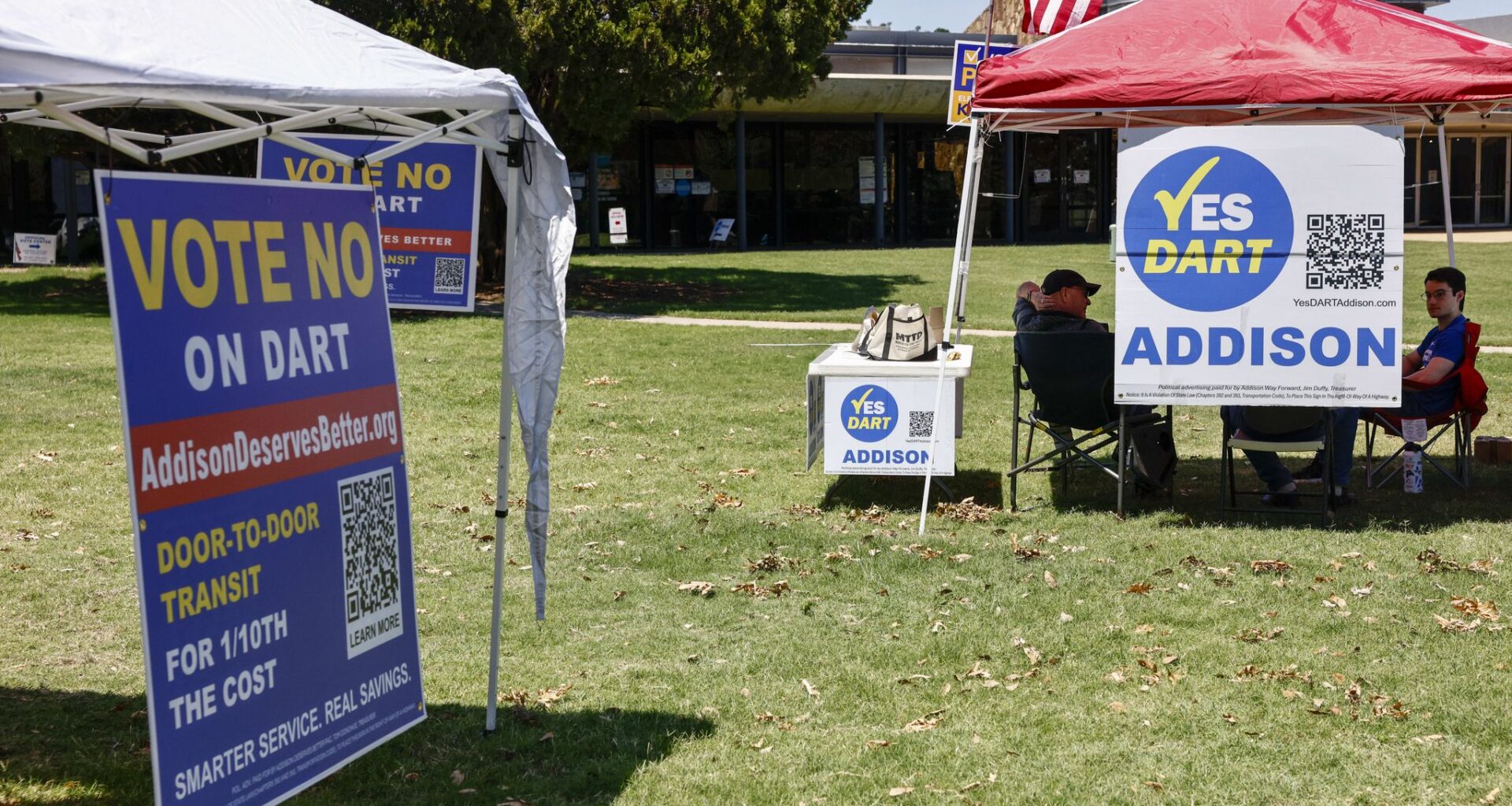
Electioneers in support of DART are seen outside Addison Town Hall on Election Day on Saturday, May 2, 2026.
Elías Valverde II/The Dallas Morning News
Voters in Addison, Highland Park and University Park confronted a stark question Saturday: stick with Dallas Area Rapid Transit or walk away from a network they’ve been part of for more than 40 years.

If the three cities leave, DART’s rail, bus lines and other operations there would end almost immediately, reshaping public transportation in North Texas as growth accelerates and demand rises.
Article continues below this ad
The Dallas Morning News will provide live election results this evening when the polls close at 7 p.m.
Some local leaders and DART critics say the agency hasn’t delivered enough return on the taxes they pay, and smaller suburbs would be better served by on-demand microtransit, app-based vans.
DART supporters say fixed routes provide access for riders who rely on transit to get to work, school and appointments, offering broader reach and reliability across the region than on-call options.
Polls close at 7 p.m. for an election that drew strong early turnout in the three cities.
Article continues below this ad
Make Dallas News a preferred source so your search results prioritize writing by actual people, not AI.
Add Preferred Source
All of DART’s bus, train, paratransit and on-demand services end in any cityn that withdraws the day after votes are canvassed. That’s scheduled on May 12 in Addison and May 13 in the Park Cities.
At stake are dozens of bus stops, Addison’s new Silver Line access, the status of university shuttles and DART’s paratransit and GoLink microtransit service. And DART said it would lose nearly 4% of its sales tax revenue if all three cities bolted.
Even if they drop out, cities must continue paying sales tax to the agency for several years until debts associated with their contributions are cleared.
Article continues below this ad
Voters then can elect to use their sales tax on other services, such as public safety and economic development.
DART rider and Dallas resident Patric Morgan greets voters outside Addison Town Hall on Saturday, May 2, 2026. Morgan said he uses DART in Addison and rode the bus to get to the polling place.
Elías Valverde II/The Dallas Morning News
Voter split
In University Park, Tom Leiser, 73, said he voted to split from DART, questioning whether the tax is the most efficient use of public money. He said smaller, flexible transit options could work better.
Article continues below this ad
“When the employment base is so spread out, there’s just not a way for a late-arriving mass transit system to work effectively,” Leiser said outside a polling place at a church.
Also in the Park Cities, Bob West, 83, said he voted for DART.
“I grew up riding the bus,” West said. “It’s important that we have public transit … we’re an independent city, but we’re still part of the whole.”
In Addison, Dayne Campfield, 27, said she voted to stay, even though she doesn’t often use DART, to support commuters who rely on buses and trains. Losing the new Silver Line station would be a “big disappointment,” she said.
Article continues below this ad
“People move to Addison for the culture of the restaurant and bar scene, and it being so walkable and accessible,” she said. “It’s definitely a place that’s growing and thriving, and it deserves to be poured into.”
Another Addison resident, Chris Wielgosz, pointed to the “Addison Orbit” service as an alternative, saying it can connect riders to nearby transit stops.
Dallas resident Tammy Greenberg pictured outside University Park United Methodist Church on Election Day on Saturday, May 2, 2026, in University Park. Greenberg rides DART to her synagogue in the Park Cities and is encouraging voters to support DART.
Elías Valverde II/The Dallas Morning News
“DART’s track record over 43 years is not one of efficiency and top-level service,” Wielgosz said on the last day of early voting. “DART has not been responsive to Addison’s needs.”
Article continues below this ad
DART reported about 225,000 rides in Addison from October to December, mostly on buses, along with about 4,400 in Highland Park and 12,000 in University Park. The Park Cities have about 34,000 residents.
Cities back off
DART’s future was thrown into question over the past six months when Plano, Irving, Farmers Branch, Addison, University Park and Highland Park — nearly half of the agency’s 13 member cities — took a one-in-six-year opportunity to ask voters whether they should leave.
Some of the cities canceled their exit elections after securing changes to DART’s funding and governance.
Article continues below this ad
Addison, University Park and Highland Park all have plans to replace DART services, including:
Addison Orbit, a service provided by transportation company Via, typically designed for short, local trips within a city or zone. Via, which also has contracts in Arlington and Plano, has already started picking up passengers around Addison and connects to DART stops outside city limits.
The University Park City Council approved a contract with Via to provide paratransit service starting May 13 if it withdraws from DART.
The Highland Park town council approved an agreement to implement a locally controlled microtransit pilot program to either complement or replace DART depending on the election.
Coppell and Flower Mound exited DART in the 1980s, the last time any cities did so.
Signs in support and against DART are seen outside Addison Town Hall on Election Day on Saturday, May 2, 2026.
Elías Valverde II/The Dallas Morning News
The latest exit campaign chiefly stemmed from suburban leaders’ concerns that DART isn’t delivering enough value for the taxes they pay, while advocates warn leaving would fracture the system and hurt transit-dependent riders.
Article continues below this ad
Addison residents have cited a study that found the city received about $9.5 million in services versus $16.3 million in taxes contributed in fiscal 2023, though the report’s methodology has been criticized.
University Park and Highland Park contribute millions each year and lack rail stations within their borders. The nearby SMU/Mockingbird Station in Dallas will remain open regardless of the results.

By signing up, you agree to our Terms Of Use and acknowledge that your information will be used as described in our Privacy Policy.
As the fight over DART escalated, the divide turned personal.
Article continues below this ad
Addison Mayor Bruce Arfsten said he’s seen animosity brewing between residents on opposite sides.
“Once we get past the election, there will be people that are upset or have hurt feelings,” Arfsten said. “I hope that they’re able to move on from whatever the results are.”