
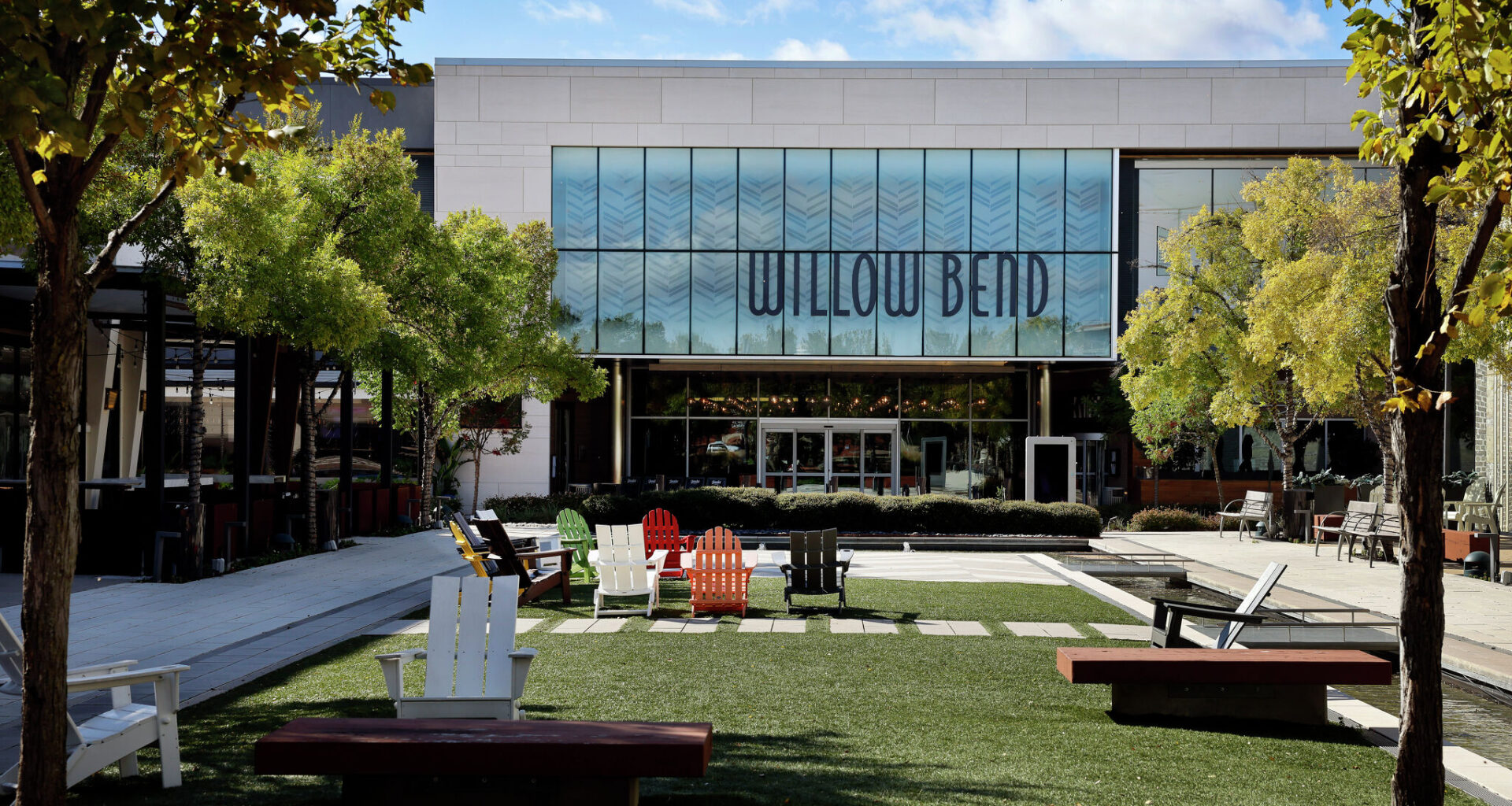
An exterior view of The Shops at Willow Bend mall at W Park Blvd and the North Dallas Tollway in Plano, Texas, October 28, 2025. The Shops at Willow Bend will be demolished to make way for The Bend, an open-air mixed-use development.
The Dallas Morning News/Hearst N/The Dallas Morning News via Gett
A chapter is closing at one of Texas’ most iconic malls—and with it, the last era of old-school enclosed mall construction in the state, where no traditional enclosed mall has been built since 2001.

The Shops at Willow Bend in Plano, once a symbol of early-2000s retail ambition, is now slated for demolition within the next year as developers move forward with plans to reinvent the property as an open-air, mixed-use district called The Bend. The transformation marks both an end and a reinvention: the final major enclosed mall built in Texas, giving way to the next generation of retail design.
Article continues below this ad
We all remember the heyday of the mall: teenagers roaming and giggling with shopping bags in hand, department stores endlessly packed with clothing racks and the mediocre but beloved taste of food court Chinese.
In Texas, that era quietly ended more than two decades ago.
Developers Centennial Real Estate also purchased the Macy’s property at The Shops at Willow Bend in 2024. The mall is set for redevelopment, changing from a traditional enclosed mall into an open-air mixed use district.
Google Maps Street View
The Shops at Willow Bend, a 1.4-million-square-foot complex built in 2001 by Taubman Centers, is widely considered the last traditional enclosed mall constructed in Texas, according to The Dallas Morning News. Its upcoming demolition signals the formal end of that development cycle.
Article continues below this ad
Developers told Chron earlier this week that the Plano mall is scheduled for demolition within the next year. The Bend, an open-air mixed-use district, will rise in its place, focused on green space, retail, restaurants, residential units, office space, and a hotel.
While other traditional enclosed malls certainly still exist in Texas—like the Houston Galleria, which opened back in 1970—there has been a notable developmental shift away from the traditional mall layout.
Article continues below this ad
A rendering of The Bend, a mixed-use hub to be built at the site of The Shops at Willow Bend in Plano.
Centennial Real Estate
A shift in how Texans shop and gather
The change reflects more than architectural preference—it mirrors a broader shift in consumer behavior.
“Few malls were built in the last two decades as competing retail models, like power centers and online shopping, met many consumer needs,” according to a 2026 report from Texas A&M’s Real Estate Research Center titled ‘Does the Mall Still Have it All?’
Article continues below this ad
Department store sales have also faded over the last decade as consumers shift to online alternatives—stores that historically occupy the largest physical footprint within malls, according to A&M’s study.
And while that appears to explain the death of the traditional mall, what explains the rise of the mixed-use district, often taking its place? Some point to increased variety.
“Consumers are also seeking out a greater variety and experiences not possible in a traditional enclosed mall anchored by department stores,” Tom Ryan with Retail Wire wrote in 2024, highlighting accessible parking as another advantage of open-air shopping centers.
A 2023 study from shopping center retail firm DLC Management reports that customers are looking to stay closer to home when they shop.
Article continues below this ad
The Shops at Willow Bend is largely remembered as the last traditional enclosed mall to be built in Texas. The property will be redeveloped as The Bend, an open-air mixed-use district.
Google Maps Street View
From shopping destination to live-work-play hub
“Lifestyles have changed and people are looking for greater convenience and options in a neighborhood shopping center,” Adam Ifshin, DLC Management CEO, wrote. “This attracts a greater mix of retailers and services to a center. Gyms, new restaurant types where people can work, meet and eat, and medical services.”
In other words, Texans (and even more broadly, Americans) didn’t stop gathering, browsing or spending—they just changed settings. As Ifshin put it, today’s retail is “about becoming a destination,” one that’s built around convenience, experience and everyday life.
Article continues below this ad
In many ways, the decline of the traditional mall mirrors a broader societal shift toward greener, more walkable, live-work-play spaces designed less just for shopping and more for how people want to live.
If Willow Bend’s transformation is any sign, the future of retail in Texas may look less like an enclosed mall and more like its own community.