
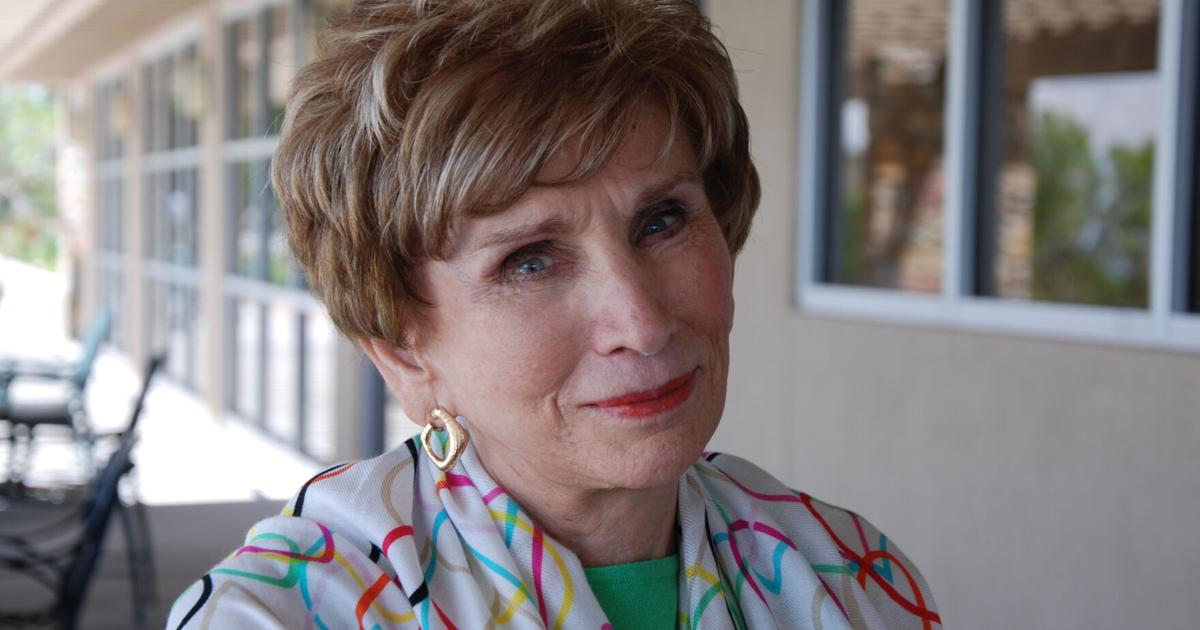
Edith Eva Eger, a former El Pasoan and Auschwitz survivor who rose to international prominence as a psychology lecturer and author, died last week in California, her family announced.
“Today, our dearest Edie left her earthly body. She slipped away with all the grace she lived with. Like an angel returning home. She passed away in the tender care of her family and dedicated team,” the family stated in an April 28 Instagram post.
Eger was 98. She leaves behind a legacy of healing and survival that has inspired people around the world.
“It is really a countless number of lives that she has impacted with her message,” said Jamie Flores, executive director of the El Paso Holocaust Museum, which hosted several events with Eger, including the Dimensions in Testimony exhibit – an interactive display featuring real-time, voice-activated conversations with recorded Holocaust testimonies.
El Paso at one time was home to about 100 Holocaust survivors, Flores said. With the passing of Eger, the last death camp survivor in El Paso is Tibor Schaechner, who turned 98 in March.
Born Edith Eva Elefánt on Sept. 29, 1927, in Kosice, Hungary, her early life was sheltered and happy, she said in interviews. Describing herself as “a dreaming child romantic,” she excelled at ballet and acrobatics and performed for the President of Hungary as a young girl.
“My life was filled with love, dancing, art, music, and the threat of violence was not a part of that life,” Eger said.
At 16, her childhood was shattered when she and her family were arrested in Nazi-occupied Hungary and sent to the Auschwitz-Birkenau concentration camp. Arriving at the camp, she was pulled away from her mother by Josef Mengele – the German SS officer known as the “Angel of Death” – who ordered her mother killed that same day. Eger’s father also died in the concentration camp.
Eger and her older sister, Magda, were placed into forced labor crews and spent a year of World War II enduring the horrors of the Nazi campaign to exterminate Europe’s Jewish population.
Eger was terrorized by Mengele and witnessed the torture and deaths of her fellow Jewish people, experiences that plunged her into deep spiritual turmoil.
“I saw a child put on a tree, the soldiers betting where they would shoot it, in the eye, or the leg – I saw a pregnant woman, in labor, with her legs tied, and she died of suffocation,” Eger said. “On Yom Kippur, 1944, in Auschwitz, I had a dialogue with God. I fought with God, and could not understand why the innocent suffered so.”
Surrounded by death, the young girl reconciled with God and was determined to survive so she could one day have a life filled with love, passion and affection, saying, “I would not just die without experiencing that.”
For more than 11 months, the threat of death was ever present, through hunger, disease, suicide or random violence. Every mass shower they were forced to take was filled with terror, Eger recalled, never knowing if it would be water or Zyklon B poison gas released through the shower heads.
As the war neared its end, rumors spread through the camps that Allied forces were advancing. Every moment of survival could mean a rescue from Nazi enslavement.
Those rumors proved true, prompting the Nazis to begin the infamous death marches as they fled.
Eger and her sister were among the thousands forced on those marches. Desperate to stay alive until a possible rescue, Eger briefly escaped to grab carrots from a nearby garden to feed to her sister, who was on the brink of death from starvation. But a Wehrmacht soldier saw Eger climbing the walls back into the makeshift prison compound and beat her severely with his gun.
Near death, the sisters were moved to a camp in Austria. On May 4, 1945, U.S. soldiers liberated the camp, but Eger was close to death. Injured and weighing 55 pounds, she had been presumed dead by German soldiers, who had thrown her into a pile of decomposing bodies before their rushed escape.
As Allied troops searched the camp, a young American soldier saw Eger’s hand move and pulled her from beneath the dead, rescuing the emaciated teenage girl who, a year before, had been a dancer and gymnast living a joyful life with her family.
“When I look at an American soldier, I think, ‘without you, I would not be here now,’” said Eger, in a conversation with a journalist years after her rescue.
After recovering, Eger married Béla “Albert” Eger, a Hungarian Jewish Holocaust survivor she met in a hospital after the war. They moved to Czechoslovakia, where they began raising three children.
In 1955, Eger and her family moved to El Paso. She enrolled at the University of Texas at El Paso and earned her first degree in psychology in 1969. She later completed a doctoral internship at William Beaumont Army Medical Center and earned her doctorate in clinical psychology from UTEP in 1978, at age 50.
Eger became active in the community, joining many civic organizations, including the Pioneer Women for Israel, the El Paso County Educators Legislative Council, the Robert A Taft Institute of Government and the El Paso Chapter of the National Organization for Women. She was also a member of the YWCA Hatha Yoga group.
Eger led workshops, lectures and panel discussions on a variety of issues, including female sexuality, domestic violence, the humanistic implications of abortion and the psychology of rape.
During her 35 years in El Paso, she was also a teacher at Coronado and Bowie high schools and rallied against the segregationist policies of the United States.
For much of her life after the war, Eger did not speak of her time in the Nazi prison camps. That changed after a psychology presentation at UTEP motivated her to begin speaking about her experiences as a Nazi prisoner.
She recalled that after she finished her guest lecture, the professor told students, “She is a survivor of Auschwitz, and richer for it,” Eger said in an interview. “And when he asked the large class how many knew about Auschwitz, only five hands went up,” she said.
She then devoted her professional life to a public campaign that combined her role as a post-traumatic stress disorder psychologist with the experiences she learned as a Nazi death camp prisoner. Her lectures and speeches gained wide interest and turned into best-selling books, including “The Choice” and “The Gift.”
Her audience expanded with appearances on “The Oprah Winfrey Show” and other national television programs as she became an internationally recognized voice on overcoming the challenges of hardship.
“She represented resiliency. She represented hope and strength and truly giving back to a community, out of her own experience and wisdom and grace,” said Flores with the El Paso Holocaust Museum. “El Paso can be very proud that she once called our community home. We are honored to be part of her legacy.”
In 1991, Eger moved from El Paso to a home overlooking the Pacific Ocean in La Jolla, Calif. Her son and granddaughter still live in El Paso.
In one of her last social media posts, Eger reflected on forgiveness and the Nazi regime that imprisoned and tormented her.
“I don’t have any godly powers to forgive anyone for anything. I have the power to choose, to acknowledge that revenge is a very temporary feeling,” she said. “Forgiveness is really, truly a gift that I give to myself, that I don’t carry the Nazis with me, that I don’t live in the past, that I have my ultimate, precious, wonderful freedom. Free at last.”