
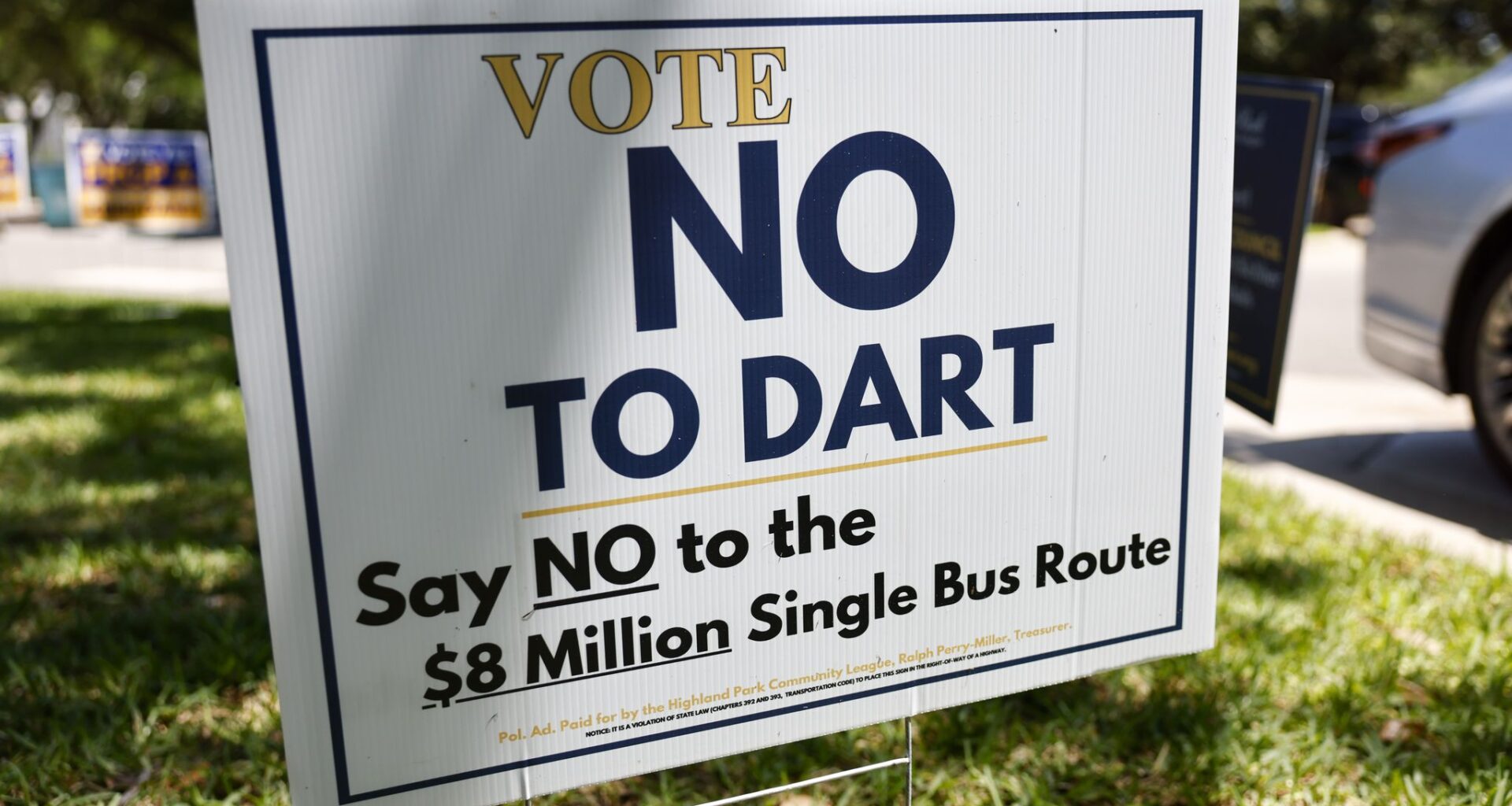
A sign encouraging voters to say no to DART is seen outside University Park United Methodist Church on Election Day on Saturday, May 2, 2026, in University Park.
Elías Valverde II/The Dallas Morning News
In 1983, when Dallas Area Rapid Transit was born at the ballot box, Highland Park embraced it by a higher margin than any city in the region. On Saturday, it said goodbye.

Highland Park voters chose to abandon DART in a dramatic shift of priorities — from supporting a regional transit vision to questioning whether it delivers enough value.
Article continues below this ad
In doing so, it became the first city in nearly 40 years to break away.
Nearly 70% of Highland Park voters Saturday chose to exit the system, a striking twist from the 77% who favored joining DART in 1983. That’s when Dallas and more than a dozen suburbs agreed in an election to fund the transit agency through a one-cent sales tax.
Coppell and Flower Mound were the last two cities to leave DART, back in 1989.
Make Dallas News a preferred source so your search results prioritize writing by actual people, not AI.
Add Preferred Source
Walt Humann, known as the father of DART for his push in the 1980s to create the transit system, remembers Highland Park voting overwhelmingly to join the agency.
Article continues below this ad
“No one ever asked, ‘Tell me what’s in it for me,’” he said Sunday. “It was always how can we help the region and how can we help our own citizens … Today in Highland Park, it’s more transactional. How much are we getting and how much are we paying?”
Although DART lost a member city for the first time in nearly four decades Saturday, the agency has emerged from more than six months of threatening uncertainty relatively unscathed.
Article continues below this ad
Since November, nearly half of DART’s member cities considered leaving the agency, and of the three withdrawal elections that moved forward, only Highland Park chose to leave.
Buses, trains and other service will continue in Addison and University Park, where voters backed DART.
In an election marked by strong early turnout and energetic campaigns on both sides, about 70% of voters in Addison supported staying in DART. In University Park, the outcome was closer, with 54% favoring continued membership.
Addison Mayor Bruce Arfsten said voters in his city spoke up for a regional system.
Article continues below this ad
“Even if they don’t ride DART,” he said, “they still see the value of it for Addison being part of a larger region. This is bigger than us.”
DART Board Chair Randall Bryant said his agency is focused on moving ahead, hiring a new CEO and finding ways to expand service.
“The cities that are a part of DART still believe in a regional transit system that works best for the region,” he said. “More work now begins to mend those fences as well as progress forward together.”
The front page of The Dallas Morning News in August 1983 showing election results for Dallas Area Rapid Transit. (Dallas Morning News Archives)
Dallas Morning News Archives
Why did Highland Park vote out?
In an opinion article published by The Dallas Morning News in March, Highland Park Mayor Will Beecherl wrote DART does not deliver services with value commensurate with the town’s investment.
Article continues below this ad
Non-DART cities have an economic advantage over DART member cities with more flexibility in spending sales tax, and Highland Park has little to no voice on DART’s governing board of directors, he wrote.
“When existing funding and service delivery models no longer reflect actual usage patterns or community priorities, the town has an obligation to evaluate alternatives,” Beecherl wrote.
Beecherl’s father, Louis Beecherl, was a member of a DART rail opposition group in the 1980s called SMART, Sensible Metro Area Rapid Transit, an “unofficial watchdog” committee that opposed DART borrowing money to build a train system, according to past reporting.
Humann lives in the Park Cities and saw his neighbors reject the agency he has championed for decades.
Article continues below this ad
DART supporters Peter Young (from left), Jeff Kilpatrick and DART creator Walt Humann speak during an Election Day watch party in support of DART at Stoneleigh P on Saturday, May 2, 2026, in Dallas.
Elías Valverde II/The Dallas Morning News
“I have high praise for the 30% of Highland Park voters who voted in favor of keeping DART,” he said. “There must have been a lot of pressure from neighbors to vote the other way.”
“I hope Highland Park takes this as a message to improve their community,” Humann said.
A well-funded “Vote No” campaign succeeded in the town, where letters, advertisements and signs encouraged voters to rethink the town’s obligation.
Article continues below this ad
According to finance reports, the Highland Park Community League, which campaigned to leave DART, paid nearly $20,000 on advertising in the May election. Leaders of the league contacted by phone Sunday declined to comment.
The ads decried the millions in sales tax the town pays to DART — $9 million in the 2025 fiscal year, according to DART — for one bus route that sees about 35 boardings per day, as well as paratransit and on-demand services.
“That is not a partnership, it is a subsidy,” said a March letter from the community league.
Article continues below this ad
Peter Young, 29, rides DART to class and events around the Dallas area from his home in Highland Park. He campaigned in the Park Cities in DART’s favor, and said he was embarrassed his town opted to give up on the system.
Driving his advocacy for DART, he said, was “the shame of living in the richest town in the state and not paying [his] fair share.”
Highland Park, with a population around 8,700, has a median household income greater than $250,000 and a per capita income of nearly $200,000, according to census data.
Residents can take solace, Will Beecherl wrote, in knowing that the town “played a meaningful role in building a regional transit system” by paying into DART for over 40 years.
Article continues below this ad
DART agreed to refund some sales tax and pursue governance changes to reduce Dallas’ control, but it wasn’t enough to sway Highland Park voters.
DART board chair Randall Bryant celebrates with supporters during an election night watch party in Addison, Saturday, May 2, 2026.
Smiley N. Pool/The Dallas Morning News
What’s next
DART estimates Highland Park’s exit would cut about 1% of its sales tax revenue, roughly $9 million in 2026 and $270 million over 20 years. The town will continue sending sales tax for several years to cover debts. After that, Highland Park can redirect the tax to other uses.
Article continues below this ad
Beecherl said sales tax is the town’s “only meaningful flexible revenue source,” and sending half to DART “significantly constrains” its ability to meet essential local needs.
Highland Park will canvass results May 13, with DART service ending the next day. About 15 stops associated with bus route 237 along Preston Road will close, and buses will pass through without stopping.

By signing up, you agree to our Terms Of Use and acknowledge that your information will be used as described in our Privacy Policy.
GoLink, paratransit and access to park-and-ride facilities will also end.
Article continues below this ad
The Town Council approved a locally controlled microtransit pilot with on-demand and paratransit components, covering trips within the town and nearby destinations, including Love Field and Mockingbird Station.
“These service components support continuity of transit services and maintain regional connectivity for residents, workers and others with transit needs,” the town website states.