
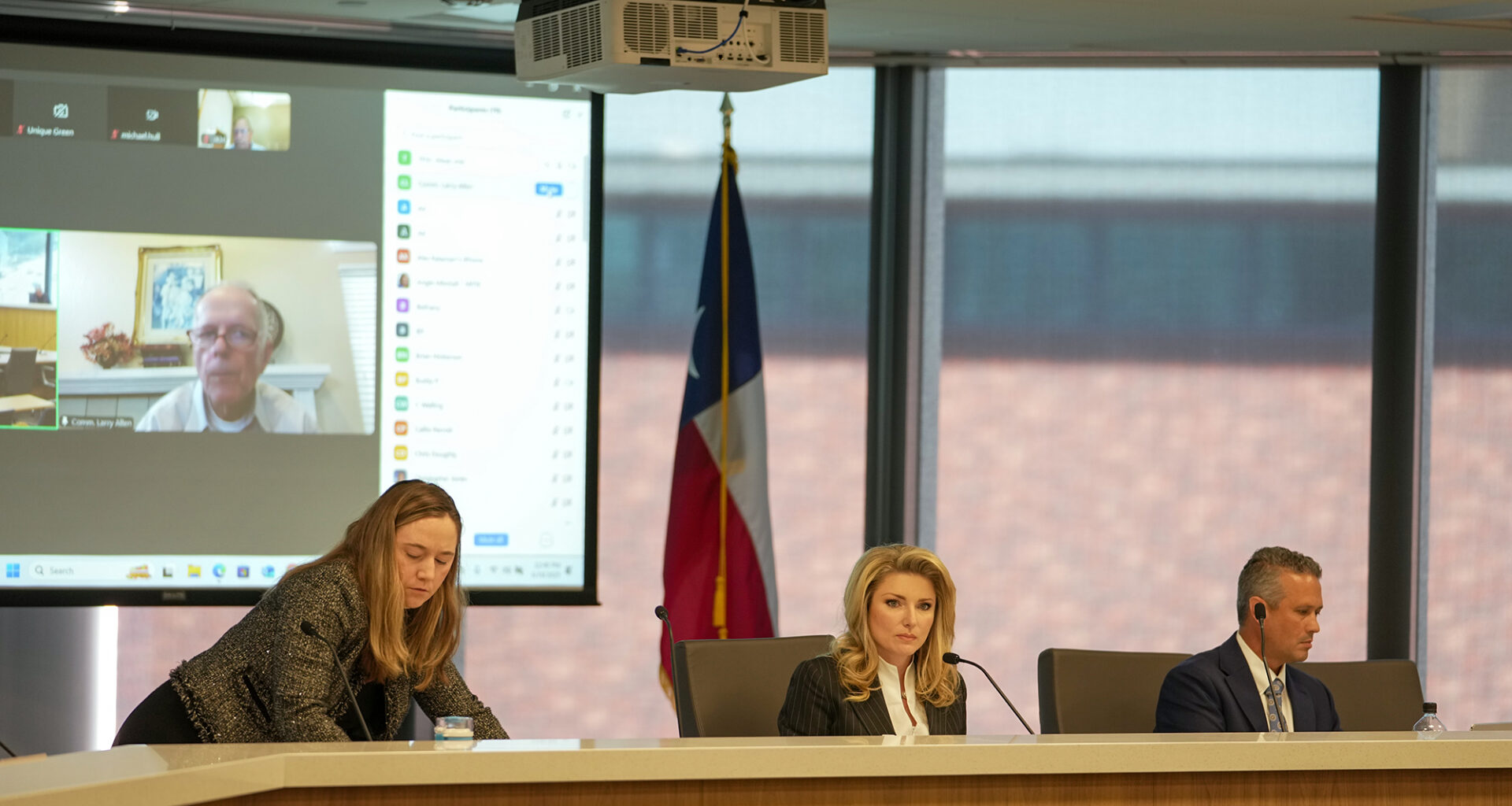
Members of the Texas Funeral Service Commission meet to discuss terminating Scott Bingaman as the agency’s executive director on June 18, 2025, in Austin. At center is Kristin Tips, who until last month was head of the commission’s board.
Ricardo B. Brazziell/Austin American-Statesman
Texas’ inability to regulate body donation left research stalled and oversight in limbo for years, driven by dysfunction inside the agency tasked with fixing it. Now, officials say a Monday meeting could resurrect regulations, setting limits on how bodies are handled and allowing research to resume.
“We have already begun to take concrete steps toward implementation,” said Eric Opiela, the new presiding officer of the Texas Funeral Service Commission.
After several investigations drew attention to the mishandling of anatomical donations, lawmakers were alarmed at the lack of regulations governing body donation – and the inability of state officials to hold some companies to existing rules.
Article continues below this ad
As a result, lawmakers charged the commission with crafting new rules for private companies that transport anatomical specimens and university researchers.
EXCLUSIVE: ‘Petrified’ ex-funeral head warned Abbott’s office of agency turmoil
But they were left in limbo for more than two years as the commission struggled to adopt a final set of rules to end the confusion – even after its former executive director, Scott Bingaman, drafted proposed legislation.
In an audio recording from June 2, 2025, obtained by the Houston Chronicle, Bingaman lamented that his plans for regulation of non-transplant anatomical donation organizations, or NADOs, kept hitting a wall with his boss, funeral commission chairwoman Kristin Tips.
Article continues below this ad
“She’s being seen as a roadblock, and I need her to come to the table,” Bingaman said to Opiela, explaining some compromise with the industry was inevitable.
Sixteen days later, Bingaman was fired unanimously by the commission.
Tips did not respond to a request for comment regarding Bingaman’s concerns or firing. During the legislative session, Tips focused less on regulating NADOs and more on banning them, outlining some of the horror stories that have drawn media attention and contrasting how funeral services providers like herself could handle care.
Upon termination, Bingaman accused the agency of “rot,” singling out Tips for focusing on protecting the funeral home industry over the interests of the general public. He later sued the commission, alleging Tips was misusing commission resources for her own gain.
Tips and her husband, Robert “Dick” Tips, own and operate the Mission Park Funeral Chapels, Cemeteries and Crematories in San Antonio.
Article continues below this ad
In its rebuttals to his lawsuit, the commission accused Bingaman of mismanaging the agency and disputed his claims.
Tips quietly left the commission last month, with Gov. Greg Abbott’s office declining to say whether she resigned or was replaced. Days later, officials confirmed Opiela was the “presiding officer” of the commission, a change in the leadership title for the seven-member board.
Since last summer, the agency’s tumult was widely known and a source of frustration for lawmakers and Abbott’s office – and something Opiela was aware of days before Bingaman was dismissed.
HOUSTON FUNERAL ALLEGATIONS: Gruesome claims shocked the nation. Then a quiet horror unraveled.
During the recorded discussion with Opiela, Bingaman outlined his worries, ranging from Tips’ relationship with the governor’s office to officials’ desire for her to be less visible in the state Capitol and regulation of NADOs.
Article continues below this ad
By June 2025, Bingaman said he concluded they could regulate the NADOs with some compromises, but Tips was looking to approve NADOs one-by-one via the commission.
“I’ve had these frank discussions with her, and she doesn’t really take it seriously,” Bingaman told Opiela in the 52-minute conversation. “She pushed too hard, way too hard.”
Regulating NADOs had been a long-sought goal of the commission – and state lawmakers – since Texas abolished its state anatomical board in 2023, in favor of giving its duties to the funeral commission.
Rules for NADOs also affect willed body programs around Texas, which routinely send donated bodies to schools for research and teaching. The remains are then often cremated in school-owned crematories at a lower cost than sending them to a private funeral home or crematory.
In attempts to curtail abuse, some sought to practically outlaw body donation and research uses in Texas altogether in favor of funeral services for all.
Article continues below this ad
The outcome: Universities could not use donated bodies in the state and could not access bodies from out of state because of restrictions on their transport.
‘Didn’t want to deal with her anymore’
In the phone call, Opiela expresses frustration that it has taken so long to settle on regulations. One hiccup was that previous lawyers were uncertain the commission had the authority to draft the new regulations, while Bingaman and then-staff lawyer Christopher Burnett argued that they did.
“We spent an entire legislative session wasting our time because somebody didn’t see this,” Bingaman said.
Scott Bingaman, former executive director of the Texas Funeral Service Commission, reacts to the commissioners’ vote on June 18, 2025.
Ricardo B. Brazziell/Austin American-Statesman
At the time, Tips was a visible presence in Austin, where she often testified with Bingaman in committee hearings – a rarity for an appointed chair but not unprecedented – and in her personal capacity as a funeral home owner.
“I got hired to do a job, and she wants to drive the boat, and it’s hard, very difficult for me,” Bingaman told Opiela.
Opiela agreed the divide was counterproductive, but cautioned Bingaman to tread carefully. When Opiela was appointed to the commission in 2022, communication between the board and staff was limited, and a clash of personalities ultimately led to the executive director’s ouster.
“I don’t want it to get to that point,” Opiela said. “There doesn’t need to be a rift between you and any of us.”
INSIDE THE FUNERAL COMMISSION: How the agency charged with regulating death fell apart
Working with lawmakers, funeral commission lawyers and the industry, Bingaman told Opiela he was finding common ground for some regulations – at least sufficient to restart university body donation programs and establish limits to where and how bodies could be disposed of and dissected. Some of those rule changes were included in SB 2721, which failed in the 2025 session after lawmakers could not make sense of the rules and industry concerns.
Bingaman laid much of that on Tips, who wanted a more company-by-company approach.
“I know that will make her mad if I approve these guys,” Bingaman told Opiela.
The tension drew the attention of Abbott’s office, which was supportive of Tips at periods but also fretting that the regulations were not coming together and state lawmakers were growing impatient, Bingaman said.
“The governor’s office had said that every time that they had a suggestion for what they could do with 2721, she pushed back on all of it, to the point that they just didn’t want to deal with her anymore,” he told Opiela.
Abbott’s office did not respond to questions, saying only that the governor “expects the TFSC and all state agencies to operate with integrity and focus on their core mission of safeguarding Texans.”
Busy summer
Though the commission typically met quarterly, Opiela said he expects monthly meetings through the summer to essentially catch up on other business.
Some progress is already being made, Opiela said – something he credited to Tips.
“The last two quarters under Chair Tips, we caught up on a licensing backlog, issuing/renewing over 1,500 licenses, and are now meeting the legislatively mandated performance measure for licensing,” Opiela said via email. “We’re now tackling the backlog in complaint resolution, and have hired two additional highly qualified temporary investigators to assist in processing cases.”
Defense attorney Eric Opiela speak in court on March 25, 2024 in Conroe. Opiela is the new presiding officer of the Texas Funeral Service Commission.
Yi-Chin Lee/Staff photographer
Monday’s meeting will jump-start more matters, pending commission approval. Along with reforming the anatomical board, the commission will consider approving five universities restarting their anatomical specimen imports and exports.
Opiela said anatomical rules can be established and refined this year through the process for state regulations, which starts with posting in the Texas Register. The first step toward new rules, Opiela said, is restarting an advisory committee on anatomical donations. Appointments to that board are set for approval this week.
“Once the Advisory Committee is reconstituted, I plan to immediately call a meeting to get their blessing on the extensive work that was previously done on the anatomical rules,” Opiela said, referring to the draft plan Bingaman organized. “My goal right now is to publish them in the (Texas) Register sometime in June.”