
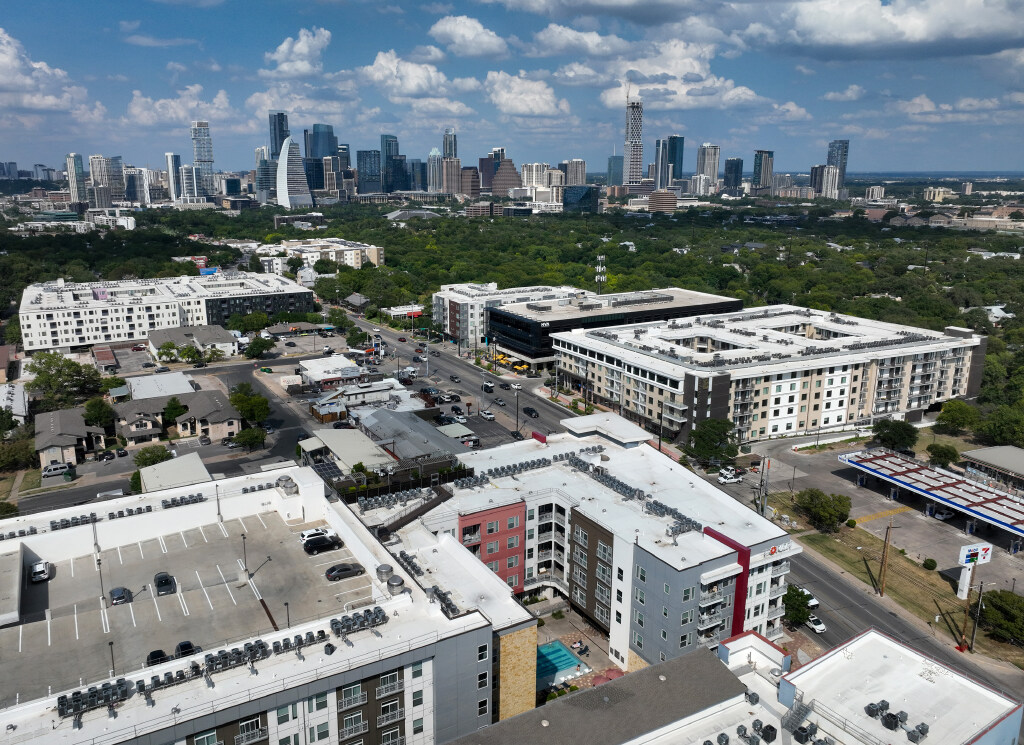
Apartments and condominiums are seen along South Lamar Boulevard in Austin on Aug. 26, 2025. A new study finds Austin has one of the nation’s widest gaps between renting and buying, with mortgage payments 117% higher than rent — far exceeding San Antonio, where owning costs about 25% more.
Austin American-Statesman file photo
The difference between buying vs. renting in San Antonio is higher than the national average, but it doesn’t come close to Austin.

A recent study found that in San Antonio, the monthly cost of owning a home is nearly 25% higher than renting. In Austin, the gap is significantly wider: Monthly mortgage payments are 117% higher than rent, making homeownership feel almost out of reach for renters hoping to make the transition.
Article continues below this ad
Construction Coverage, a data firm for the homebuilder industry, analyzed 838 U.S. cities to determine the gap between buying and renting. The analysis revealed that nationally the median mortgage payment is 20% higher than the median rent, as of February 2026.
With rising mortgage rates, sale prices and insurance rates driving the difference, this is a dramatic shift from the 2010s when homeownership was often more affordable.
FORECAST: After boom and cooldown, Austin housing market heads into 2026 with cautious optimism
In San Antonio, the median monthly mortgage payment with property taxes included is $1,698, while the median monthly rent is $1,361. Ranking 54 major metros from the best situation for homeownership to the worst when compared with renting, San Antonio falls in the middle of the pack at No. 21.
Article continues below this ad
Austin ranks No. 51 — in other words, No. 4 among the nation’s major metros with the widest gaps — with a median monthly mortgage payment of $3,323 versus a median rent of $1,531.
Homeownership was more attainable in the years following the Great Recession, when mortgage payments remained affordable as the economy recovered and the nation went through a prolonged period of low interest rates. Record low mortgage rates and high demand also fueled a homebuying frenzy throughout 2020 and 2021.
By 2022, mortgage rates began to climb from pandemic-era lows, and renting took the forefront as the more affordable option. Since 2021, interest rates have more than doubled, and even though sales have slowed, prices continue to rise nationally.
A home is marked sold in the Spring Creek neighborhood in Taylor, about 30 miles from Austgin, on Oct. 16, 2025. A new study found that Austin has one of the nation’s widest rent-to-buy gaps.
Aaron E. Martinez/Austin American-Statesman
Austin and San Antonio housing markets
In the Austin metro area, the median home price in 2022 increased by nearly 11% year-over-year, to an annual record of $503,000. But as prices rose, the number of sales decreased. As of January this year, Austin has seen sales drop 18% from the previous year.
Article continues below this ad
Homes also are spending an average of more than two months on the market, almost triple the average from a year ago. It’s the highest since March 2012, when homes took an average 83 days to sell.
The state of the Austin housing market is concerning enough that Goldman Sachs predicted it could experience a crash similar to the Great Recession, which lasted from December 2007 through June 2009. Home values are forecast to worsen through the year in Texas’ capital city amid continued skyrocketing interest rates and declining housing prices.
IN 2025: ‘Meh’: Austin’s housing market cooled in 2025, with stubborn prices and falling sales
Compared with Austin, homeownership in San Antonio is much more attainable. Median prices in San Antonio have held steady throughout the last three months — edging up less than 1% to $316,850 in March. Austin, meanwhile, has a median price of $500,627.
Article continues below this ad
Even so, homeownership has become noticeably less accessible than it was a few years ago in the Alamo City. The upfront and monthly costs of buying — down payments, closing costs and higher monthly mortgage bills — are harder for first-time buyers to manage, making the jump from renting to owning more difficult.
Rivercrest Apartments on East Riverside Drive in Austin as seen on Feb. 9. Between 2015 and 2024, Austin added 120,000 units to its housing stock, representing a 30% increase.
Jay Janner/Austin American-Statesman
Austin and San Antonio rental markets
San Antonio has seen some of the most negative rent growth month-over-month among major apartment markets in the U.S.
Article continues below this ad
In April, the Alamo City was one of five major markets that recorded monthly rent declines. Along with Houston and Las Vegas, San Antonio rent was down 0.2%, according to Apartments.com’s recent report. Tampa and Fort Lauderdale in Florida had a 0.1% drop.
“San Antonio’s rental market has remained relatively stable, largely because rents have already corrected from their 2022 peak,” said Jonathan Jones, senior researcher for Construction Coverage. “Modest year-over-year declines and an incrementally growing housing supply continue to keep prices in check.”
In addition, both Austin and San Antonio are still trying to absorb an influx of supply within the apartment market.
Between 2015 and 2024, Austin added 120,000 units to its housing stock, representing a 30% increase, according to the Pew Research Center. That’s more than three times the overall rate of growth in the United States. The surge in new construction drove rents down, with median rent for a one-bedroom unit falling from $1,482 in August 2022 to $1,151 in March 2026, according to Apartment List data.
Article continues below this ad
On an annual basis, Austin has seen the largest decline of 4.1% in rent, while San Antonio followed with a 3.1% decrease.
“The start of the spring leasing and homebuying season usually triggers a surge in demand for multi- and single-family housing,” said Danny Khalil, director of market analytics for commercial real estate data firm CoStar. “As a result, rents usually see significant growth right about now. Suffice to say, this is highly unusual and indicative of the degree to which we are in a tenant’s market in South Central Texas.”
RELATED: San Antonio apartment construction plunges as occupancy slips, rents soften
Even though renting has become more affordable than buying in both markets, they have the highest apartment vacancy rates among the nation’s major metros. San Antonio’s multifamily market has a vacancy rate of 15.7%, while Austin’s is at 14%.
Article continues below this ad
The Alamo City took the top spot from Austin, which dipped to No. 3 after holding the title for the highest vacancy rate for several quarters on CoStar’s list ranking the 50 largest multifamily markets in the U.S.
In the early 2020s, both San Antonio and Austin experienced an influx of new apartment developments that outpaced demand and jacked up vacancies. But construction has tapered off, helping stabilize rent prices and occupancy rates.
Melissa Cabello Havrda, chief government relations director for the San Antonio Apartment Association, said luxury and affordable apartments are still filling up, while middle-tier buildings are having a hard time getting renters through the door. In response, building owners are trying to offer more deals, like free first and last month’s rent, to attract tenants. They’re also adding upscale amenities, such as virtual golf stations, salons and car wash stations.
Article continues below this ad
“You can’t just have a pool and tennis courts anymore. You have to have state-of-the-art accommodations and concierge services,” she said. “Managers and owners are doing everything they can to get renters through the door.”