
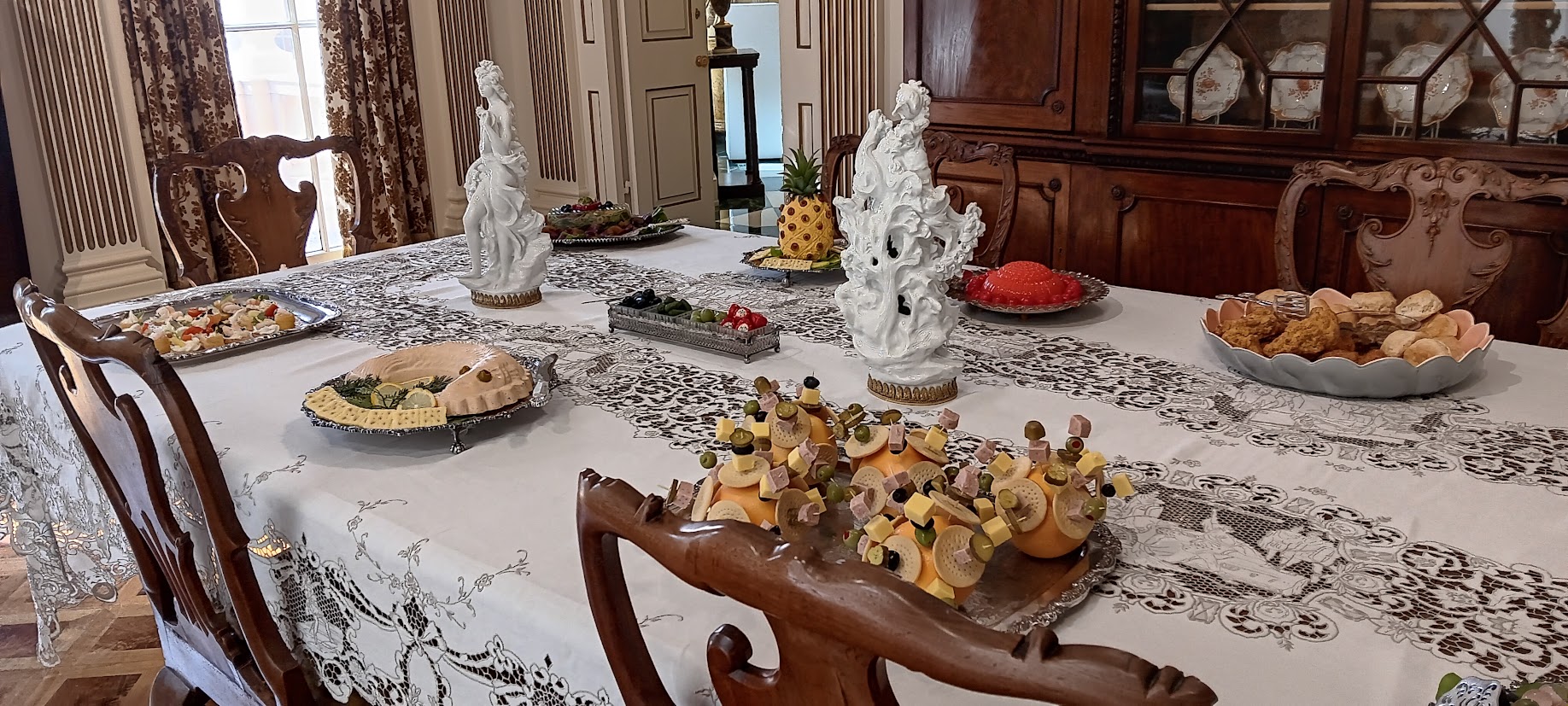
The cornucopia of Jell-O molds at the Rienzi museum, as part of a new exhibit of midcentury dining.
Image courtesy of MFAH
It’s difficult not to touch the Jell-O molds at the Rienzi museum in Houston. But you don’t need to poke your finger at them to realize they’re fake. As people circled around the exhibit on the creaky wooden floors, not a single one jiggled. That’s evidence enough right there.

They’re all part of a “Midcentury Menu: Dining in the Atomic Age,” a new Museum of Fine Arts exhibit at the Rienzi that takes the phrase “touch with your eyes” to new heights. Because some visitors are defying house rules and touching them.
Article continues below this ad
“That has happened, but not as much as I was anticipating it would happen,” exhibit curator Misty Flores jokingly told Chron. “We had a lecture on Sunday, and a woman on the way to it passed through the dining room and asked, ‘Is this what we’re having after the lecture?'”
She was politely told that the food is all fake and actually part of the exhibit. You’ll find midcentury classic dishes rendered in inedible resin like Spam and cream cheese loaf, a salmon mousse, a cheese and cracker display that resembles Sputnik, radish and celery Jell-O, frozen fruitcake, and egg and ham Jell-O, among various others.
Jell-O jiggles its way into the American life
The exhibit is not called “Dining in the atomic age” because the dishes look like they’d somehow survive a nuclear blast. Rather, they’re a testament to the postwar period that saw an age of abundance manifest itself in multiple corners of American life. Families moved to the suburbs by the thousands, with its promises of hope and modern living.
Article continues below this ad
An aspirational lifestyle that marketed the ideal home seemed to take center stage with food and home entertaining, aided by an onslaught of new kitchen appliances and cookbooks. And into this fold triumphantly arrived Jell-O, jiggling its way into the American zeitgeist.
“There’s all of this hope, this prosperity, the space race is happening, and the way that kitchens are designed, they’re very much looking to the future, an aspirational lifestyle,” Flores tells Chron. “Jell-O itself becomes this futuristic thing, with any kind of food you want suspended in gelatin.”
Is that a shrimp in my Jell-O?
Delicious as some of the creations may look at first glance, one element may cut into your appetite as you peer a little closer: they’re savory. Gaze through the looking gelatin and you’ll see fillings like eggs and shrimp and cabbage. One has peas, another cubes of ham. Part of me would rather eat actual resin than try a slice of that. But when you’re in an age of abundance, apparently anything goes.
Article continues below this ad
“They were really big on eggs and shrimp in gelatin—I’m not sure why,” Flores said. “They were savory and put in lime Jell-O for some reason, but a lot of the time it was plain, unflavored gelatin. I don’t know if you ever encountered unflavored gelatin or smelled it, but it’s the most horrible thing you could ever smell. It’s awful.”
The cornucopia of Jell-O molds at the Rienzi museum, as part of a new exhibit of midcentury dining.
Image courtesy of MFAH
The genesis of the exhibit somewhat resembled cooking, just without real ingredients. Flores pored through the old cookbooks and handwritten recipes belonging to Carroll Sterling Masterson and Harris Masterson III, the philanthropists who previously owned the Rienzi home. She then worked with several fake food makers, including the Fake Food Workshop in Scotland and Replica Ltd in the UK, who often used hard resin in producing them.
“I would send them these recipes and pictures, and they would dream up these fantastical things,” Flores said.
Article continues below this ad
They certainly did. It’s why you’ll find visitors staring into the Jell-O molds like they’re fish tanks, wondering what strange ingredient they’ll find next. But just because it was an age of abundance, it doesn’t mean it was an age of all great food.
“I always think about that Jeff Goldblum line from Jurassic Park,” Flores tells Chron. “‘Just because you can do it, doesn’t mean you should.’ When I see some of these Jell-O things, I think, ‘Why?'”
“Midcentury Menu: Dining in the Atomic Age” is on view at the Rienzi until July 31, 2026
Article continues below this ad