
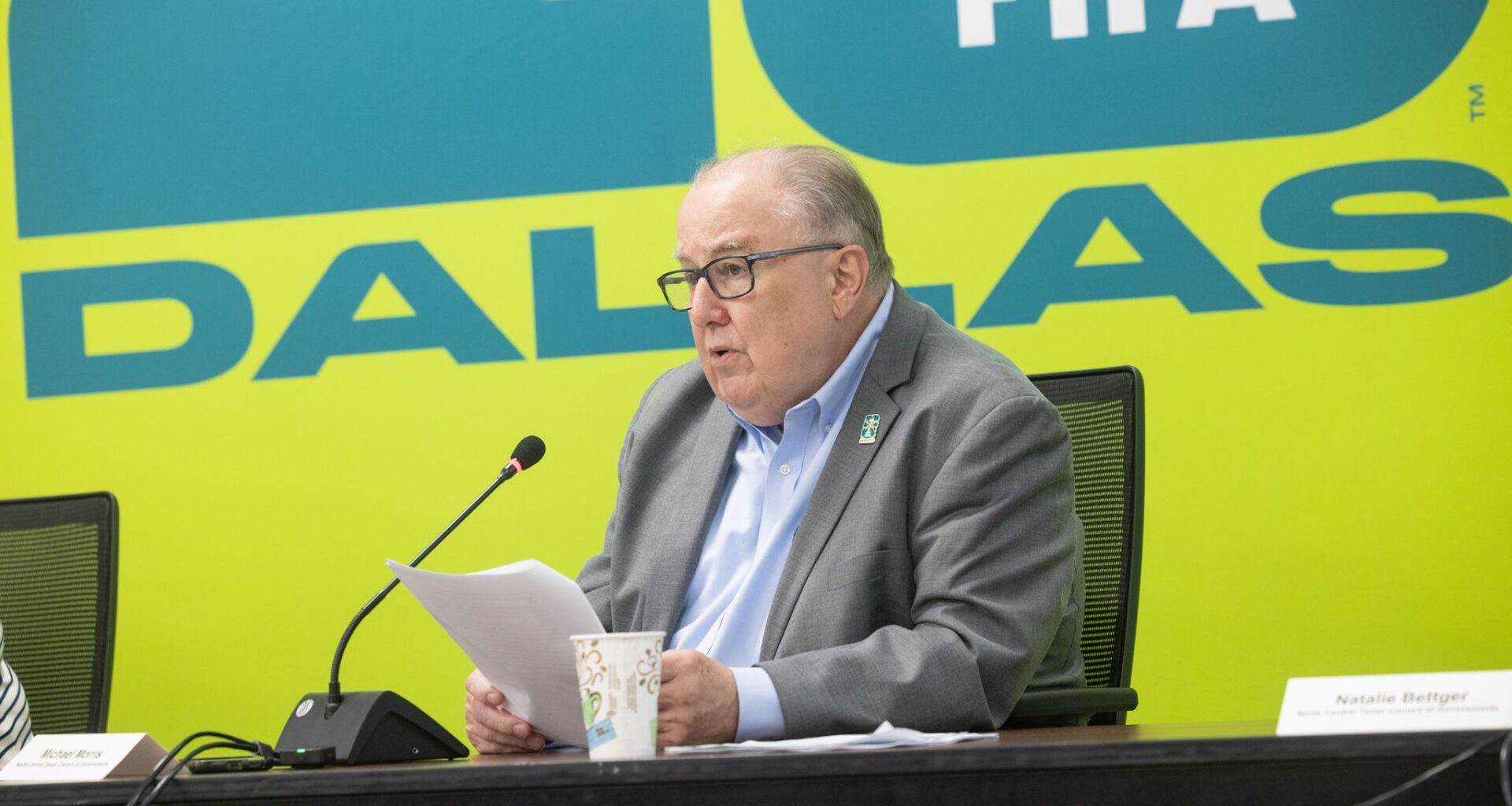
Michael Morris, North Central Texas Council of Governments transportation director, speaks as the North Texas FWC Organizing Committee and NCTCOG detail the mobility plan for FIFA World Cup 2026 during a press conference at NCTCOG in Arlington, TX, Thursday, April 2, 2026.
Juan Figueroa/The Dallas Morning News
Visions of the future of North Texas — and how to engineer it from wishful thinking into reality — are hatched in a large conference room about 100 yards from Six Flags over Texas in Arlington.

It is where bureaucrats make decisions that impact the everyday lives of more than 8.3 million North Texans, who are mostly unaware of the proceedings.
Article continues below this ad
And it is where the region’s power brokers take high-stakes positions over how to spend billions of the public’s money.
And where one man — for 36 years — led so many deals that they have become impossible to count.
Michael Morris, as transportation director for the North Central Texas Council of Governments, has been the ultimate persuader.
Make Dallas News a preferred source so your search results prioritize writing by actual people, not AI.
Add Preferred Source
How do you put a tolled highway in north Dallas without enraging the owners of high-rises in the way? Bore underground tunnels. How do you find cash to finish the Margaret Hunt Hill Bridge when money is strangled by red tape? You depend on your local allies — the city of Dallas and private donors — to help foot the bill.
Article continues below this ad
But at the April 30 regularly scheduled meeting of the Regional Transportation Council, a 45-member group of elected officials from all over North Texas in charge of setting policy for the Council of Governments, Morris was not there. He was not seated in his swivel chair at the head of the meeting.
Two days prior, Morris had been shown the door by the Council of Government’s Executive Director Todd Little in what past and current members of the Regional Transportation Council say was a strategic and unlawful coup to take control of the heart and soul of transportation policy in North Texas.
Up until now, Morris was its heart and soul. But now, without Morris, the future direction of the transportation arm of the Council of Governments is up in the air.
Regional Transportation Council chair Rick Bailey (center left) and Michael Morris (center right), director of transportation for the North Central Texas Council of Governments and staff director to the Regional Transportation Council, lead as the Regional Transportation Council meet at NCTCOG’s Transportation Council Room on Thursday, March 12, 2026, in Arlington, TX.
Juan Figueroa
Morris may have left an indelible mark on North Texas’ highways, bus routes, commuter rail and air travel, but he also took positions that made him a polarizing figure and drew a fair share of criticism.
Article continues below this ad
He pushed toll roads to help relieve congestion when the state Legislature didn’t provide sufficient funding for infrastructure projects. And he’s said repeatedly he would push for more today.
In recent months, he took sides on a highly volatile issue: the future of the Dallas Area Rapid Transit district. He pledged $75 million of mostly federal funding to persuade the cities of Farmers Branch, Irving and Plano to continue their pledge in financial support for DART, even after deafening criticism in some cities that the service cost too much, drew crime and had poor ridership.
What’s more, to the chagrin of some regional lawmakers, Morris has said the only way out of perpetual gridlock as millions more move to Texas is to build a high-speed rail system. There’s little room left for more highways, he told The Dallas Morning News in more than one interview; the area is built out.
That’s a lot of hooey, said state Rep. Matt Shaheen, R-Plano, who has introduced multiple bills in past legislative sessions to reduce or stop tolling in North Texas. He is not a member of the executive board or the RTC, but like many lawmakers, he has a keen interest in who controls transportation policy in North Texas.
Article continues below this ad
“I see a desire to shift more investment into roads and less into mass transit,’’ said Shaheen, who isn’t necessarily a sharp critic of Morris but rather the policies he supports. “It’s so expensive.”
That’s not even taking into account what he referred to as “toll fatigue” in the region. It’s valid to argue that the state Legislature was lax in transportation funding, but that applied decades ago. Now, Texas sets aside an annual $40 billion in state and federal dollars for transportation projects.
What’s more, he said, people who live in North Dallas and Plano, for example, drive on toll roads that have already been paid off. Yet, their toll dollars are used to build roads in other counties.
State Sen. Bob Hall, R-Edgewood, said he saw in a mobility demonstration on Interstate 635 between U.S. 75 and Interstate 30 that traffic became much worse in the free lanes when tolled lanes were introduced.
Article continues below this ad
That worsens traffic congestion, he said, and is discriminatory to people who can’t afford to pay to go faster.
The North Central Texas Council of Governments is an association of local cities and counties that work together to address issues across 16 North Texas counties. It is overseen by its executive board, which consists of 17 locally elected officials and one ex-officio non-voting member of the state legislature.
Michael Morris, speaks as transportation director during the Regional Transportation Council workshop to discuss the future of DART, hjeld in Arlington on Thursday, February 12, 2026.
Stewart F. House
The Council of Governments has multiple committees that tackle a host of matters that affect the lives of North Texans. That includes aging and disability resources, emergency preparedness, air quality and, at issue here, transportation planning.
Article continues below this ad
The committee that oversees transportation policy is the Regional Transportation Council. The RTC is a 45-member body that includes county commissioners, county judges, mayors, council members, an airport board member and members of the various county transportation boards, such as the Fort Worth Transportation Authority and the Denton County Transportation Authority.
Many members of the executive board of the Council of Governments are also on the RTC.
Morris, in essence, was caught in the power struggle between the two entities he served.
The News made repeated efforts to contact Morris. Brian Wilson, a spokesman for the Council of Governments, told The News that Morris was declining to comment.
Article continues below this ad
But in a recent interview with The News’ editorial board, he acknowledged that politics likely have played a role and have made matters “very unsettled” for the RTC.
“I’m just keeping my head down and delivering what I always do,” he told the editorial board.
While a lot of the debate is about policy differences, some of the discussions inside the conference room of the Council of Governments have become personal.
On April 27, a 300-page lawsuit submitted to a Tarrant County district court by plaintiff Denton County alleged the Council of Government’s executive board had become a “lawless rogue governmental entity” and is “in the process of firing or reducing the role of Michael Morris” but didn’t have the right to do so because he reported to the RTC.
Article continues below this ad
Who actually has the authority to fire Morris — Little, the executive board or the RTC — is for now an unresolved matter of debate.
The suit accused 15 individual executive board members of attempting to wrest control from the RTC, including attempting to influence the policy of the RTC by hiring a new director that will follow directions from Little.
“Mr. Little is of the impression that he has the authority to hire and fire,” RTC chairman Rick Bailey told The News. He called it a “desperate move by a desperate man.”
Moderator Michael Morris, director of Transportation for the North Central Texas Council of Governments (NCTCOG), speaks during 2025 Infrastructure Summit at Irving Convention Center, Thursday, Aug. 7, 2025, in Irving.
Chitose Suzuki
Little, a former Ellis County judge, did not respond to multiple calls or text messages.
Article continues below this ad
The suit also alleged the executive board is “currently unlawfully constituted” since its membership isn’t consistent with federal law, because there is no Texas Department of Transportation representative on the board and there is a representative from Erath County, which is one of the 16 counties that comprise the COG but not one of the 12 counties served by the RTC.
Furthermore, the suit states, because of the executive board’s actions, the relationship between the local area governments and the TxDOT is “in grave peril.” TxDOT controls state and federal government funding, and noncompliance with the law “jeopardizes” the region’s eligibility for federal funding, according to the lawsuit.
In its response to the lawsuit, the COG executive board said the allegations “rest on a fundamental misreading” of federal law. The membership is, in fact, consistent with federal law, the board said, and it has the sole right to hire and fire the transportation director.
Denton County originally filed the suit in Denton County’s 431st District Court, where a judge granted a restraining order that, in part, prevented Morris from being fired.
Article continues below this ad
Later, the suit was transferred to Tarrant County. There, a judge reversed that portion of the restraining order. Morris was fired the same day.
The showdown has pitted elected officials from the same counties and regions against one another and is expected to continue until the matter is resolved in court.
The RTC moved recently to hire independent counsel just to navigate through the many conflicts that may arise. Some of its members have suggested joining the suit as a plaintiff with Denton County.
Regional Transportation Council chair Rick Bailey (center left) and Michael Morris (center right), director of transportation for the North Central Texas Council of Governments and staff director to the Regional Transportation Council, lead as the Regional Transportation Council meet at NCTCOG’s Transportation Council Room on Thursday, March 12, 2026, in Arlington, TX.
Juan Figueroa/Staff Photographer
The result of the showdown has deep implications. Morris’ replacement will shape the future of transportation projects and where funding is directed in North Texas. Need an artery to relieve traffic in a fast-growing rural community? Are bottlenecks in downtown Dallas more important? What has priority?
Article continues below this ad
The feud appears to have created two factions. One faction is made up of longtime elected officials who support and hope to bring Morris back. The other is a smaller faction of more recent arrivals to governance that is glad he’s gone.
Collin County Commissioner J. Duncan Webb, a former RTC chairman, said the dispute over who has power has been going on for at least two years.
“What we have here is a power struggle over who is the guy to control transportation policy funding in the Metroplex,’’ Webb said. “Up until now, we had never had issues between the RTC and the executive board.”
At the April 30 meeting, the majority of RTC members who were present voted to adopt an agreement provided by TxDOT that assigns responsibility over transportation decisions to the RTC.
Article continues below this ad
But that opinion is not exactly shared — or understood — by all.
Cara Mendelsohn, a councilwoman from Dallas who is on the executive board and the RTC, stated at Thursday’s meeting that she needed more clarity on the issue. An earlier decree by former Texas governor Dolph Briscoe Jr., she said, conflicts with TxDOT’s current opinion. Briscoe served as Texas governor from 1973 to 1979.
“We’re all looking for that clarity and I’m for that,’’ Mendelsohn said. “Again, as a member of both bodies, it’s not like I lose a voice in either place. So there may be ideas about my opinion that are not accurate.”
At stake are billions in state and federal funding, which could be cut off from North Texas because the executive board of the Council of Governments has shifted control away from the legally designated body, the RTC, the lawsuit alleges.
Article continues below this ad
Mendelsohn, who is named as a defendant, declined to provide further comment at Thursday’s meeting. She also did not respond to two phone calls requesting an interview.
Consensus builder
For most of his tenure, Morris enjoyed monolithic support and respect.
He had a unique combination of talents. Trained as a civil engineer, he could depend on his technical knowledge and skill at juggling local, state and federal funding as needed.
Article continues below this ad
Those same skills were most recently on display when he asked the RTC in February to support a funding initiative for the Dallas Area Rapid Transit district, said Randall B. Bryant, DART’s board chair. Bryant is also a member of the RTC. He is not on the COG’s executive board.
Although the vote was not unanimous, the RTC voted in favor of Morris’ recommendation to set aside $75 million in state and federal funds for DART services. The commitment reversed the position of several cities, which had been reluctant to continue to financially support DART service in their communities. As a result, city officials in Farmers Branch, Irving and Plano rescinded a decision to ask voters in an upcoming election to withdraw from DART.
On Saturday, Highland Park voters rejected DART, while University Park and Addison voters agreed to remain.
“That was solely based on the efforts of Michael Morris and his ability to work with DART and our member cities,’ Bryant said.
Article continues below this ad
Bryant is among the RTC members who have worked with Morris in recent years.
Morris was pragmatic, a consensus builder, and he worked to improve traffic flow and ease congestion at a time when North Texas doubled in population, said Dallas County Judge Clay Jenkins, who served as RTC chair in 2024. Jenkins is a member of the RTC and is also named as a defendant on the executive board. He did not vote to fire Morris.
Morris was always keen on trying to build it faster and more efficiently, Jenkins said. As a result, it allowed the region to stretch its budget further, often achieving more with the same amount of money.
Article continues below this ad
Morris introduced a new procurement mechanism for the construction of highways. Under the design-build model, Jenkins said, contractors pledged to ensure traffic flowed at a certain rate during the duration of construction. The contractor would have a dock in pay if it didn’t complete the project on time.
In Fort Worth, Morris secured funding when money was tight during the subprime mortgage crisis for a rail center that contributes to the region’s shipping and logistics hub today.
“I can’t speak for everyone,” Jenkins said, “but I would say that even the people who want to see him go would have to say, yes, he did a tremendous amount of good.”
Former Tarrant County Judge Glen Whitley worked closely with Morris over regional transportation issues and infrastructure development as chairman of the RTC and president of the executive board of the Council of Governments.
Article continues below this ad
Morris had a knack for fostering a collaborative spirit, Whitley said, even among the most difficult to reach.
“That’s something that’s very difficult,” Whitley said, “and he’s been perfect at it.”
Mike Krusee, a former state legislator who worked closely with Morris over statewide transportation issues more than 25 years ago, said it spoke well of Morris that he remained steadfast in the positions he embraced.
His stance on toll roads that are controversial today were popular decades ago. But he hasn’t reversed course.
Article continues below this ad
“Nothing would shut Michael up for doing what he felt was right for the people of North Texas,” Krusee said, “even when people told him you better shut up.”
In the end, Morris likely fell out of favor, said Brandon Rottinghaus, professor of political science at the University of Houston, for many of the same reasons that brought him success.
“The problem with the consensus model for governing,” Rottinghaus said, “is that it can frustrate reformers who want to move for faster change and local actors who feel underrepresented.”
“Politicians want clearer wins for their constituencies and often pragmatic balance in policy making might not fit the bill.”
Article continues below this ad
Lack of trust
Roughly 48 hours after Morris was terminated, sparks flew at the April 30 RTC in what might be a preview of what’s to come: more infighting and contentious governing.
There were accusations of conflicts of interest and potential violations of the state’s open meeting law. Much messiness revolves around the fact that some members serve on both boards.
It revealed division on the RTC.
Article continues below this ad
Collin County Commissioner Darrell Hale, a recent appointee to the RTC, went as far as threatening to sue fellow RTC members who acted beyond their authority.
“That way if I am going to be unseated from my rightful position with full rights as an RTC member,” Hale said, “we will know who is acting in an ultra vires capacity (beyond their authority) against Collin County because you may receive your own lawsuit in an individual capacity from Collin County.”
Bailey, the Johnson County Commissioner and RTC chairman, quickly moved to stop the discussion.
“I don’t want it to get out of control,” he said, then gave the floor to the RTC’s independent legal counsel.
Article continues below this ad
After the meeting, Arlington Mayor Jim Ross and other members said they hoped things would simmer down.
“I’d love to find a way for us to get back to having those types of trustworthy relationships,” he said.

By signing up, you agree to our Terms Of Use and acknowledge that your information will be used as described in our Privacy Policy.
But there’s no way that can happen in the current climate, Ross said. He and others want answers about why Morris was suddenly fired.
Article continues below this ad
And why was it done, he said, on the eve of the largest sporting event in the North Texas region. Morris was a key part of the planning team for the World Cup, Ross said.
“To fire someone some 44 days before the World Cup kicks off,” he said, “is beyond belief.”