
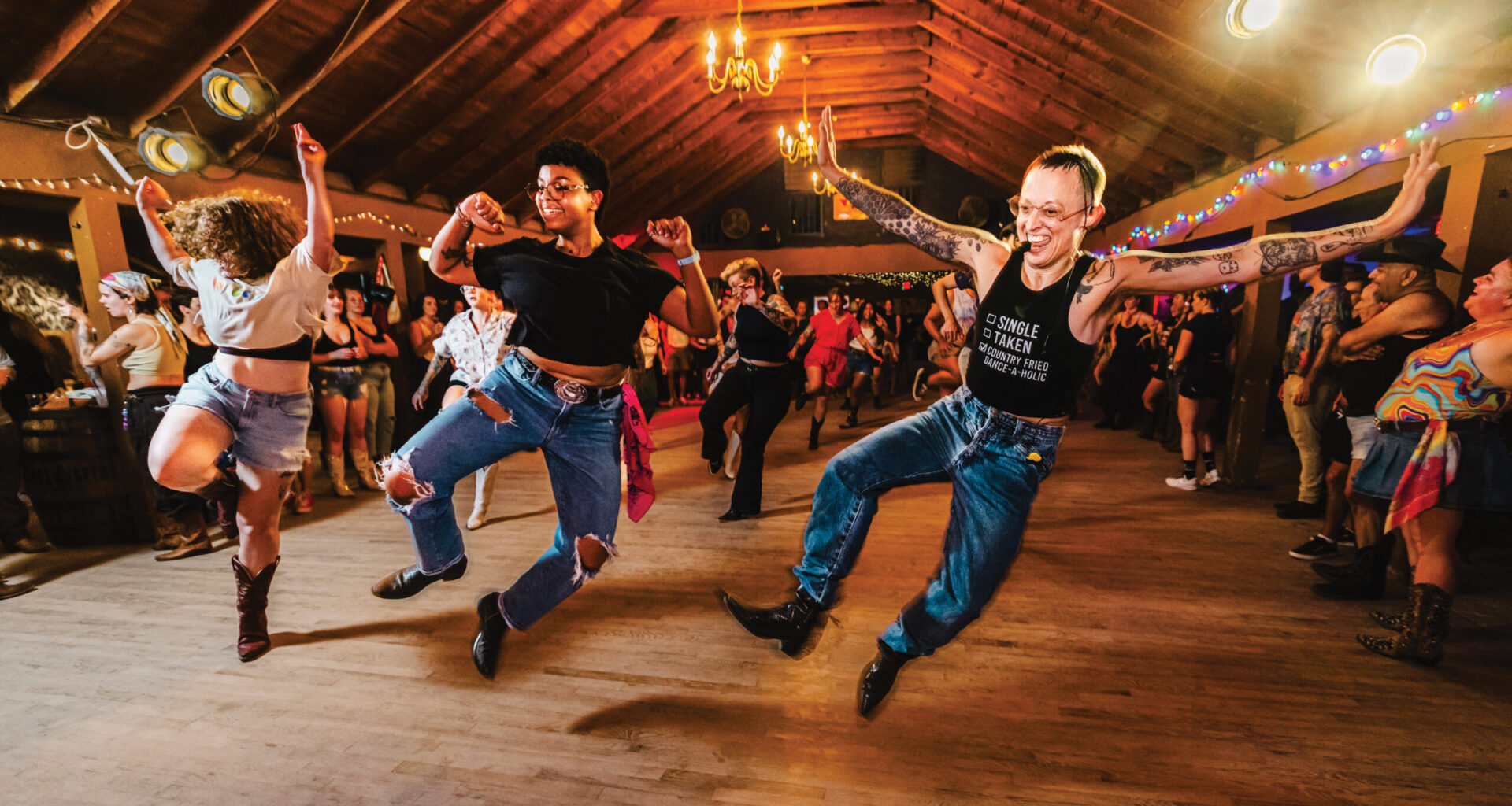
A crowd of dancers shimmies across the wooden floor of Sagebrush. Instead of holding a partner close and moving in pairs, neatly organized rows of individual dancers move with separate-but-together synchronicity. It’s mostly regulars, who confidently know the steps since they turn up to the Neon Rainbows Bronco Queer Line Dancing workshops every two weeks in a multicolor array of cowboy boots. There are also a few newbies, glancing around the room to check their steps, then up toward the velvet-curtained stage where instructor Nico Osier issues instructions over a microphone headset.
For decades, the honky-tonks of Austin have been an ideal place to two-step. At country bars across the city, dancers rock, coil, and unfurl across the floor, hands clasped. But, until recently, it was nearly impossible to find a good place to line dance.
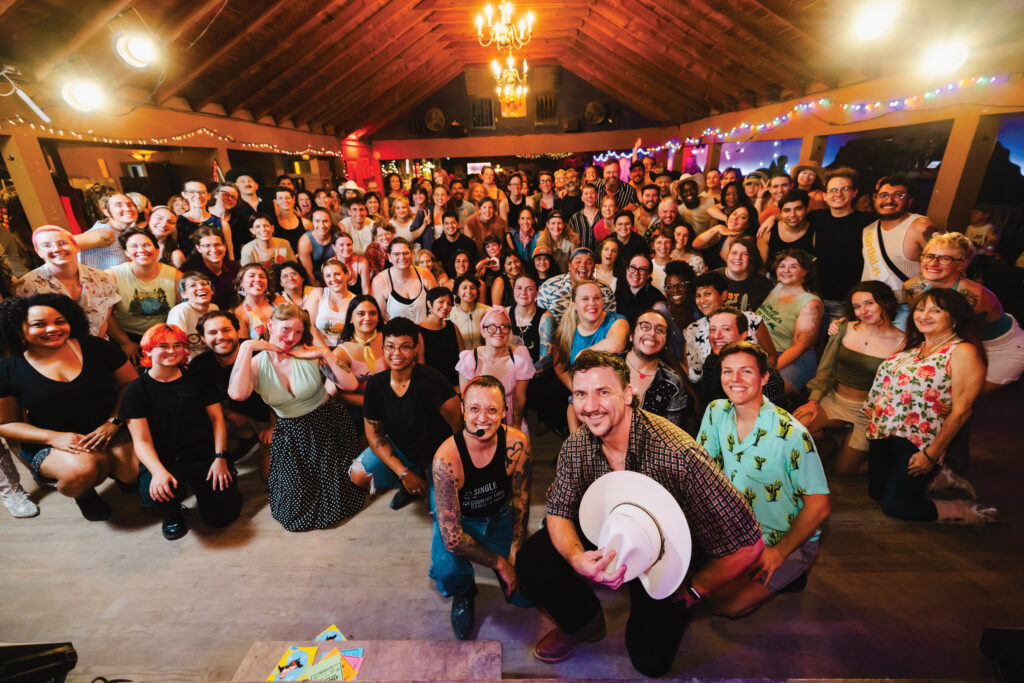 Nico Osier and DJ Ed West pose with participants of one of their country line dancing classes.
Reinvigorating the style of dance in Austin has been almost entirely the work of Nico Osier, the instructor and organizer behind Country Fried Dance. Osier is a Michigan native who, like many, first learned to line dance in a school gymnasium. A precise definition can be a bit slippery, though it roughly involves repeating unpartnered choreography in unison with others. But it’s that fluidity that makes the style so suited for a resurgence.
Osier was still just a guest at Austin’s recurring queer country party, Neon Rainbows, when they first began to imagine the possibilities. “There were a few people leading dances,” Osier says. “I eventually learned those dances, and I was like, ‘What’s next?’ and they were like, ‘That’s it. That’s what we’ve got.’”
What began as Osier’s personal quest to learn new routines and find spaces to practice them has since grown into a calendar-bursting network of parties and classes. On any given week, Osier is boot-scooting from a daytime workshop at a library to biweekly lessons at Sagebrush to a late-night sapphic disco line dance night. For these events, the instructor now teams up with Neon Rainbows founder DJ Ed West.
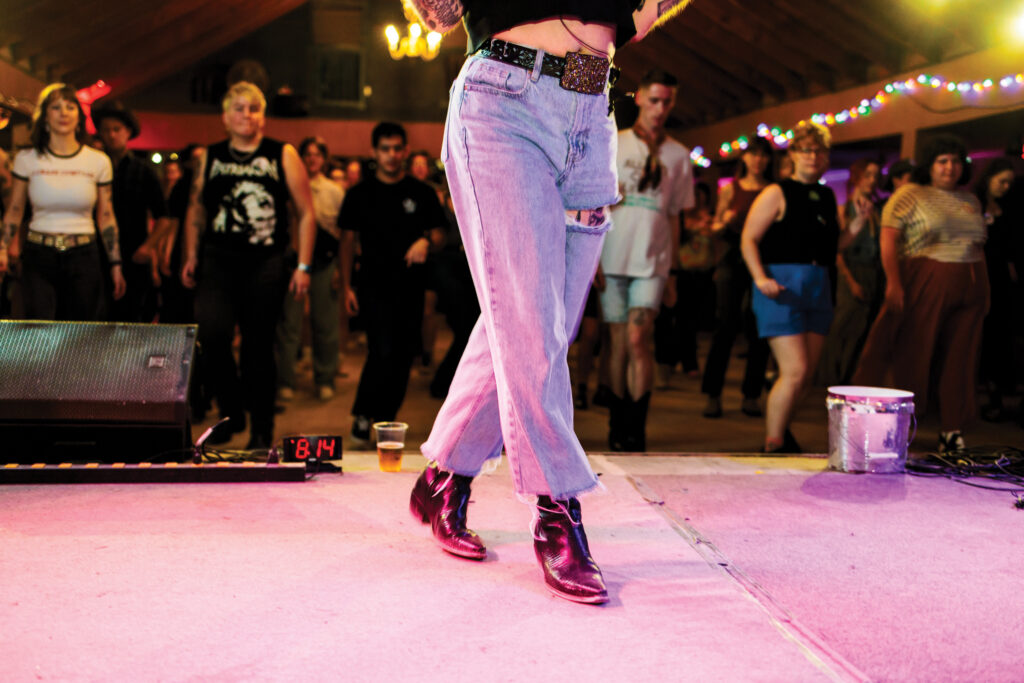
“There had to be somebody who cared enough to know dances and teach people dances. That’s me,” Osier says. “Then, there needs to be a place where we can do it all together. That’s where Ed West of Neon Rainbows has been critical.”
Contrary perhaps to popular belief, plenty of people in Austin wanted to line dance—they simply needed the right place to do it. Osier chalks up the runaway success of Country Fried Dance to a range of factors, from post-pandemic loneliness to pop country songs that have recently gone viral as TikTok trends, like a series of steps to Dasha’s “Austin (Boots Stop Workin’).”
It helps that cowboys have been enjoying a renewed moment in the national spotlight. Plus, the passage of time has allowed line dancing to shake off some of the cringe it accrued during its ’90s supernova, when the Billy Ray Cyrus “Achy Breaky Heart” video went proto-viral, and delegates bopped in sync to the “Macarena” at the 1994 Democratic National Convention.
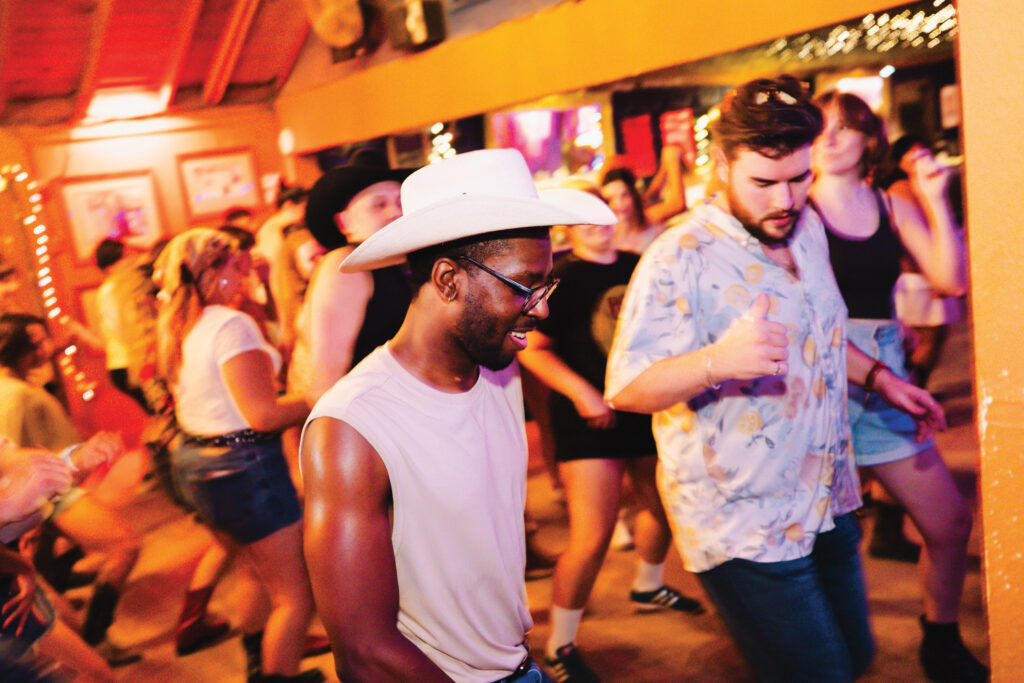
While country and western line dancing—like the campy heel-stomping John Travolta did in 1980’s Urban Cowboy—might have fallen out of mainstream favor, synchronized dance never disappeared. Many foundational line dances can be traced back through the African diaspora, and the style has been enduringly popular in the Black community, particularly in the form of party staples like the “Cupid Shuffle” and “Wobble.” The separate-but-together quality also has special significance in the queer community, where it historically allowed same-sex partners to twirl together without attracting unwanted attention. Historic venues like The Round-Up Saloon in Dallas, which opened in 1980, did much to enshrine the relationship between line dancing and the queer community.
There’s also the fact that, contrary to many clichés, line dancing need not be relegated to dusty country and western cassette tapes. Many who once viewed it as a corny cowboy thing are surprised to learn just how versatile the approach can be. “Line dance really is micro dancing other styles,” says Osier. “There’s elements from tap, Cha Cha, and waltz.”
The catalog of songs with dedicated choreography is practically infinite, spanning genres from pop to R&B to country, and there’s almost limitless opportunity for experimentation. Osier delights in helping newcomers make that discovery. “I found one popular [Pitbull] line dance that goes really well to Aretha Franklin’s ‘Respect,’” he says.
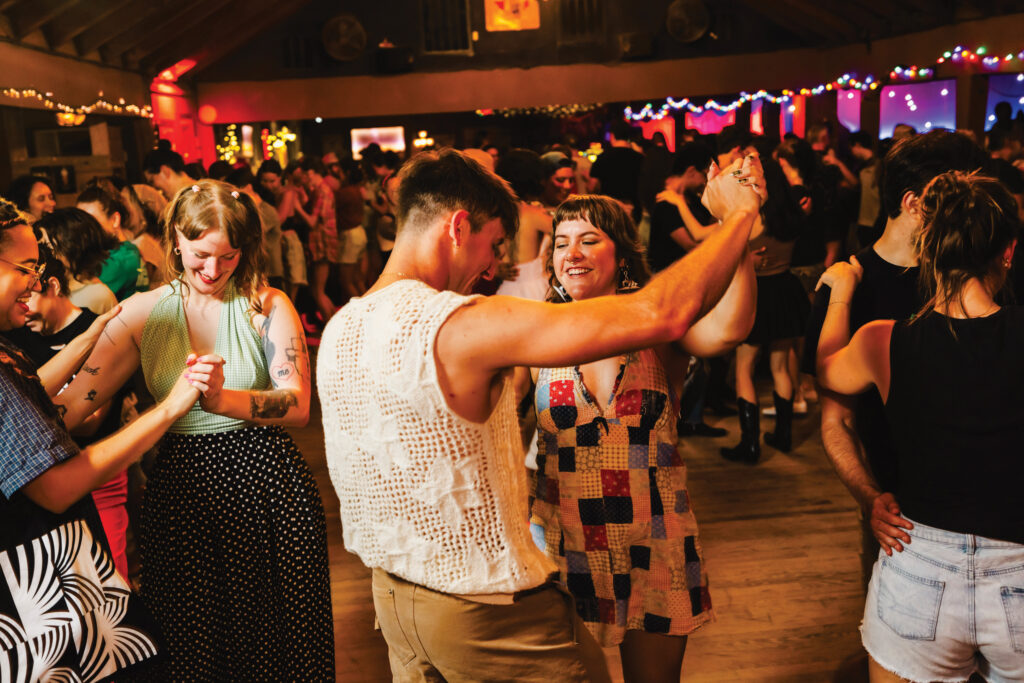 Neon Rainbows Bronco Queer Line Dancing has imbued Austin with renewed love for the retro activity.
This is a key part of Country Fried Dance’s magic. Line dancing is naturally fluid and experimental. But the style is an intuitive fit for Osier’s worldview, which returns again and again to meeting people where they are at.
“I just really think dance is for everybody,” explains Osier, who grew up dancing tap, ballet, and jazz. That means teaching in a mix of day and nighttime classes, in sober spaces and bars, to all ages, and to all kinds of music. They’re quick to adapt dance steps for anyone who needs physical accommodations, and they’ve tapped sign language interpreters to make certain events more accessible. Most importantly, it means facilitating a friendly, supportive atmosphere. “I role model one mistake (or more) per lesson, so you can see how to give yourself grace,” Osier says. “If I’m facing the wrong wall or I miss [a step], I’ll be like, ‘Ooh, so that’s my solo.’”