
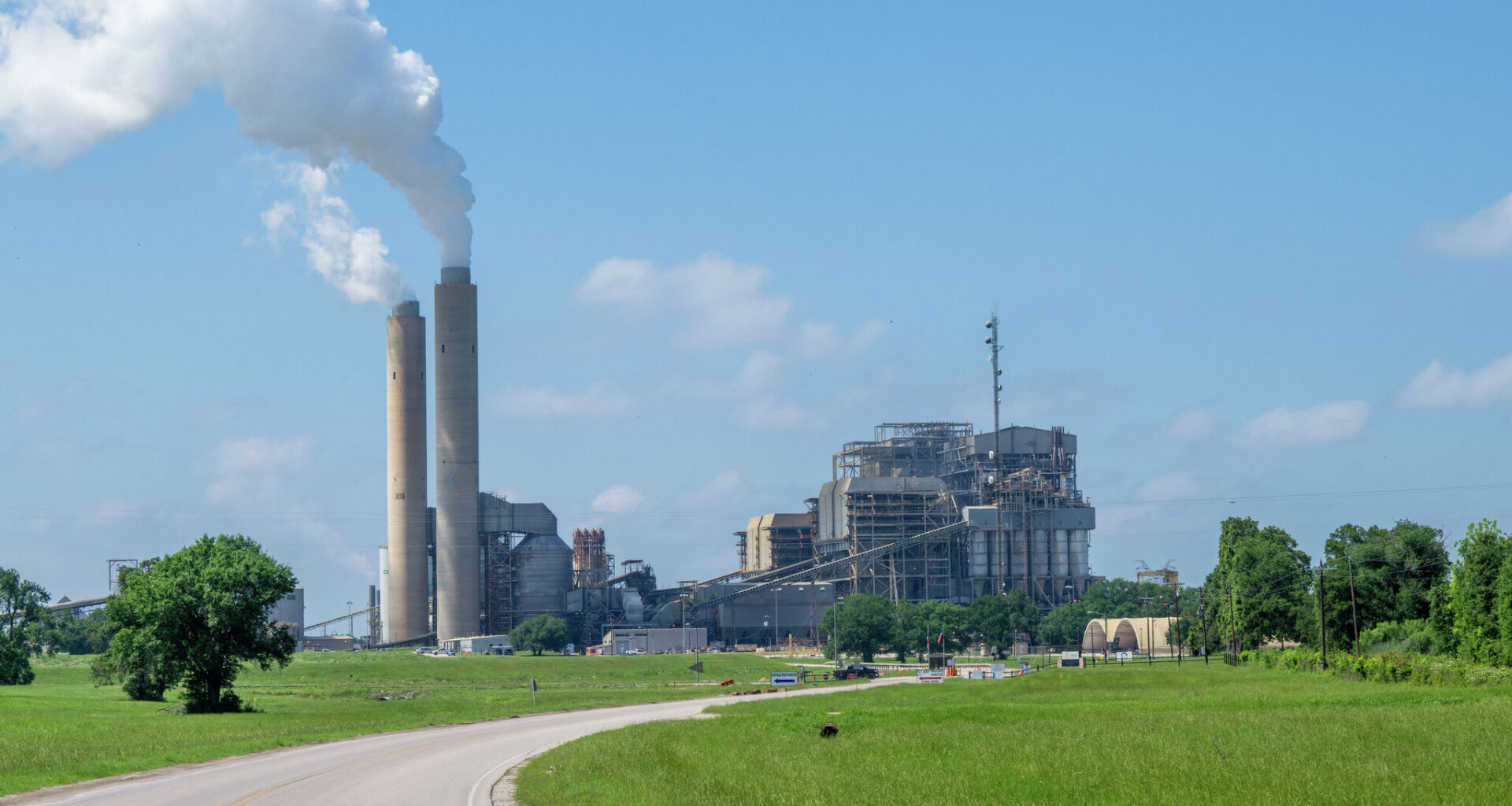
Emissions fume at the coal-fueled Oak Grove Power Plant on April 29, 2024 in Robertson County, Texas. A new report from the Sierra Club finds that Texas coal plants consumer about 34 billion gallons of water annually.
Brandon Bell/Getty Images
It’s no secret that Texas is facing a looming water crisis, but a new report argues that more focus should be geared towards thermal plants when it comes to conservation—particularly coal.

The Sierra Club, a long-standing grass roots environmental organization in the U.S., released a new analysis of water usage by thermal plants across the country. The report indicates that Texas thermal plants consumed roughly 100 billion gallons of water in 2024—about a third of which is attributed solely to coal plants.
Article continues below this ad
The draft of the 2027 Texas State Water Plan estimates the state could face a shortage of 1.2 trillion gallons as soon as 2030.
“When we analyze just how much water Texas coal and gas plants use to operate, while low-to-no-water options exist, it’s clear that our state must stop clinging to dirty, water-hungry power generation,” the report reads.
Texas tops coal energy generation
Texas has more coal plants than 47 states and leads in total coal energy generation, according to the Sierra Club. The organization details 12 coal plants statewide, which have the right to consume a total of 116 billion gallons of water per year.
Article continues below this ad
“The 116 billion represents what (the plants) are allowed to access,” Lindsay Mader, deputy press secretary for Sierra Club and a resident of Central Texas, said in a webinar presenting the findings on Tuesday. “I think that this shows just how much our state has valued industry when it comes to water, historically.”
Just seven coal plants in Texas have rights to impound 98 billion gallons in reservoirs, according to the report.
The state bestows water rights to these plants for free—a decision dating back to the 70s and 80s when the state saw power plants as providing a public benefit and being good for the economy, Mader said. But nothing prevents the plants from selling the water rights when they’re done with them.
Article continues below this ad
“Nothing is in place to require them to return the rights to the state,” Mader said, pointing to an example with Fairfield Lake. “Sometimes these companies sell the rights to wealthy developers.”
The Limestone generating station is shown Tuesday, April 20, 2021 in Jewett. Limestone consumed about 3 billion gallons of water in 2024, according to a new report from the Sierra Club.
Houston Chronicle/Hearst Newspap/Houston Chronicle via Getty Imag
Will data centers ever consume as much water as thermal power plants?
When it comes to water consumption, data centers are also on top of mind for many Texans. However, the Sierra Club says thermal plant usage still beats out these facilities in terms of consumption, even based on future growth predictions.
Article continues below this ad
Houston Advanced Research Center’s 2026 report estimates that by 2028, data centers will consume about 119 to 127 gallons per megawatt-hour.
“Assuming data centers in Texas consume water at this rate in 2030, 77,965 (megawatts) of data center demand would consume 81-87 (billion gallons) of water annually for cooling,” the report reads.
As of 2025, HARC reports that data centers consume about 25 billion gallons of water per year for electricity generation and cooling systems in the Lone Star State.
“Even with the ERCOT max estimate regarding a massive data center buildout, data centers would still be consuming less than Texas thermal plants,” Mader wrote in an email Tuesday. “No matter the situation, we support local communities’ efforts to fight these centers, whose myriad impacts are far-reaching.”
RELATED LINK: Can Texas’ identity outlast the data center takeover?
Article continues below this ad
A road leading to the coal-fueled Twin Oaks Power Station on April 29, 2024 in Robertson County, Texas. A new analysis from the Sierra Club reports Twin Oaks used 1.1 billion gallons of water in 2024.
Brandon Bell/Getty Images
A push for change
Noah Ver Beek, senior energy campaigns analyst with the Sierra Club, said there is no current incentive for coal plants to reduce their water consumption. The Sierra Club points to a variety of available alternative options—solar, wind and battery storage—that they believe plant operators should be transitioning towards.
Activists are calling on state legislators to push for transparency and action.
Article continues below this ad
“We really can’t depend on the plant owners alone to do the right thing,” Cyrus Reed, conservation director with the Sierra Club, said during the webinar. “We also need our state agencies and our legislature to…step up and make sure that good decisions are made for the betterment of Texas.”
The Sierra Club recommends that Texas agencies and lawmakers closely track coal plants’ water use, account for plant retirements in water planning, crack down on unused water rights and pollution and expand energy efficiency programs.
Reed said the organization is pushing for the retirement of coal power plants in the state by 2030, shifting towards solar, wind and battery storage alternatives that use negligible amounts of water.
Article continues below this ad
“Renewables…don’t pollute our communities and power our grid while barely using a drop,” the report reads.