
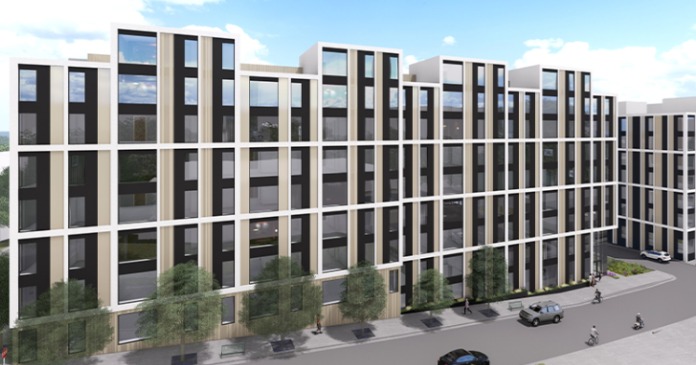
Austin-based developer Elevate Development Partners has secured a $116 million acquisition and construction loan to build a 260-unit, 759-bed student housing community for students attending Texas State University in San Marcos, Texas. S3 Capital provided the financing in a deal arranged by Walker & Dunlop. This transaction represents the lender’s first student housing deal.
The project is being developed in partnership with Flintco, who will lead construction. The Preiss Co. will serve as property manager.
When completed, the development will bring 280,124 square feet of net rentable space to market. Shared amenities include study lounges, a social lounge, a mail and package room, a swimming pool, a fitness center and a yoga room. Apartments at the development will be fully furnished.
“Student housing sits at the intersection of durable demand and limited new supply, particularly at large public universities where enrollment growth continues to outpace available beds,” Steven Jemal, managing director of origination at S3 Capital, told Multi-Housing News. “At Texas State, those dynamics are especially pronounced, which creates a compelling backdrop for well-located, purpose-built development. As we look ahead, we see this as a scalable opportunity to apply our lending strategy in markets with similar fundamentals.”
The new community is taking shape adjacent to Texas State University in San Marcos, along Interstate 35. San Marcos is approximately 30 miles south of Austin and 38 miles from Austin-Bergstrom Airport.
The Walker & Dunlop Capital Markets Institutional Advisory team was led by Managing Director Sean Reimer, Senior Managing Directors Aaron Appel, Keith Kurland, Jonathan Schwartz, Adam Schwartz and Dustin Stolly arranged the transaction.
Enrollment at Texas State University reached a record high of 44,596 students for the fall 2025 semester, up 9.6 percent year-over-year. The increase comes as student housing demand nationwide remains strong, with national preleasing for the 2026-2027 academic year reaching 58.6 percent in February, up from 54.4 percent a year earlier.
