
Following previously announced course content reviews and consolidations of ethnic and gender studies departments, Texas universities have escalated departmental closures and timelines for changes to curricular programs.
As reported by Inside Higher Ed and The Texas Tribune, Lubbock-based Texas Tech University (TTU) has declared that all certificate and degree programs focused on sexual orientation and gender identity — abbreviated as “SOGI” in a six-page memo sent on Thursday, April 9, by TTU system Chancellor Brandon Creighton — will be eliminated. The memo states that provosts must submit recommendations on elimination of all courses of study “centered on” SOGI subjects by Monday, June 15. The “centered on” threshold is defined in the memo as content wherein “sexual orientation or gender identity serves as the primary subject, main theoretical framework, central narrative, or driving pedagogical purpose.”
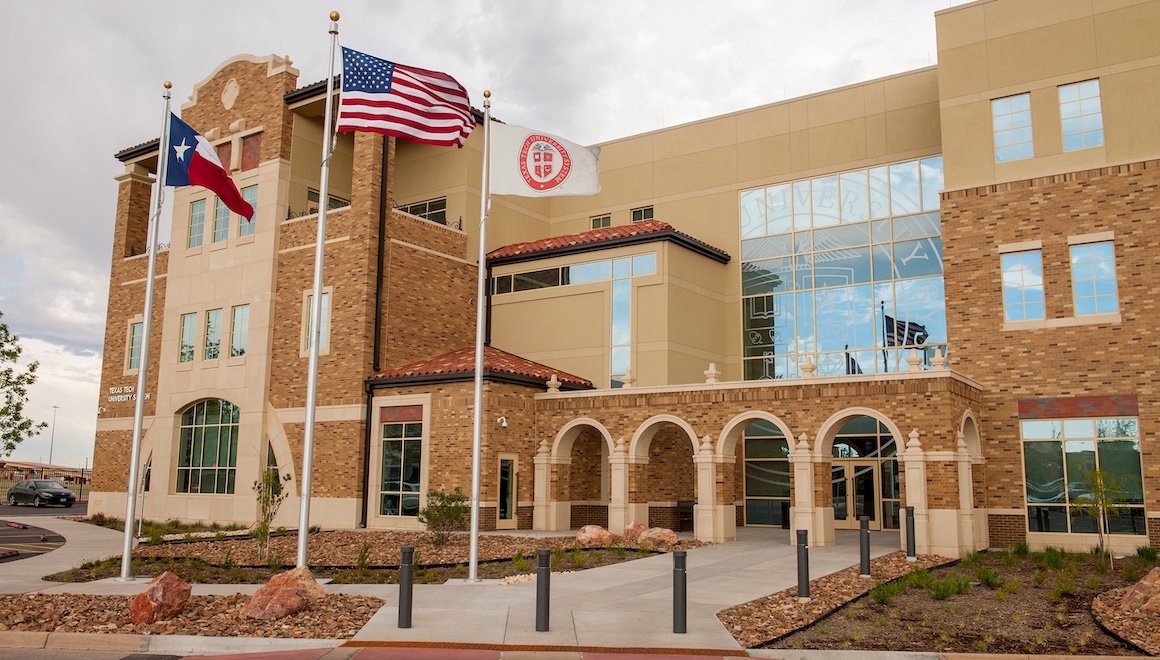
 Texas Tech University System administration building in Lubbock
Prior to his appointment as TTU System Chancellor, Mr. Creighton served as a Senator in the Texas Legislature, authoring Senate Bill 17, a law restricting diversity, equity, and inclusion (DEI) offices or policies at public colleges and universities. Texas educational institutions have scrambled to comply with SB-17 and the subsequent SB-37, restricting race- and gender-based studies, enacting restrictions on course content, eliminating courses of study, and closing and consolidating departments.
Andrew Martin, Professor of Studio Art in the TTU School of Art and President of the American Association of University Professors (AAUP) Chapter at TTU, told Glasstire that the new memo follows on previous TTU System restrictions imposed by the previous Chancellor, Tedd L. Mitchell. As noted in the New York Times, that September 2025 memo restricts all mention of gender to two biological sexes, male and female. Mr. Martin explained that the new memo expands on that edict to essentially prohibit “any content related to gender identity and content related to human sexual orientation.”
Uncloseted Media, a New York-based independent media outlet focused on anti-LGBTQ issues, reported in a Tuesday, April 28, social media post that TTU has introduced “a strict censorship policy on LGBTQ topics. The new rule restricts professors from discussing LGBTQ issues in core courses and requires instructors to skip content about sexual orientation or gender identity from standard textbooks.”
As reported in Glasstire in July 2024, the Lubbock City Council cut $25,600 in Cultural Arts Grants Program funding supporting the First Friday Art Trail, taking issue with LGBTQ-related programming. The popular event, which has drawn thousands to the city’s art sector for more than two decades, is hosted monthly by the Louise Hopkins Underwood Center for the Arts (LHUCA). In August 2024, council members voted to reinstate $5,000 of the originally recommended funding.
Mr. Martin said the TTU System directives “ignor[e] the contributions of LGBTQ-plus parts of our population, to the arts, to the humanities. … There’s a significant part of our population that are being excluded from the curricular content at our university. I don’t think we’re even a university anymore, if this is the way we’re going.”
At the University of Texas at Austin (UT), a timeline for departmental consolidations first announced in February has been accelerated to fall 2026 from the initial deadline of fall 2027.
As reported by The Barbed Wire, a Texas-based independent journalism outlet, the new timeline was announced in a Thursday, April 2, email sent to UT College of Liberal Arts faculty by David Sosa, Dean of the college. Several departments will be affected by the consolidations: French, Italian, Germanic, Slavic, and Eurasian Studies will be folded into a new Department of European and Eurasian Studies. Race and gender studies programs — including African and African Diaspora Studies; Women’s, Gender, and Sexuality Studies; American Studies; and Mexican American and Latino Studies — will be combined in a new Social and Cultural Analysis department.
A faculty member quoted in the Barbed Wire article ascribes the accelerated timeline to Mr. Sosa’s desire to complete changes prior to the Texas Legislature’s 2027 session.
Speaking as an AAUP representative, Mr. Martin took issue with whether a presidential executive order legally applies to state universities. The executive order issued by President Trump on April 23, 2025, titled Reforming Accreditation to Strengthen Higher Education, asserts that “accreditors have remained improperly focused on compelling adoption of discriminatory ideology, rather than on student outcomes,” and declares DEI initiatives as constituting “unlawful discrimination.” Universities have since eliminated DEI offices, ordered submission of course content for administrative review, consolidated or eliminated race- and gender-based study programs, and have canceled exhibitions and events.
Von Venhuizen, TTU Associate Professor of Ceramics for nearly 25 years, told Glasstire that several artworks were left out of an exhibition currently on view at the Mayer Museum at Angelo State University, one of five TTU System campuses. Overt political content was the issue, he said, and a compromise was worked out with museum administration and curatorial staff on what to include in Community, his dual exhibition with artist Steve Hilton, Fain Professor of Fine Arts in Ceramics at Midwestern State University in Wichita Falls, also part of the TTU System.
 A detail view of Von Venhuizen, “All the King’s Men,” 2025, rubbed graphite, press molded and 3D printed stoneware clay, painted wooden dentil molding, crushed velvet, steel legs, approx. 15 x 8 x 8 feet. Image courtesy of the artist
Mr. Venhuizen’s work in the show was to have come from his Thoughts and Prayers exhibition at Mount Mercy University, which was on view March 3 through April 4, 2025. One installation, titled All the Kings Men, featured a wall-painted silhouette of the Capitol Building in Washington, D.C. fronted by a row of 16 ceramic skull-headed busts incised with an “X” on each forehead, set atop red velvet on a long table.
Though he agreed to keep the contested artworks out of the exhibition, Mr. Venhuizen said of the general atmosphere of university restrictions, “Never in my wildest dreams did I think that artists wouldn’t be allowed … to talk about other artworks, teach about these artworks, or make artwork that maybe questions things.”
Mr. Martin, a TTU professor for 30 years, countered recent actions by federal and state governments and university systems, asserting, “The idea that politicians can dictate what is learned and not learned at state universities is anathema to the idea of a free country. It’s the tactics of authoritarian rule, whereby you eliminate opposition and consolidate your power by effectively shaping the reality of the citizens, to omit what you don’t like and to agree with your viewpoint.”