
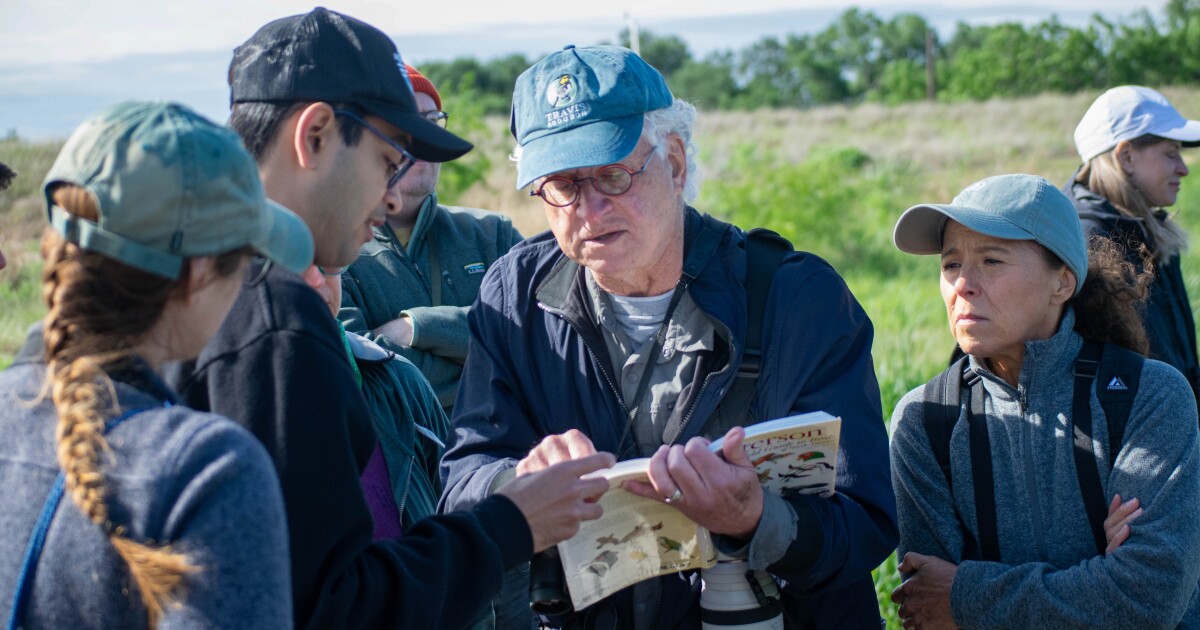
Birding is perhaps one of the best hobbies for Austinites to get acquainted — or reacquainted — with the region.
It’s a hobby that first took me on a tour of the area’s green spaces — in search of great horned owls tucked away in thick, wooded trails or up in the canyonlands in hopes of spotting the elusive golden-cheeked warbler.
And I wasn’t alone. Birding is booming, and Central Texas might just be one of the best places for prospective birders to spread their wings and begin to see their surroundings in a new light.
The U.S. Fish and Wildlife service estimates nearly 100 million Americans are birders — a growing trend reflected locally.
Annemarie Read, program coordinator for Travis Audubon, the local chapter of the Audubon Society, estimates that over the last three to five years attendance to their birding events has risen between 100-200%, with many programs reaching capacity. Membership has also more than doubled.
So what is behind the soaring interest, and how might a curious Austinite join the flock?
Birding benefits
For the prospective birder, there’s no shortage of paths one can take in approaching the hobby.
“So, the thing about birding is, it can be whatever you want,” said Jordan Weingarten, a member of Travis Audubon who led the group’s spring 2026 Birding 101 class. “It could be an excuse to go traveling. It could be an excuse to see things that you haven’t seen before.”
The hobby gained a lot of steam as the COVID-19 pandemic spurred many toward activities that allowed for social distancing. Fledgling birders also found stress relief and other mental health benefits — a sentiment echoed by Jennifer Bristol.
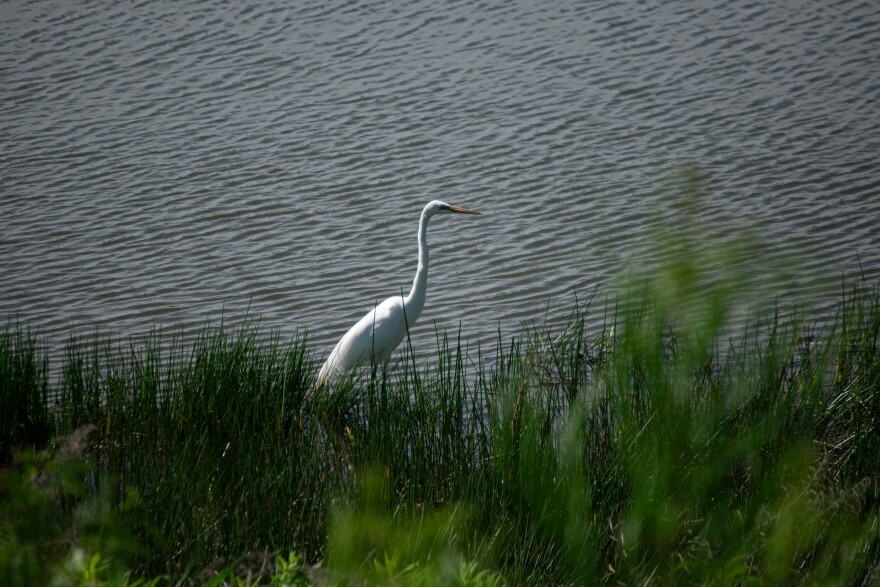
A great egret stalks for prey at the Southwest Greenway near Mueller Lake Park.
“When you have an a-ha moment, like you see a bird and you feel a sense of discovery, that’s a dopamine release in your brain. And those are the best kind of dopamine releases that you could hope for,” she said.
Bristol is the author of two books about birding: “Parking Lot Birding: A Fun Guide to Discovering Birds in Texas” and “Cemetery Birding: An Unexpected Guide to Discovering Birds in Texas.”
“There’s such a joy in seeing the birds,” she said. “It doesn’t matter if I’m looking at a grackle or if I am looking at something that I have never seen before, the thrill is still… It’s always amazing.”
Birding can also be a lifelong hobby.
“If you used to rock climb, there aren’t many people doing serious rock climbing in their 60s and 70s,” Weingarten said. “You throw out your knee and there are entire sports you can’t do. You can bird.”
Danielle Belleny, a San Marcos-based wildlife biologist, also stressed that it’s a pastime open to anyone.
Through her work in organizing Black Birders Week, as well as writing books encouraging kids to take up the hobby, Belleny has sought to find many ways for communities to tear down barriers that might exclude them.
“Finding ways for us to feel comfortable in our own spaces and also being able to connect outdoors for all those various benefits is super important and it’s definitely something that I would love to encourage more folks to get out and do,” Belleny said.
Plan where you want to go
Central Texas has no shortage of prime locations for birding — from dedicated green spaces and state parks to your backyard. That’s because the region is part of one of the largest bird migration routes — the Central Flyway.
“In the spring and then as well in the fall, we are getting billions of birds migrating through the area,” said Caley Zuzula, program manager at Travis Audubon.
You don’t always have to hit the trails to take part. Other popular pastimes include backyard birding, parking lot birding — and even birding in cemeteries.
But if you’re itching to go on a bit of a longer trek, here are a few specific locations to consider visiting:
Mills Pond
For beginning birders wanting a leisurely stroll, Zuzula said this small park in Wells Branch is a hotspot for warbler birds in the spring.
Roy G. Guerrero Park
The large park within the city limits of Austin boasts access to the Colorado River and hundreds of acres of green space — traits which Zuzula said help make it a popular destination.
Hornsby Bend
With its water retention pond and industrial facilities, this southeast Austin location may not seem like a birding hotspot at first glance, but the area remains a favorite stopover for those looking for waterfowl in particular.
Commons Ford Ranch
Zuzula said Travis Audubon helps manage the 40 acres of restored prairie at this West Austin park — offering great opportunities for views of grassland birds like meadowlarks, dickcissels and buntings.
Balcones Canyonlands National Wildlife Refuge
When you’re ready to make the leap to more of a rugged trek, this wildlife refuge northwest of Lago Vista remains an important location preserving the habitat of the endangered golden-cheeked warbler.
Before you head out the door
OK, you’ve picked your destination, but what might you need for your trek?
While gear isn’t a total necessity to observe the birds in your area, there are a few things that might help with the experience.
Apps
Merlin and eBird, released by the Cornell Lab of Ornithology, are both valuable tools.
The Merlin app helps with identification — and uses photos, descriptions, dates and locations to help identify birds. The app also allows for audio recording to identify birds via their songs and calls.
“It’s a really fantastic way to just kind of learn more about the birds around you,” Zuzula said.
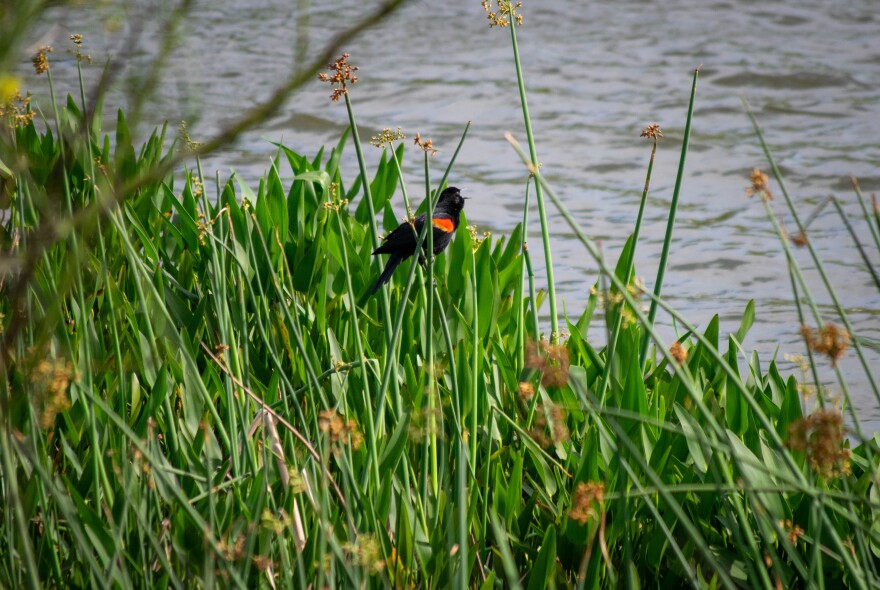
A red-winged blackbird sings at the Southwest Greenway near Mueller Lake Park.
The eBird app allows for the logging of bird sightings in an area, also helping prospective birders know what they might expect to see in a particular area or where a hotspot might be on a given day.
Binoculars
Reliable binoculars are another common tool. There are an array of brands at a variety of prices, but the Audubon Society has a budget breakdown to find the right pair for you.
Guides
Having access to tools and databases via your phone certainly has its benefits, but some may want to go a more traditional route. Many birders opt for book guides as a result.
These guides are usually split between regions of the U.S. — Eastern and Western, with the Rocky Mountains denoting the split. As a result, Central Texas birders will want to grab a guide to Eastern birds.
Sibley Field Guides are among the most-recommended, along with those from the National Audubon Society and the Peterson Field Guide series.
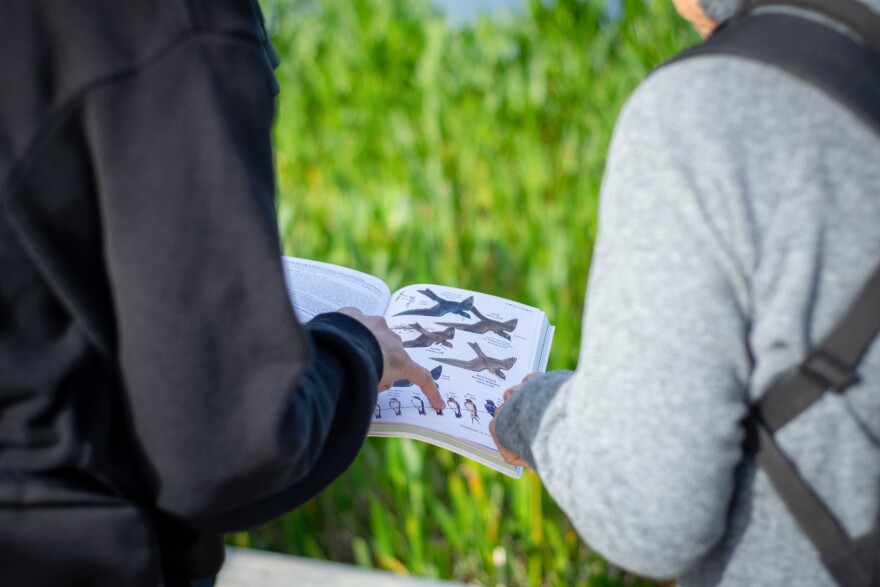
Participants in a Birding 101 class from the Travis Audubon Society look at a page showing different species of swallows from a field guide.
Outdoor gear
What you need will also depend on the environment. Some trails require hiking boots, while others need little more than some good sneakers.
For Bristol, her backpack always contains sunglasses that aren’t tinted in a way that might lead to misinterpreting the colors on a bird, some sunscreen, a lens cloth for her optics, a hat and lipstick.
“You never know who you’re going to run into out there,” she said.
However, all the gadgets and tools available shouldn’t be a barrier to deciding whether to bird, Belleny said. They key is just to start.
“I think being able to just watch what you can, whether it’s a house sparrow or a pigeon or something, there’s some cool behavioral things you can still see,” she said. “Nature is anywhere that you are.”
What to look out for
Do you have a spark bird?
A “spark bird” is a name given for the bird that first ignites one’s passion for birding.
For me, it was a painted bunting — a small bird that, as the name suggests, boasts colorful plumage that stirred my imagination and made me pay closer attention to what else I might have missed from the natural world around me.
Maybe you similarly saw a colorful bird that you’ve never noticed before or spotted a rare visitor that made you want to keep your eyes peeled towards the skies and treetops.
More than 400 species call Central Texas home at least part of the year, Zuzula said, so you have ample candidates to choose from as your spark bird.
Here are four easy species for beginners — and one rare Central Texas native:
Northern cardinal
Northern cardinals can be found in Central Texas year-round. The birds are sexually dimorphic, meaning males and females can be easy to tell apart by appearance.
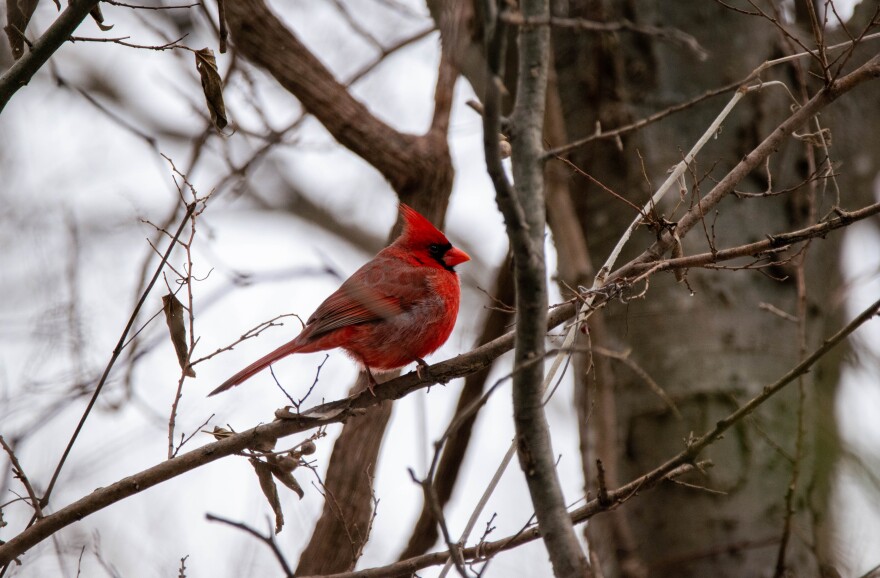
Male Northern cardinals, like this one puffing up for warmth during the January 2026 freeze in Austin, are known for their distinctive red plumage and black masks.
Male species are bright red with a black mask, while the female species are a more drab gray. Both species boast a distinctive orange bill.
Blue jay
Blue jays are another colorful, longtime inhabitant of the region. As the name suggests, look for their bright blue plumage and listen for their loud calls — sometimes mimicking a hawk, Zuzula said.
Carolina wren
Most birders might hear a Carolina wren before they see one.
That’s because the Travis Audubon 2026 Bird of the Year has a very distinct and easily-identifiable song, often heard near creeks and wooded areas. Look for a small, reddish-brown bird with a slightly curved beak.
Titmice
The Central Texas region is home to two species of titmice — the black-crested titmouse and the tufted titmouse.
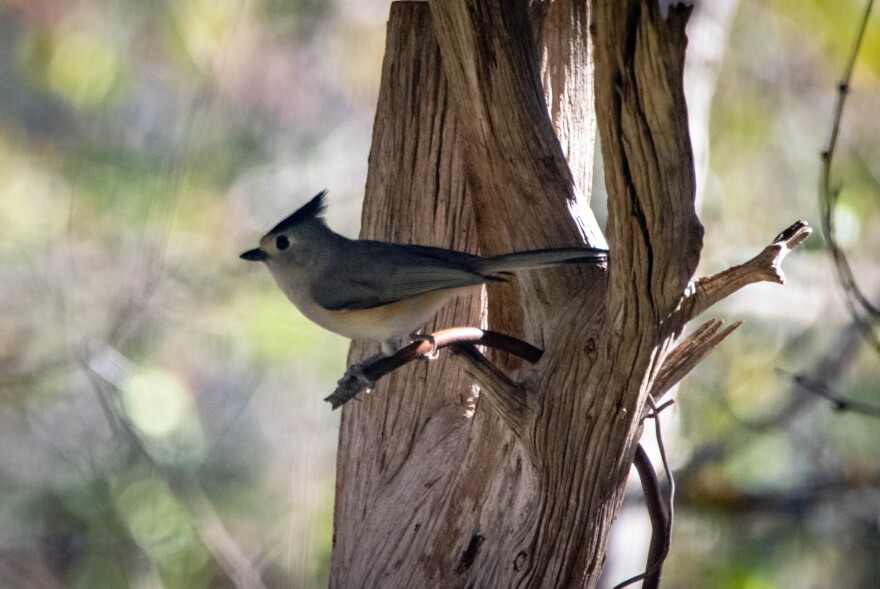
Many titmice in the Austin region are hybrids of the black-crested titmouse and tufted titmouse.
However, this often leads to mating overlap between the species, resulting in hybrids of the two becoming one of the more common sightings of titmice in the area, Zuzula said.
Golden-cheeked warbler
As the name implies, the golden-cheeked warbler boasts easily-identifiable golden markings on its face. But that doesn’t mean it’s easy to spot — the endangered species largely inhabits the ash juniper woodlands that provide the materials it needs for nesting.
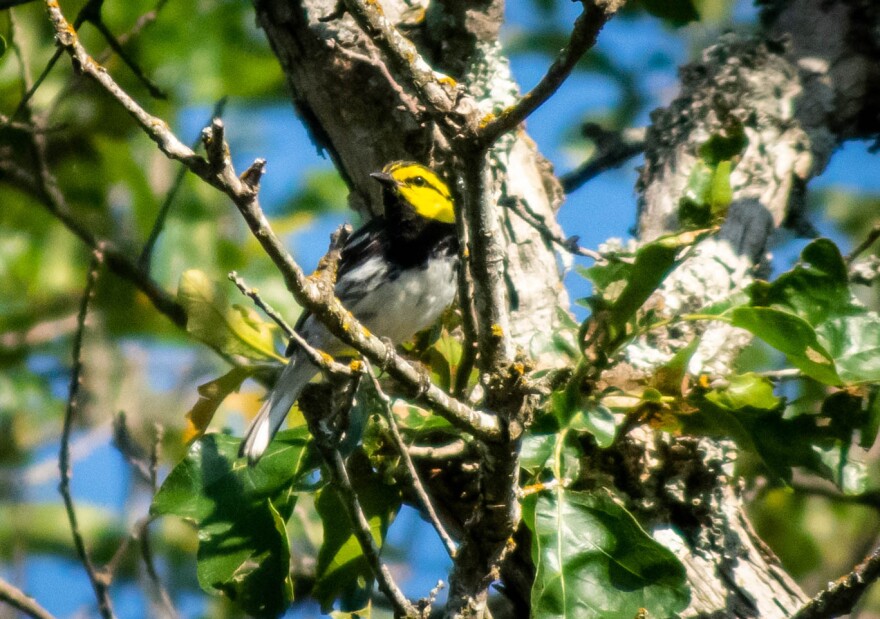
The Golden-cheeked warbler nests only in the Central Texas region, where it relies on the ash juniper tree for its bark. This makes it particularly vulnerable to habitat loss.
It’s the decline of such environments in Central Texas — the only region in the world where the species nests — that has led to its endangered status. But its regional exclusivity has made it an icon for Texas birders, even leading to calls for it to replace the Northern mockingbird as the official state bird.
While you’re on the trail
So you’ve got your spark bird, you know where you’re going, wrangled some binoculars and maybe applied some lipstick… But what do you do while you’re actually on the ground birding?
Bristol said getting aware of the different types of environments birds inhabit is a good starting point. That includes recognizing that birds aren’t always up in the branches of trees, but also around the trunks or even in the grass.
“Some are eating insects that are on the ground, but some are also then way up in the top of the canopy as they are feeding,” Bristol said.
She also stresses that the hobby is more meditative.
“You don’t have to be like, ‘go, go go, I want to get to this destination. I’ve got to hike these many miles today. Really got to press myself,’” she said. “No, it’s much more slow. It’s a slow pace.”
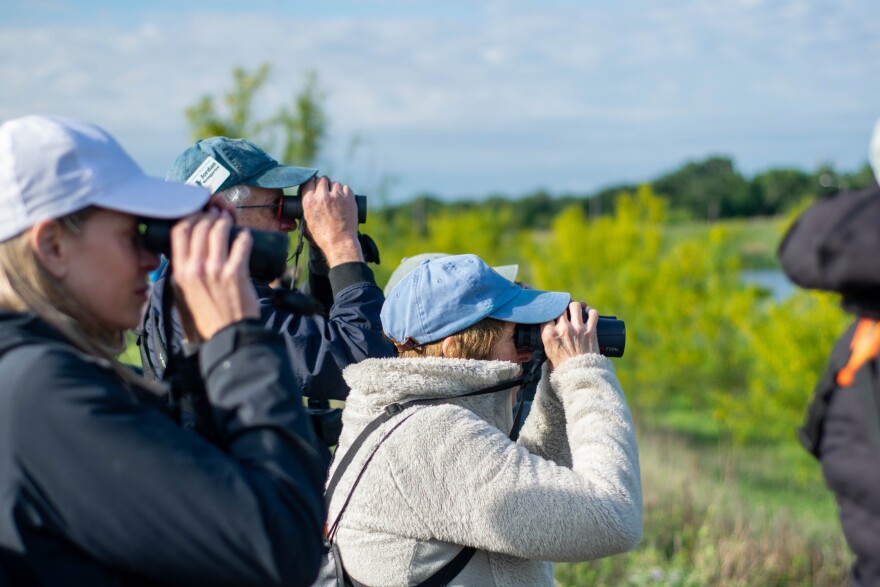
Participants in a Birding 101 class from the Travis Audubon Society look for birds during a trip to the Southwest Greenway near Mueller Lake Park.
General trail safety is also important.
While you may be looking up and around for the birds, looking where you’re going should take precedence, Zuzula said. She keeps an eye on her path when in motion and comes to a stop before scanning her surroundings for birds.
“Especially in Central Texas where during the summer we get rattlesnakes, you want to watch where you are going,” Zuzula said.
There’s also general trail etiquette — both for other people and for the birds.
Bristol stresses sticking to trails so as not to disturb natural scenery, but leave space for others to pass by.
The birds need space, too — especially nesting birds — Zuzula said.
“It is important to realize that when you are birdwatching, you just need to be considerate of the bird and think about how the bird is behaving in response to your presence and make sure that it doesn’t look like it’s stressed out,” she said.
Events
Want more birding action? Here are a few events to bird with others or just celebrate local wildlife: