
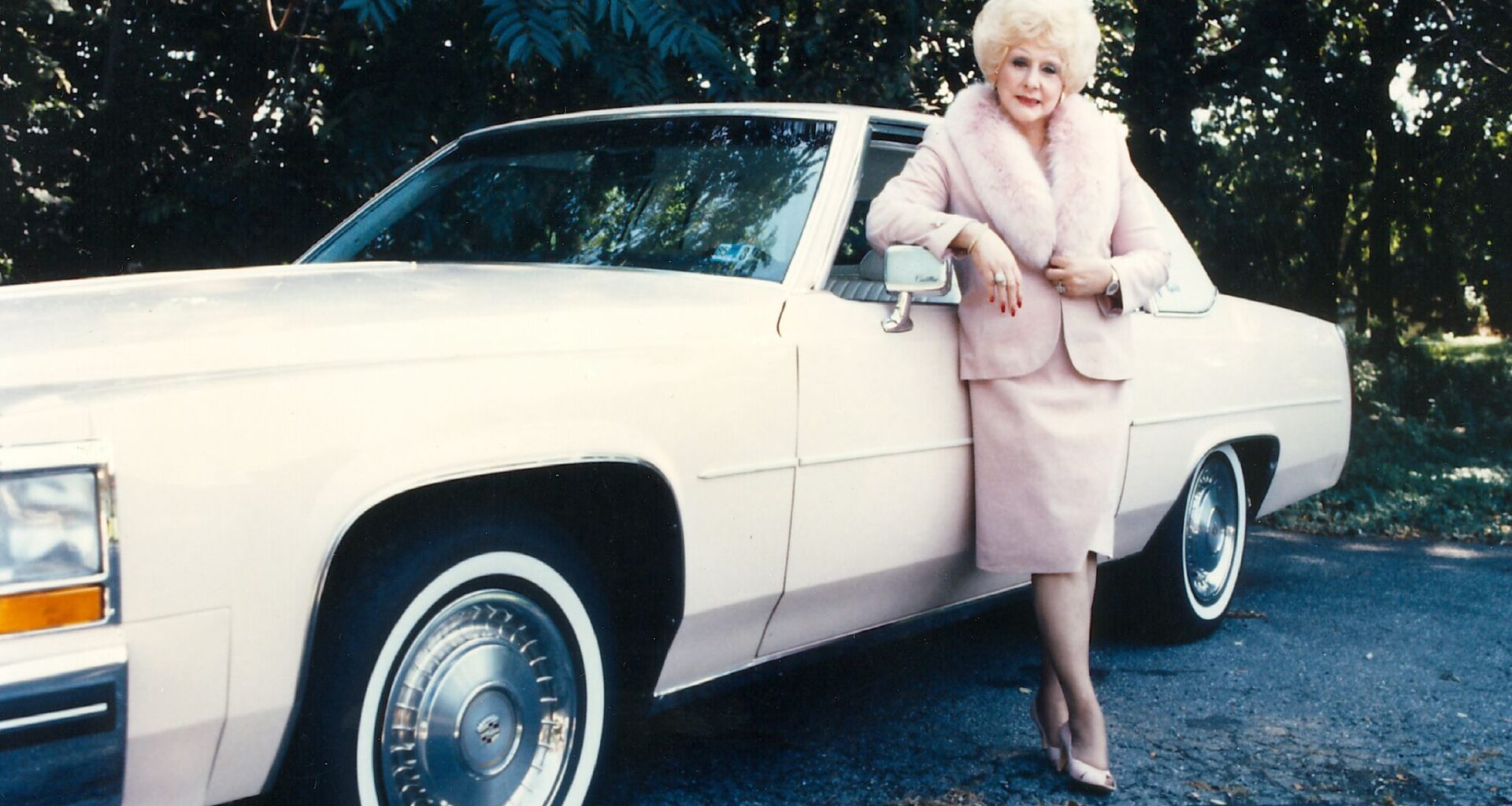
Mary Kay with her pink 1986 Fleetwood Cadillac.
Mary Kay archives
Mary Kay Ash is a woman easily recognized but rarely known. With her gauzy pink gowns and platinum blond wig, she can be pretty campy: The makeup she wore like a mask, the dogs she toted around like babies, the pink Cadillacs that roared onto the stage at motivational seminars for top consultants.

Selling Opportunity, an absorbing new biography by former Glamour editor Mary Lisa Gavenas, rescues the Dallas cosmetics giant from the tomb of kitsch and lore. We watch as the girl born Mary Kathlyn Wagner in Hot Wells, Texas, in 1918 — fourth child to poor parents, a high achiever who graduated high school at 16 and won second-best typist in Houston — transforms into the first woman to chair a company on the New York Stock Exchange and a female empowerment figure on par with Oprah.
Article continues below this ad
Much of what we know about Mary Kay comes from the woman herself, prone to tall tales and romantic hyperbole in the bestselling memoirs that doubled as self-help manuals. Gavenas peels back the ruffly layers of mythology to reveal a woman who is enterprising, tireless, gracious — but also isolated by her success and trapped in a persona. Still, Mary Kay emerges as an American original, one of Texas’ grande dames and a girlboss (ladyboss?) way ahead of her time.
Here are a few of the book’s takeaways.
As a young mother, Mary Kay was a top seller for Stanley Home Products, left, and later ran a billion-dollar empire (right, pictured with her poodle Gigi).
Mary Kay wasn’t the first to give away pink Cadillacs
Mary Kay became a singular figure, but she was riffing on ideas in the culture at the time. She launched her direct-sales company in 1963 with motivational traditions borrowed from Stanley Home Products, the cleaning supply company where she plied her trade. Her friend Mary C. Crowley (mother of Don Carter, who brought the Dallas Mavericks to town) had already launched a direct-sales outfit called Home Interiors and Gifts, where prizes included fur-lined checkbook covers and one slogan was “Think mink,” just a letter removed from Mary Kay’s famous “Think pink.” Crowley also gave away Cadillacs to top sellers.
Article continues below this ad
Make Dallas News a preferred source so your search results prioritize writing by actual people, not AI.
Add Preferred Source
Most surprising is that even pink Cadillacs as sales incentives didn’t originate with Mary Kay. In 1952, Brownie Wise was given a pink Cadillac by inventor Earl Tupper, whose Tupperware products she turned into a phenomenon. Wise is a mostly forgotten figure, but the divorced single mother reconfigured direct sales, once the domain of men going door-to-door, into a “party-plan” system for wives and mothers, a model on which Mary Kay built an empire.
Mary Kay was likely channeling Wise when she bought a shiny new 1968 Cadillac DeVille, custom-colored in pale pink, to celebrate the first few years of her successful cosmetics company. The 19-foot pastel behemoth was so eye-catching that her sales force started buying them, too, and Mary Kay hit upon the perfect incentive prize, which also became one of the most famous marketing tools of the late 20th century.
Beauty empires can get ugly
Mary Kay may have borrowed from other direct-sales companies, but she didn’t respond well when a former employer borrowed from her. After top seller Jackie Brown left Mary Kay to start rival BeautiControl in 1966, Mary Kay sued Brown, who sued her right back.
Article continues below this ad
The fight dragged on for years, ending in a draw, but BeautiControl continued to plague Mary Kay into the ’90s, leading to a battle of beauty empires captured in Skip Hollandsworth’s juicy “Hostile Makeover” in Texas Monthly and the 2002 movie it inspired, Hell on Heels, starring Parker Posey as the brash new head of BeautiControl and Shirley MacLaine as the unsinkable cosmetics queen.
The new Mary Kay pink Cadillac XT6 at the beauty brand’s convention Friday, July 19, 2019 in Dallas.
Ryan Michalesko/Dallas Morning News
Mary Kay was married six times
The company line on Mary Kay is that she had three husbands. Actually, she had six, a detail she kept so well hidden that The New York Times obituary after her death in 2001, at 83, got it wrong.
Article continues below this ad
Marriage is a category where Mary Kay’s eternal optimism might have worked against her. At 16, she ran off with a handsome, feckless radio personality named Ben Rogers, with whom she had three children. She was divorced by 28, when she married her 55-year-old boss at Stanley Home Products, who died of a heart attack within a year. That tragedy repeated itself in the ’60s when husband number five, a salesman named George Hallenbeck, died of a heart attack after a morning jog. By 46, she’d been widowed twice.
In between, there was husband number three, Al Miller, who didn’t bother to show up in court when she divorced him, and husband number four, Charles Weaver, the unambitious brother of her wildly ambitious friend and mentor, Mary C. Crowley.
Her final husband was Mel Ash, the charmer she married in 1966, and the two gave the appearance of a happy courtship until his death in 1980, although “appearance” is a pivotal word with Mary Kay. According to the book, she loved to spin dramatic fables about how Mel gave her a Hallmark card every Thursday and showered her with jewelry. (If he did, she paid, because Mel had no job.)
To be an ambitious, driven woman in the corset of ’60s gender roles was no easy feat. When the couple commissioned architect Frank L. Meier to build an eccentric round house near Preston Hollow, Mary Kay — who called every shot — would ask Meier to placate her husband. “Make him feel like he’s a big part of this,” she said.
Article continues below this ad
Mary Kay understood people
By the end of her life, Mary Kay sat atop a billion-dollar company with a global reach, despite having no head for numbers. What she understood was people. They want to feel special. They want to believe in dreams, whether that’s a pearly lotion that could reverse Father Time or a side hustle that could allow a cash-strapped mother to balance work and home life while chasing the promise of a brand new car.
Is Mary Kay a scam? Gavenas doesn’t give much ink to the idea, since the company buys back 90% of unsold merchandise, but the internet has no shortage of disgruntled employees bad-mouthing the company.
Mary Kay weathered the criticism with grace and the Teflon exterior of a born saleswoman. When Bloom County cartoonist Berkeley Breathed turned Mary Kay into a recurring villain in a cartoon strip — eventually putting out a book called The Night of the Mary Kay Commandos — she sent him a thank-you note.
Article continues below this ad
Mary Kay Ash in her pink bathroom, 1989.
Erich Schlegel/Dallas Morning News
Mary Kay is kind of an emotional black box
The museum constructed inside Mary Kay headquarters, with mannequins of the bewigged founder in luxury gowns, turns out to be a good approximation for the woman: polished, immovable, unknowable. In 1984, she built a lavish pink home in Preston Hollow whose pink bathroom had pink toilet paper and sinks made from pink quartz carved by the same guy who did Liberace’s bathroom. Pink wasn’t even her favorite color.

By signing up, you agree to our Terms Of Use and acknowledge that your information will be used as described in our Privacy Policy.
She was trapped in a brand, in a persona. “She hated that house,” said a friend and top sales associate. Why did she build it? Unclear. There’s a lot about Mary Kay’s interior life that remains a black box, and I don’t think that’s a limitation of Gavenas’ book so much as a reflection of the woman who prided herself on presentation. She was all exterior. She was always selling.
Article continues below this ad
She built her company according to the motto, “God first, family second, career third,” but it’s not clear she followed that order. There’s not much insight in the book about her children, including her son Richard, who ran the company with her until he left in the ’90s. (Why? Unclear.) Her work changed lives, though. If her personal life lacked for connection and warmth, she never had any shortage of love at her company.
Her salesforce loved her at a distance by the end, though. In 1996, she suffered a stroke that left her unable to speak. She spent the next five years silent and housebound, unwilling to show her face at the company where beauty was a premium. The woman who made everything seem possible had reached a point where moving without a wheelchair became impossible. If this is a sad end, it’s also a common one for the outsized dreamers who fight and scrap their way to the top: You reach the summit, only to discover you’re the only one there.