
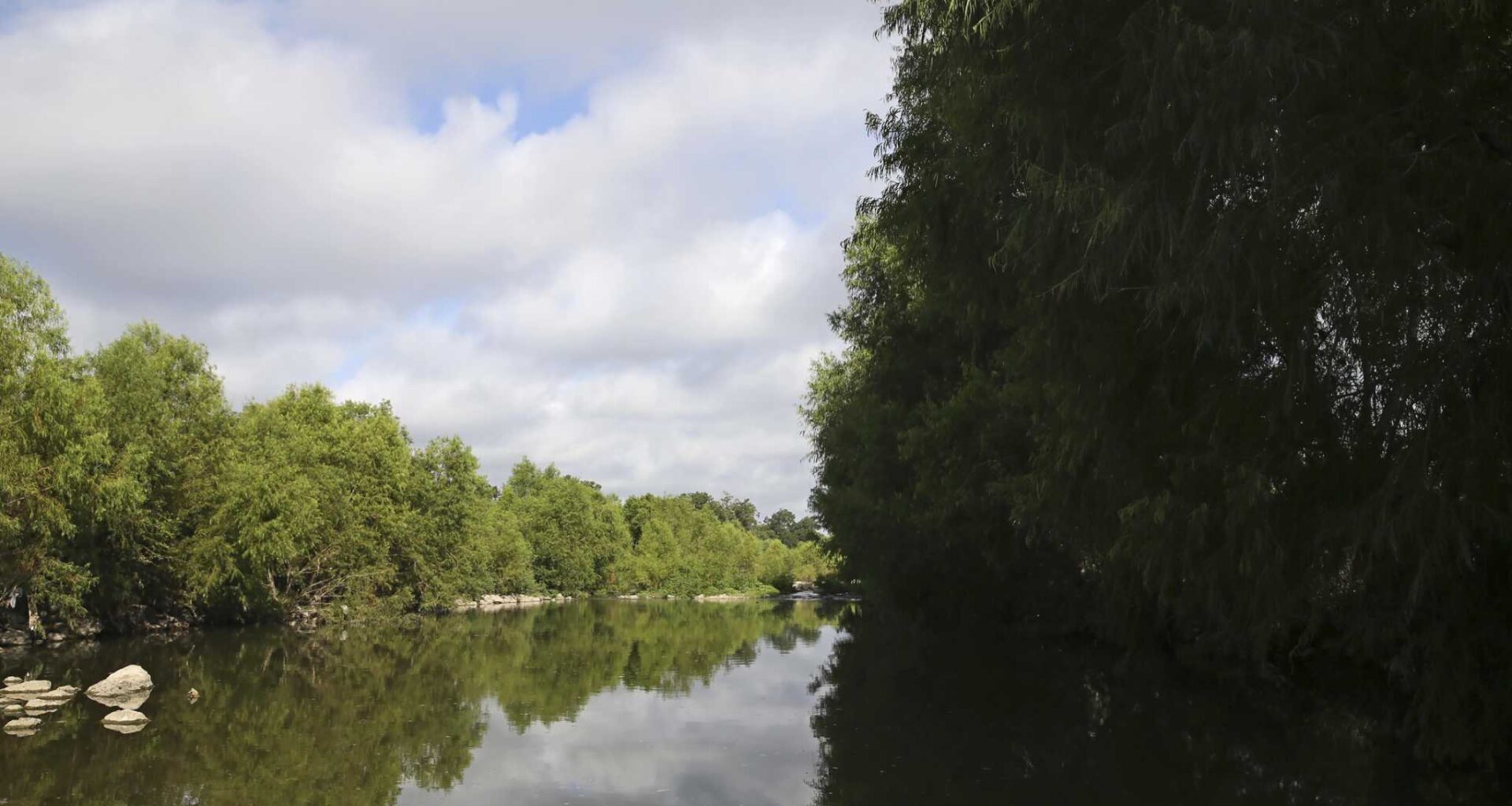
The San Antonio River’s Mission Reach is seen in August 2021. San Antonio has shown that even in a fast-growing state, communities can stretch limited water supplies further while restoring the waterways that make cities healthier and more livable.
Jerry Lara /San Antonio Express-News
Aquatic biologists Austin Davis, left, and Zoe Nichols stand in the riverbed of the San Antonio River along Mission Reach. The River Walk’s Mission Reach ecosystem restoration transformed a once-channelized stretch of the San Antonio River into a thriving habitat and community asset.
Billy Calzada /Staff photographer
Luke Metzger is executive director of the nonprofit Environment Texas Research & Policy Center.
Contributed
San Antonio is hosting River Rally at exactly the right moment.

This week, hundreds of river advocates, scientists and water leaders from across the country are gathering in San Antonio for the national water conference.
Article continues below this ad
They could not have picked a better host.
San Antonio has shown that even in a fast-growing state, communities can stretch limited water supplies further while restoring the waterways that make cities healthier and more livable.
The River Walk’s Mission Reach ecosystem restoration transformed a once-channelized stretch of the San Antonio River into a thriving habitat and community asset. Native plants returned. Birds and fish came back. Residents gained trails and green space. San Antonio’s long-standing commitment to water conservation has made the city a national model for living within environmental limits.
EDITORIAL: Texas needs to fund its 2027 State Water Plan before our wells run dry
Article continues below this ad
Texas needs that kind of leadership.
Much of the state is in drought. Reservoirs are shrinking. Aquifers are under stress. Farmers, ranchers and communities across Texas are anxiously watching the skies and wondering how long existing supplies can hold out.
The warning signs are flashing brightest in Corpus Christi, where officials have warned the city could become the first major U.S. city to run out of water if conditions worsen.
At the same time, demand for water keeps growing.
Article continues below this ad
Texas gains hundreds of thousands of new residents every year. New data centers are consuming enormous amounts of electricity and water. Water-intensive industries continue to expand. And many aging coal plants still withdraw vast quantities of water for cooling even as cleaner energy sources like wind and solar require far less water to operate.
The challenge is not simply finding more water. It is recognizing that water is finite.
Texans understand this instinctively. In a state shaped by droughts and floods, water has never been something we could take for granted. That is why voters overwhelmingly approved Proposition 4 last year to invest billions in Texas water infrastructure and supplies.
But funding alone is not enough. Texas needs a broader vision for water policy in the 21st century. That starts with conservation.
Article continues below this ad
San Antonio proved aggressive conservation works. Other cities should follow its lead by repairing leaking pipes, expanding reuse programs and encouraging water-smart landscaping.
Cities alone cannot solve the problem.
COMMENTARY: San Antonio must not squander its water in Edwards Aquifer
Agriculture accounts for more than half of Texas’ water demand, especially in the driest parts of the state. Improving irrigation efficiency and reducing water losses could save enormous amounts of water while helping keep rivers flowing.
Article continues below this ad
Industry must do its part, too, by recycling more water, modernizing industrial processes and accelerating the transition away from water-hungry coal plants.
Texas also needs to better protect environmental flows. Fish, wildlife, recreation economies and downstream communities all depend on healthy flowing water.
Texas water quality is also an issue.
Far too many Texas rivers, lakes and bays remain unsafe for swimming, fishing or drinking. Runoff pollution, industrial contamination and sewage overflows continue to threaten waterways across the state.
Article continues below this ad
Fifty years after passage of the federal Clean Water Act, too many Texans still cannot safely enjoy the waters in their communities.
Healthy rivers are not luxuries. They provide drinking water, sustain wildlife, cool our communities and give Texans places to swim, fish, paddle and connect with the natural world. They are central to Texas’ future.
San Antonio has shown that conservation and restoration can succeed even in a rapidly growing state. The question now is whether Texas is ready to apply those lessons statewide before the next crisis forces our hand.
Article continues below this ad
Luke Metzger is executive director of the nonprofit Environment Texas Research & Policy Center.
Have a response? Send us a letter to the editor.